
Anthropic’s Claude Tag learns your company from Slack, turning messages into institutional context
An always-on Claude companion in Slack is more than help. It is a new way to store your organization’s know-how.
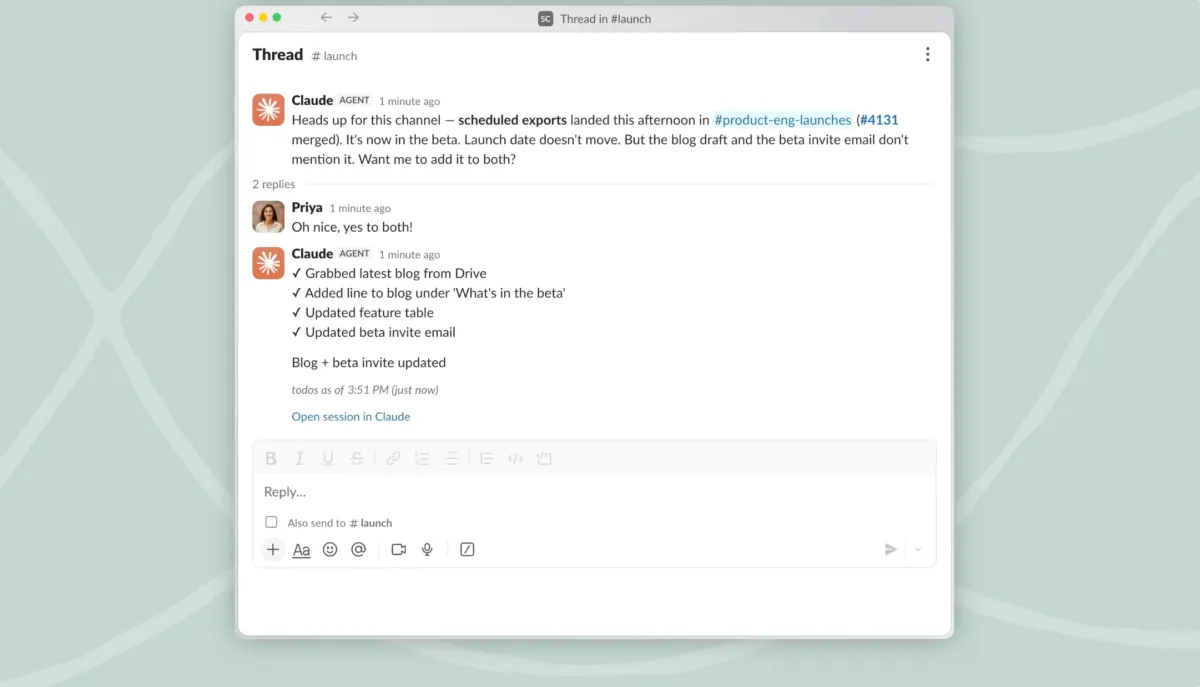
Anthropic is bringing a feature called Claude Tag into Slack, giving teams an always-on AI teammate. For decision-makers, it changes how enterprise knowledge and workflows can be captured, organized, and reused.
Anthropic’s new Claude Tag is designed to learn your company, one Slack message at a time. The headline sounds like a productivity gimmick because it shows up inside Slack, where teams already live. But the deeper point is operational: this is an always-on AI layer meant to absorb organizational context as conversations happen, then turn that context into something usable.
For executives, the first question is not “will it be helpful?” It is “what exactly does my organization become, once the system is continuously watching and interpreting our everyday work?” Claude Tag is positioned as a Slack feature that extends Claude into the flow of enterprise collaboration. The strategic angle, per TechCrunch’s framing, is that it can capture organizational context, institutional knowledge, and enterprise workflows, not just draft responses.
To understand why that matters, you have to zoom out to how enterprises actually function. Most institutional knowledge is scattered. It lives in old threads, incident postmortems, ticket histories, tribal norms, and the way a team writes when it is under pressure. Slack is a perfect habitat for that knowledge because it captures the unfiltered, real-time versions of how work gets done. The problem is that for humans, retrieving it later is expensive: search is not the same as understanding, and “the answer is somewhere in Slack” is not a strategy.
Claude Tag changes the economics of retrieval. If an AI system can learn from messages continuously, it can help teams answer questions, follow up on context, and execute workflows with less friction. That is the productivity story. But for boards and senior operators, the more consequential story is memory. Institutional knowledge is often lost when people leave, org structures shift, or processes change. A system that organizes context from communication patterns can reduce the rate at which that knowledge evaporates.
There is also a second-order implication for process design. When AI is embedded directly in Slack, the “interface” for work becomes conversational. Over time, the team does not just use the tool to respond; it uses the tool as part of the workflow. That means the organization may start to standardize how it explains decisions, documents requirements, and escalates issues. Even if teams do not intend to create a formal knowledge base, an always-on companion pressures the environment toward more structured, more retrievable communication.
Now the regulatory and risk framing. An always-on system that learns from business communications raises obvious governance questions, especially in regulated industries and for multinational enterprises with different privacy regimes. TechCrunch’s piece is focused on what the feature is and why it matters strategically, not on specific compliance details. Still, the underlying reality is that capturing and processing internal messages will put legal, security, and privacy teams in the critical path. Enterprises will need to think about data handling policies, access controls, retention, and how to ensure the AI outputs do not introduce errors into decision-making. The existence of the capability is the trigger. The implementation details are what will determine whether it is a strategic advantage or a governance headache.
There is also the competitive dimension. Slack is already the default collaboration surface for a lot of modern businesses, which means any AI that becomes deeply integrated can compound adoption. If Claude Tag becomes a “default brain” for certain teams, it can shape workflows in ways that are hard to reverse. That is not just a user experience upgrade. It is vendor lock-in by habit and by data gravity: once your team’s context patterns and operational routines are shaped around an assistant, switching costs rise.
For peers in similar roles, the stake is simple. Whoever turns day-to-day communication into reusable institutional knowledge gains leverage: faster onboarding, fewer repeated mistakes, and smoother execution when the org is under load. Claude Tag, as described by TechCrunch, is an attempt to do exactly that by putting Claude into Slack as an always-on teammate that learns from messages. The strategic play is to capture the context and workflows that normally stay trapped inside human memory, scattered channels, and historical threads.
In other words, this is less about “writing faster” and more about “remembering better.” If you are a founder, operator, investor, or board member, the decision is whether to treat this as a tool trial or as the start of a new layer of enterprise infrastructure. Because once your organization starts feeding an always-on AI from the place where work actually happens, you are not just upgrading productivity. You are changing how knowledge is stored, accessed, and operationalized across the company.
This story's Key Insights and Take-aways are locked.
Create a free account to unlock Executive Actions for one credit.
Register to UnlockAlways free for Executives Club members. Join the Club
More in Technology

Nvidia's $89B data center quarter: the 9 companies cashing in
The AI buildout is minting fortunes beyond GPUs, and memory, cloud, and cooling suppliers are riding the same wave.

Google quietly links your phone number to every Android account on your SIM
Adding a SIM now ties your phone number to all Google accounts - and future accounts inherit it. Here's the security and privacy stakes.

Hijacker AI 'Skynet mode' runs 100,000 attack steps against exposed models
Symantec caught a criminal AI agent that borrows other models, steals data, and mines crypto; the only relief is no confirmed victims yet.