

ASML is $700B now. Investors are openly asking if $1T is next
Europe’s most valuable listed chip-machine maker has surged to $700B, and the gap to $1T is suddenly debate-worthy.

ASML, the Dutch company behind machines that print the world’s most advanced chips, is now worth around $700B (€600B). The question investors are no longer dodging is whether ASML could close the remaining gap to $1T, and what that changes for boards and capital allocators.
ASML is now worth around $700B (€600B), putting it on the short list of Europe’s true market giants, not just a breakout semiconductor supplier. The company’s chipmaking machines are the bottleneck for the world’s most advanced processors, and in 2026 ASML has spent to get “steadily, expensively larger,” shifting from growth story to mega-cap gravity.
The wild part is not that ASML is big. It is that investors who already own it now say the next round number out loud, so the “could ASML...” question has stopped sounding fanciful. In other words, the market is acting like $1T is no longer a science fiction premise, it is a scenario that fits into valuation math and capital allocation plans.
To understand why that matters, you have to understand what ASML sells. Its role in advanced chip production is tightly coupled to where compute power comes from: the machines that enable the world’s most advanced chips. When the industry spends, ASML tends to be near the center of that spend, because without its tools, “better chips” stay on the drawing board. That linkage is why ASML’s value can compound quickly when demand expectations for leading-edge semiconductor manufacturing firms up.
The move from “up and to the right” to “$300B from a trillion” is also about positioning. The source frames the problem plainly: ASML is roughly $300B away from $1T, and the path there gets easier when investors stop treating the number as a joke. Markets often take their cues from ownership and sentiment, not just fundamentals. If enough holders decide the $1T discussion is rational, that can tighten the gap between current valuation and what incremental capital is willing to pay.
This is where governance and capital dynamics come in. A company at this size typically has a board and investor base that thinks in longer horizons and risk-managed scenarios, even when the market is moving fast. For decision-makers watching from adjacent sectors, the headline is a reminder that semiconductor supply chains have winners with durable pricing power and strategic customer lock-in, because constraints are physical, not theoretical. ASML is expensive to build and expensive to scale, and the source notes that ASML has been getting larger in 2026 by spending “steadily, expensively.” When capital requirements stay high, competitors do not simply copy the playbook overnight. That can help sustain the kind of valuation investors can defend.
There is also a regulatory and industrial-policy backdrop that typically shapes where tech investment flows, especially in regions that want advanced manufacturing capacity. While the source does not add specific regulatory details, it does anchor the story in Europe’s market leadership: ASML is described as Europe’s most valuable listed business. That context matters for executives because it signals political and strategic relevance. For governments, advanced chip manufacturing is both an economic lever and a national security concern. For boards, strategic relevance often translates into longer-term visibility, sometimes support, and almost always scrutiny. When a company moves toward $1T, the scrutiny does not fade. It intensifies.
The second-order implication is not just about ASML. It is about how capital allocators benchmark “the next mega-winner.” When investors openly discuss closing a roughly $300B gap to $1T for a company like ASML, that changes the reference point for valuation in the entire equipment and infrastructure layer of semiconductors. CEOs and CFOs at adjacent firms will feel it even if they are not mentioned in the article, because investor appetite can re-rate entire categories. It can also change negotiating posture with customers: if buyers believe the supplier’s financial runway is expanding, they may treat timelines and investments differently, which loops back into revenue visibility.
So the strategic stake is simple: if ASML can credibly close the gap to $1T, then the market is effectively underwriting more than earnings. It is underwriting the durability of its position as the machine gatekeeper for the world’s most advanced chips, and it is underwriting continued capital spending by ASML itself, since the source highlights that growth is “expensive.” For peers, the lesson is to watch not only current revenue, but the shape of capital needs, the strength of the bottleneck, and whether investors are willing to chase the next round number because they believe the story has moved from possibility to math.
This story's Key Insights and Take-aways are locked.
Create a free account to unlock Executive Actions for one credit.
Register to UnlockAlways free for Executives Club members. Join the Club
More in Business

Uber buys Delivery Hero for nearly $15B, vaulting to top food delivery outside China
The deal doubles Uber's dual-services footprint and pushes a ride-and-eats bundling play into 50 more markets.

Epic and Google drop settlement bid, forcing rival Android app stores by July 22
Google told the court it is ready to carry third-party app stores starting Wednesday, July 22.
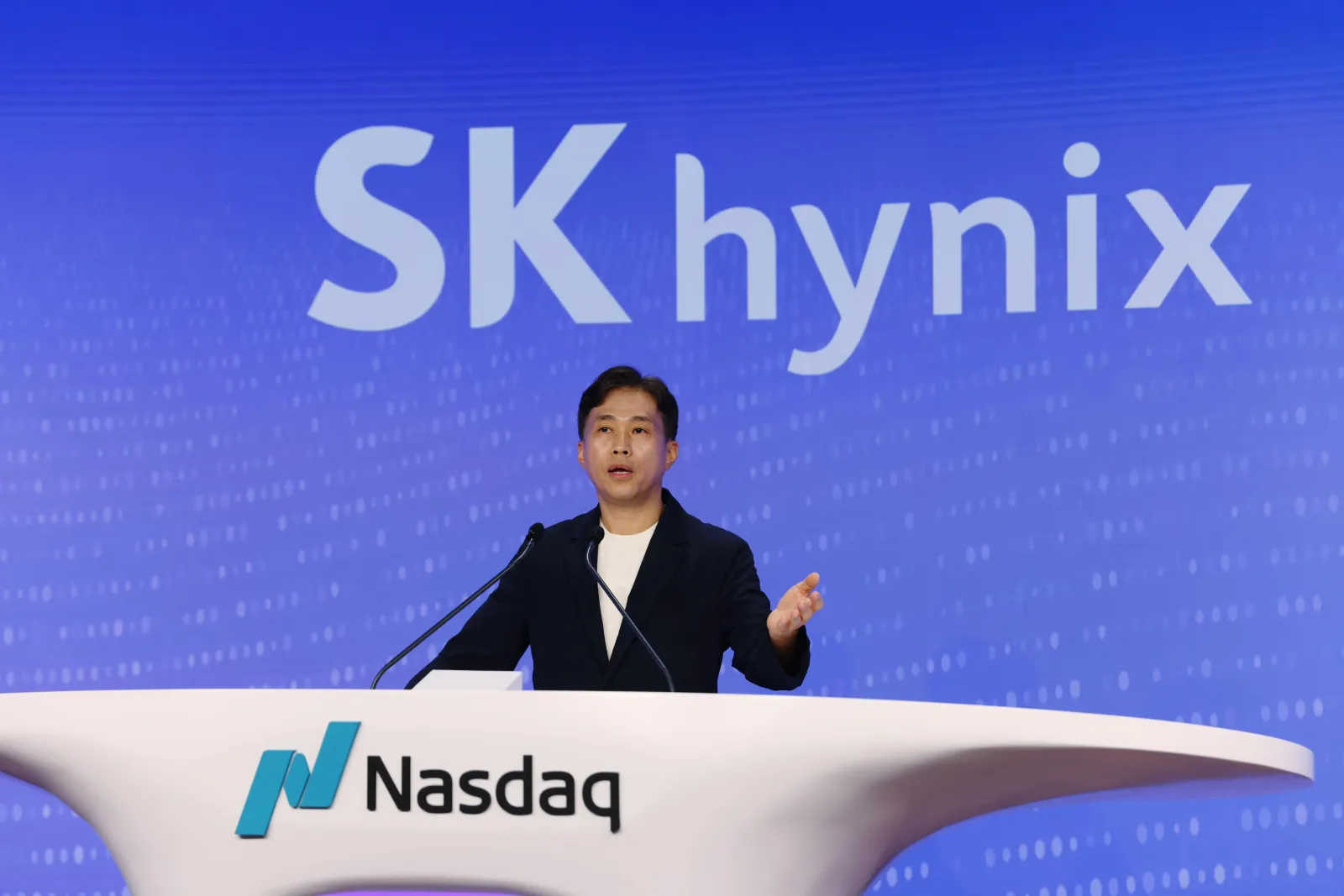
SK Hynix opens at $170, raises $26.5B, and tops foreign IPO records
In Friday's Wall Street debut, SK Hynix turns AI RAM demand into a $26.5B fundraising moment that rewrites comps.