

Blue Origin starts LC-36A rebuild, but it will not match the original pad
New Glenn’s May 28 explosion forced a rebuild and a new horizontal/vertical hybrid launch flow.
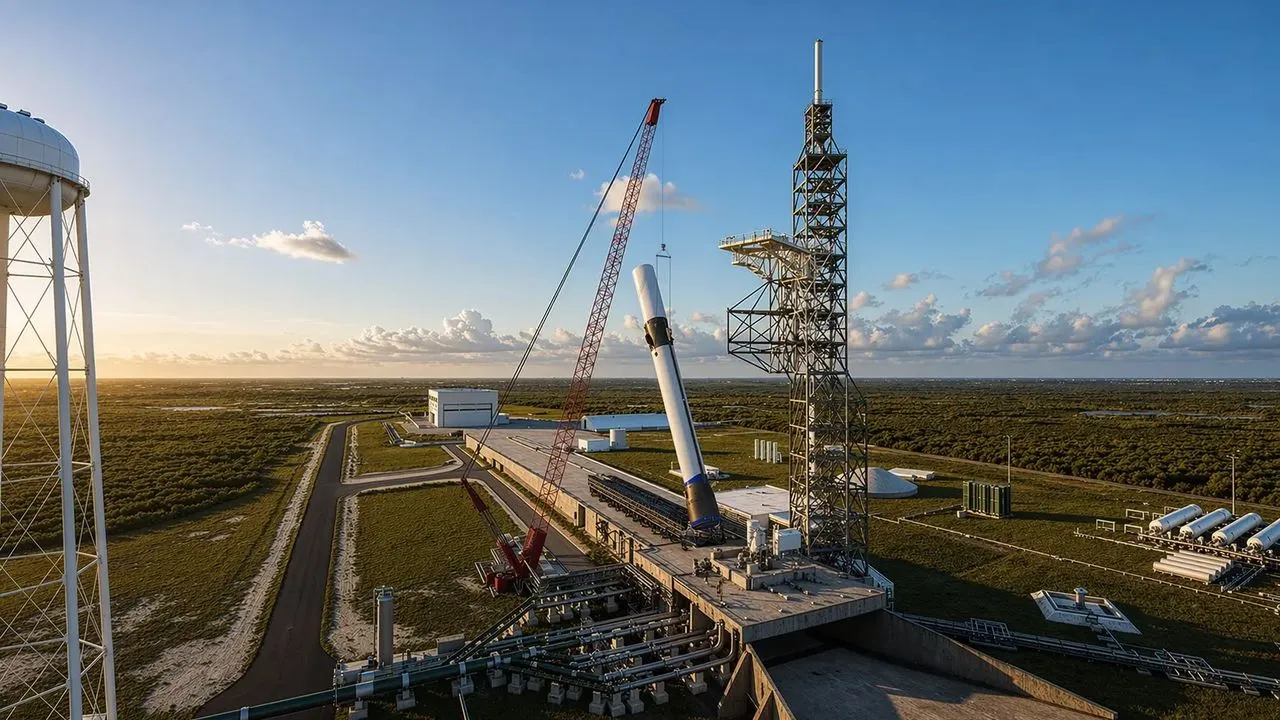
Blue Origin CEO Dave Limp says hardware recovery and debris removal are complete and reconstruction of Launch Complex 36A (LC-36A) has started after a New Glenn explosion on May 28. The pad rebuild will support a different ConOps, using a crane instead of the transporter-erector, to help Blue Origin fly again by year-end.
Blue Origin has started rebuilding Launch Complex 36A (LC-36A) at Cape Canaveral Space Force Station after its New Glenn rocket exploded during a routine engine test on May 28. CEO Dave Limp says hardware recovery and debris removal operations are complete, and reconstruction has started, but the part that matters most for decision-makers is that the rebuilt pad will not be a facsimile of the original.
Instead, Blue Origin is building a new LC-36A that lines up with a new concept of operations (ConOps) for New Glenn launches. Limp said via X that the company is moving to a horizontal/vertical hybrid configuration to get the rocket flying again this year at 36A, which is currently New Glenn’s only jumping-off point. In plain terms, Blue Origin wants to compress time-to-flight while also reducing reliance on the specific infrastructure that was destroyed.
To understand why this is such a big deal, you have to rewind to what actually broke. The May 28 incident destroyed the New Glenn vehicle itself and damaged key pad infrastructure, including the lightning tower and the transporter-erector. The transporter-erector was the system that hauled New Glenn from the integration facility to the pad and raised it vertical on arrival. Losing that architecture is not just a “repair and return” problem. It changes how you build, transport, and mate the vehicle, and it can change timelines, staffing needs, and even how your operational risk is managed.
Blue Origin’s stated goal is to fly the 320-foot-tall (98-meter) New Glenn again by the end of the year, and rebuilding LC-36A is a high priority because the pad is the only site currently set to launch New Glenn. But reconstruction is being done with a different blueprint, not a copy of the old one. Limp emphasized that the new approach will use a crane rather than a transporter-erector, and that payload mating will occur at the pad rather than inside the integration facility.
This hybrid approach is not being invented from scratch under disaster pressure. Limp said Blue Origin had already been planning to employ the “hybrid” ConOps for the super-heavy version of New Glenn it is developing, called 9X4. That name references the engine configuration of the coming vehicle: nine of Blue Origin’s BE-4s in its first stage and four BE-3Us in its upper stage. The current New Glenn configuration is a 7X2. The 9X4 target performance is also larger: it can carry 77 tons (70 metric tons) to low Earth orbit, compared with about 50 tons (45 metric tons) for the current version. The 9X4 also features a bigger payload fairing, 28.5 feet (8.7 meters) wide instead of 23 feet (7 meters).
If you are an operator, investor, or board member tracking launch cadence, this is where the second-order implications start stacking up. A launch system’s pace is tightly coupled to the ground flow: where you integrate, where you lift, where you mate payloads, and how often you need specialized handling systems. Limp also said the new ConOps has the added benefit of increasing flight cadence. That matters not because “cadence” sounds good, but because for both commercial and defense customers, schedule reliability and iteration speed are often as valuable as raw payload capability.
Blue Origin had already been developing another Cape Canaveral pad, LC-36B, to accommodate 9X4 launches, and Limp says that pad is being readied for the hybrid ConOps as well. So LC-36A is becoming both a recovery project and a proof point for a future architecture that spans from current New Glenn through the 9X4 evolution. That is a smart sequencing move from an organizational standpoint: rebuild today in a way that also de-risks tomorrow.
Meanwhile, Blue Origin is still working through the anomaly investigation from the May 28 explosion. Limp wrote that the vehicle is highly instrumented with extensive data from multiple camera angles and sensors, giving the company confidence in its ability to identify and correct the root cause. He also said early analysis points to the aft section of the first stage, while noting that more work needs to be done. The rebuild plus the investigation creates a dual track: ground systems are being redesigned to match a new operating flow, while the hardware failure is being diagnosed with a heavier emphasis on instrumentation and data fidelity.
The strategic stakes for peers are clear: Blue Origin is treating this disruption as both an operational reset and a roadmap adjustment. If it can execute the reconstruction, maintain its end-of-year flight target, and translate the hybrid ConOps into faster cadence, other launch providers will have to watch not just rocket performance, but how quickly a company can retool its ground architecture after a high-profile anomaly.
This story's Key Insights and Take-aways are locked.
Create a free account to unlock Executive Actions for one credit.
Register to UnlockAlways free for Executives Club members. Join the Club
More in Business

A flaw in PHP just forced governments to pull their own sites offline
European agencies from Belgium to Germany took websites dark to patch a critical weakness in the language behind almost 70% of the web, and the blast radius extends far beyond government portals.

BioWare shuts down, Mass Effect 5 dead after $55B EA buyout
The legendary RPG studio's closure lands months after a $55 billion investment group buyout of EA, raising tough questions for gaming's biggest acquirers.

Musk barred from the room as Tesla, SpaceX boards weigh $3.5 trillion merger
The CEO of both companies is a 'conflicted party' watching independent directors negotiate a tie-up that would create a $3.5 trillion giant he would own about a third of.