
Boox Go 6 Gen II turns a 6-inch reader into a note-taking competitor for $199.99
A $45.99 InkSense Plus stylus option and June 17 shipping date raise the stakes in the e-reader versus tablet fight.
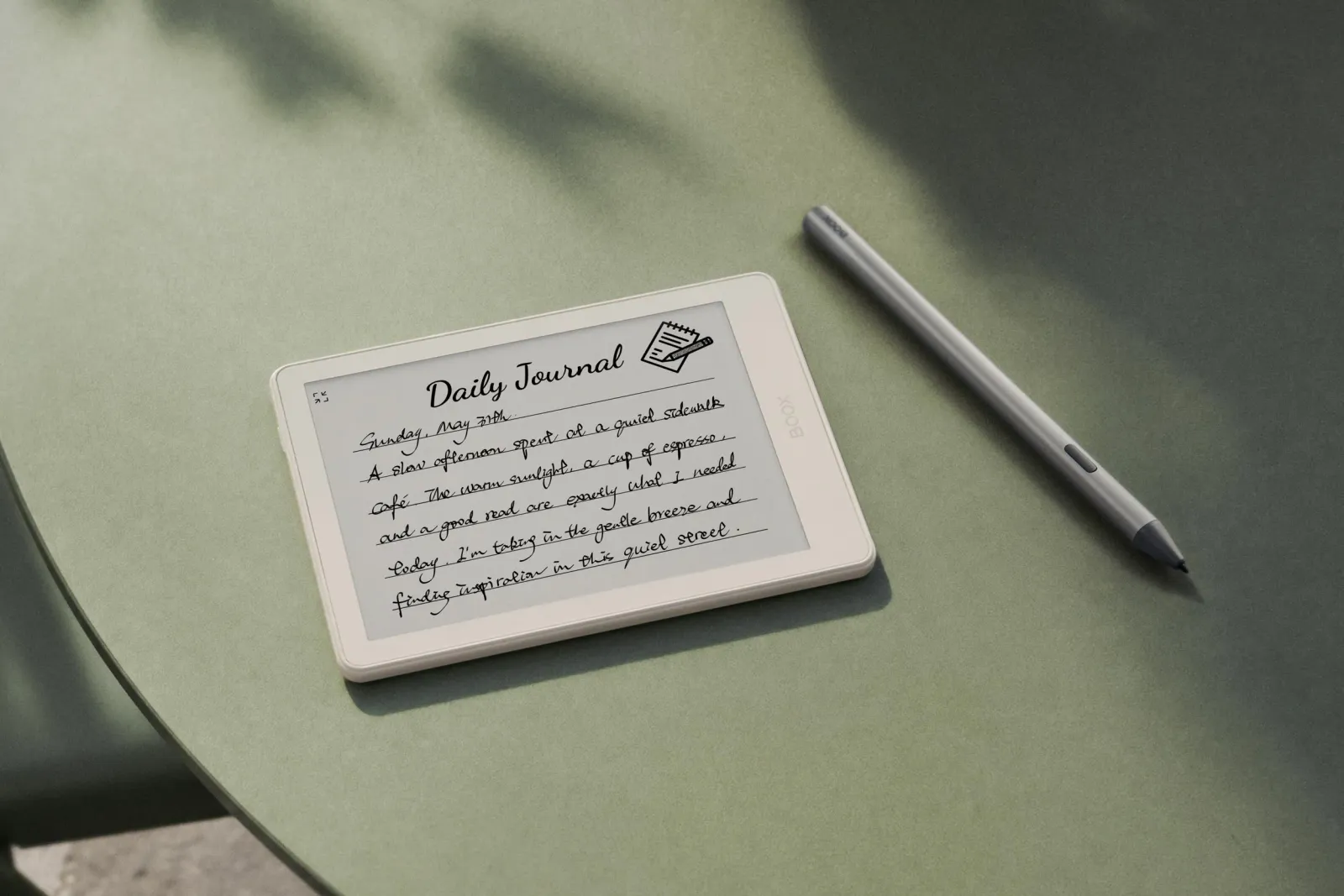
Boox announced the Go 6 (Gen II), a new version of its smallest 6-inch e-reader with note-taking support via the InkSense Plus stylus. The device starts preorder at $199.99, ships June 17, and can be bundled with the stylus for $232.99.
Boox just made its smallest e-reader harder to ignore. The company’s Go 6 (Gen II) keeps the same 6-inch, 300PPI E Ink screen, but adds note-taking by supporting Boox’s InkSense Plus stylus. That shift matters because it moves the Go 6 out of “just read” territory and into the same job-to-be-done as digital notepads and stylus-friendly slates, where switching costs and loyalty tend to be sticky.
The Go 6 (Gen II) will be available for preorder for $199.99 and is expected to start shipping on June 17. Boox is also using a familiar product tradeoff: the $45.99 InkSense Plus stylus is not included, but it can be bundled for $232.99, turning this into a clearer, priced-in alternative for people currently choosing among Kindle, Kobo, and separate note-taking devices.
Under the hood, Boox isn’t trying to reinvent the reading panel. The company sticks with the predecessor’s 6-inch, 300PPI E Ink screen, which is the baseline feature set for a compact, eyes-friendly reading experience. Instead, Boox is focusing on making handwriting and document markup plausible in day-to-day use. The Gen II bumps RAM from 2GB to 3GB, a move that signals Boox expects the added workflows to be more demanding than plain reading, such as sketching, annotating documents, and making handwritten notes.
The stylus support is the center of gravity here. The InkSense Plus stylus can be used for sketching, annotating documents, or taking handwritten notes. That’s not marketing fluff. It directly targets the “I use my device as a notebook” behavior that usually pushes people away from e-readers and toward tablets. If an e-reader can do the handwriting loop with the same kind of immediacy you get from a notepad, it reduces the need to split your workflow across multiple devices.
From a market perspective, this is a classic wedge strategy. Amazon Kindle and Kobo have long dominated reading, but the advantage of E Ink has always been battery life and readability, not necessarily multi-input creativity. By adding stylus functionality to an e-reader that remains small and screen-first, Boox is trying to claim a broader role in a buyer’s desk setup. Executives in the category should notice the timing too: the Go 6 is positioned as “smallest,” and that is where habits can either solidify or fracture. Once a customer decides their compact device is also their writing device, it becomes part of daily routines instead of a niche alternative.
Pricing is where the decision-makers will do the math. At $199.99, the Go 6 (Gen II) is clearly aimed at staying in the entry conversation. But the bundle price of $232.99 is more expensive than the entry-level Amazon Kindle, based on the source description. That doesn’t automatically make Boox the wrong pick. It reframes the buying question from “which is the cheapest reader” to “how much am I paying to replace a paper workflow with digital handwriting on an E Ink screen.” The $45.99 stylus not being included is part of that framing, too. It forces the incremental cost to be evaluated at purchase, rather than hidden in an all-in bundle.
For board-level readers and investors, the second-order implication is product scope creep in the best way. Adding note-taking turns what could have been a pure hardware refresh into a platform capability that can support software workflows, document annotation habits, and longer-term user engagement. More usage can mean more retention, and retention is the currency that converts occasional buyers into habitual customers. Even if competitors remain strong in reading, expanding the device into sketching and handwritten notes can push the category toward “e-reader plus productivity tool,” which changes how customers budget and what they compare.
There is also a systems-level competitive question that matters for anyone tracking adjacent markets. When an e-reader supports handwriting and document annotation, it becomes more comparable to devices people already consider for studying, planning, or reviewing. That shifts the competitive set. The Go 6 (Gen II) isn’t just trying to compete with other readers. It is trying to reduce the number of devices you need, which can pressure whichever product line is currently benefiting from that split workflow.
Boox’s move also underlines an important operational bet: even with the same panel spec, Boox is confident that the combination of 3GB RAM plus stylus support will make the new workflow feel usable. The scheduled shipping date of June 17 gives the market a near-term moment to validate that bet, especially among customers watching for a cleaner alternative to juggling separate readers and notepads.
Bottom line for executives tracking consumer tech, the Go 6 (Gen II) is a targeted expansion of scope, not a full category disruption. But it is exactly the kind of shift that can change purchasing priorities. If Boox can make “read, annotate, and write” feel natural on a 6-inch E Ink device, it widens its addressable market, raises expectations for what an e-reader should do, and forces competitors like Kindle and Kobo to defend not only reading, but also the notebook workflow that sits beside it.
This story's Key Insights and Take-aways are locked.
Create a free account to unlock Executive Actions for one credit.
Register to UnlockAlways free for Executives Club members. Join the Club
More in Technology

OpenAI says 10,000 agents cracked a 90-year math problem in 88 hours
The company's claim is audacious, but one mathematician is pushing back. Here's what it means for AI-driven discovery.
Meta still serves child sexual abuse ads on Instagram in India - BBC report
A new report following the BBC Eye investigation says the ads are still there - what it signals for every platform with a self-serve ad engine.

White House yanks 'Build the Wall' game after Tetris Company copyright warning
The administration's arcade game vanished in hours - and the takedown playbook every brand can learn from.