
Boox Tappy swaps touchscreen reach for fidget-satisfying buttons, for $29.99
The tiny dual-button page-turn remote adds three modes and works across devices, but notifications and compatibility vary.
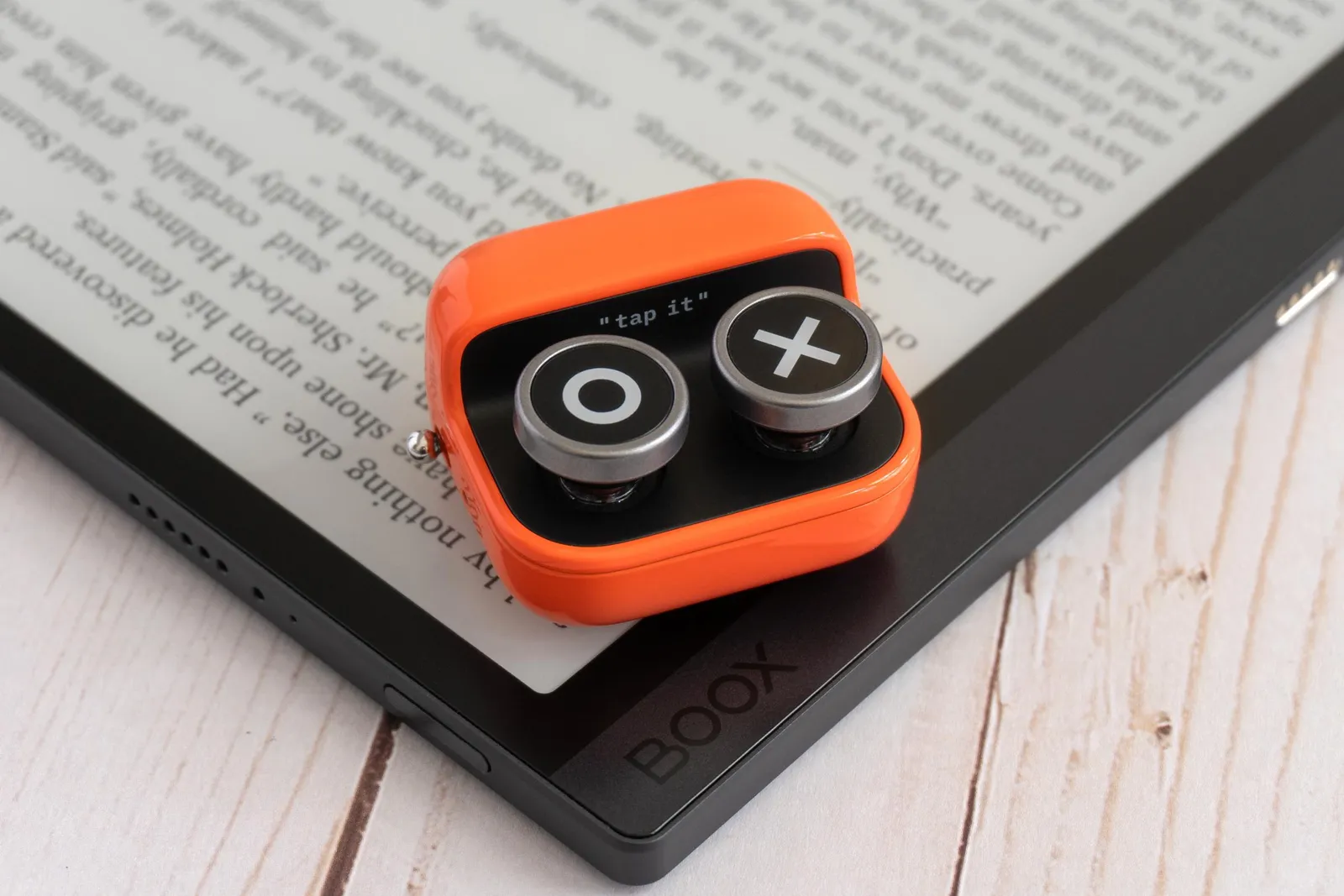
Boox’s Tappy is a $29.99 wireless page-turning remote designed around two buttons, not a bulky accessory, and it pairs via Bluetooth with Boox devices running V4.2 firmware or later. For decision-makers, it signals how quickly “accessories” are turning into product-adjacent UX that can migrate across ecosystems.
Boox’s Tappy is a tiny wireless page-turn remote that does not look like a remote at all. Instead of forcing you to reach an arm’s length for a touchscreen, it gives you two round buttons that feel like a mashup of wireless remotes, fidget toys, and macro pads. The big promise is simple: faster, more comfortable reading control. And the even bigger hook is that it does not stop at reading. Out of the box, it can run in Reading mode, Multimedia mode, or Browsing mode, with mode changes you can cycle through using both buttons for about five seconds, confirmed by LED color changes and a pop-up on the Boox device.
That multi-mode design matters because Boox is trying to make a small, $29.99 accessory behave like a reliable control layer across the places people consume content. Boox positions Tappy for its e-readers and tablets, and it works best with Boox devices running V4.2 firmware or later, including the Boox Palma 2 Pro. Pairing is straightforward: after powering it on with a sliding metal switch on the side, you hold both buttons for about two seconds to enter pairing mode, indicated by a single LED flashing blue. Then you connect it in the Boox device’s Bluetooth settings, and it reconnects automatically next time.
But the Tappy’s value is not just in pairing. It’s in the ergonomics and the “feel,” which is exactly where accessories usually fail. Boox’s Tappy is small enough to sit discreetly in your hand, with four rubber feet on its underside so it won’t slide around on a desk. The two buttons have about a quarter-inch of travel and are satisfying to press. The design is also intentionally distinct from what Boox previously shipped: the article notes that the Tappy is not Boox’s first page-turning remote, but its approach is much different from the company’s slim but boring B.T. Remoter. Compared with the Kobo Remote, which looks like a streaming dongle accessory prioritizing ergonomics, the Tappy feels more like a miniature keyboard distilled to two buttons, with design inspiration from a retro typewriter.
There are trade-offs, though, and they’re the kind product teams watch closely because they hint at what users will tolerate. The included default button labels are pixelated heart and a steaming mug of coffee, which the reviewer says they do not understand. They immediately swapped to included alternatives labeled with an X and an O. More customization, even just sticker sheets, would be preferred, and the article suggests labels like forward and back arrows, or plus and minus, would be useful alternatives to what’s included.
Functionality is also mode-driven in a way that makes it feel less like a single-purpose gadget. In Reading mode, the buttons turn pages forward and back, or control volume when you’re outside a reading app. In Multimedia mode, they skip tracks in music, video, podcast, or audiobook apps. In Browsing mode, they scroll up and down through long webpages or social media feeds as long as you’re pressing either button. To switch modes, you press both buttons for about five seconds; the LED momentarily flashes green, and repeating the process cycles Reading, Multimedia, and Browsing. Each time you switch on a Boox device, a notification pops up at the top letting you know the current mode, but it is not persistent and can be easy to miss. The reviewer argues that clearer at-a-glance indicators would help, like a trio of labeled LEDs, or a single LED that changes color per mode.
Compatibility gets messy the way accessories often do once they leave the home ecosystem. The Tappy works with other Android mobile devices and iPhones and iPads, but functionality varies. The functionality is supported in both the Kobo and Kindle Android apps, but not in the iOS or iPadOS versions. Still, the reviewer was able to use the Tappy on an iPhone and a OnePlus phone to scroll webpages, control music playback, and adjust volume. The real challenge when using it with non-Boox hardware is missing the helpful pop-up notifications that tell you which mode you switched into. Without LED indicators, the only way to know the current mode is to press the buttons and observe what happens, like whether volume changed or whether you can effectively move toward the Browsing mode you want.
Even among other e-reader ecosystems, results are uneven. Other e-readers from companies like Pocketboot or BigMe are supported, according to Good e-Reader’s testing, but the reviewer had no luck getting the Tappy to work with Kobo and Kindle. That’s unfortunate because the reviewer regularly enjoys using the Kobo Remote for reading at night and says they would happily abandon it for the Tappy. They also report the Tappy has already replaced their Apple Watch for skipping tracks when streaming iPhone audio through a HomePod, even though the buttons occasionally get accidentally pressed when the remote is bouncing around in a pocket. At $29.99, it undercuts the “expensive accessory” expectation by landing at the same price as the Kobo Remote, while claiming more flexibility across modes and devices.
For executives and boards watching consumer tech, the second-order story is that these micro-interactions are becoming a battleground. A two-button remote can function as a UX bridge between hardware, apps, and firmware, and when notifications and mode awareness are inconsistent across ecosystems, users feel it immediately. Tappy’s approach shows how quickly accessories can shift from “nice-to-have” to “primary control surface,” but it also highlights the operational burden of compatibility, indicator clarity, and app support across Android and iOS. The strategic stakes for peers building reading, media, or device-adjacent software are clear: the interface people trust might no longer live on glass, and the small devices that sit in hand could quietly decide retention.
This story's Key Insights and Take-aways are locked.
Create a free account to unlock Executive Actions for one credit.
Register to UnlockAlways free for Executives Club members. Join the Club
More in Entertainment

Entertainer Russell Brand denies 7 sex charges amid accuser's 'couldn't breathe' claim
The alleged victim's account sharpens the reputational and legal stakes for Brand, his platforms, and any business tied to a public figure under criminal scrutiny.

Russell Brand's accuser 'bewildered and confused' as he denies 7 sex charges
The criminal case against the comedian is a live test of how media companies manage talent risk when serious allegations go public.

'It's a Magic Trick': Ballet Experts Say Rosalía's SNL Pose Is Impossible
Three ballet experts tell Rolling Stone Rosalía's gravity-defying SNL stillness shouldn't be possible - and why the debate is now part of the show.