

Brussels Airlines paints a trident for Belgium before Spain World Cup quarterfinal
The airline uses a specially designed aircraft and says the gesture needs no explanation.
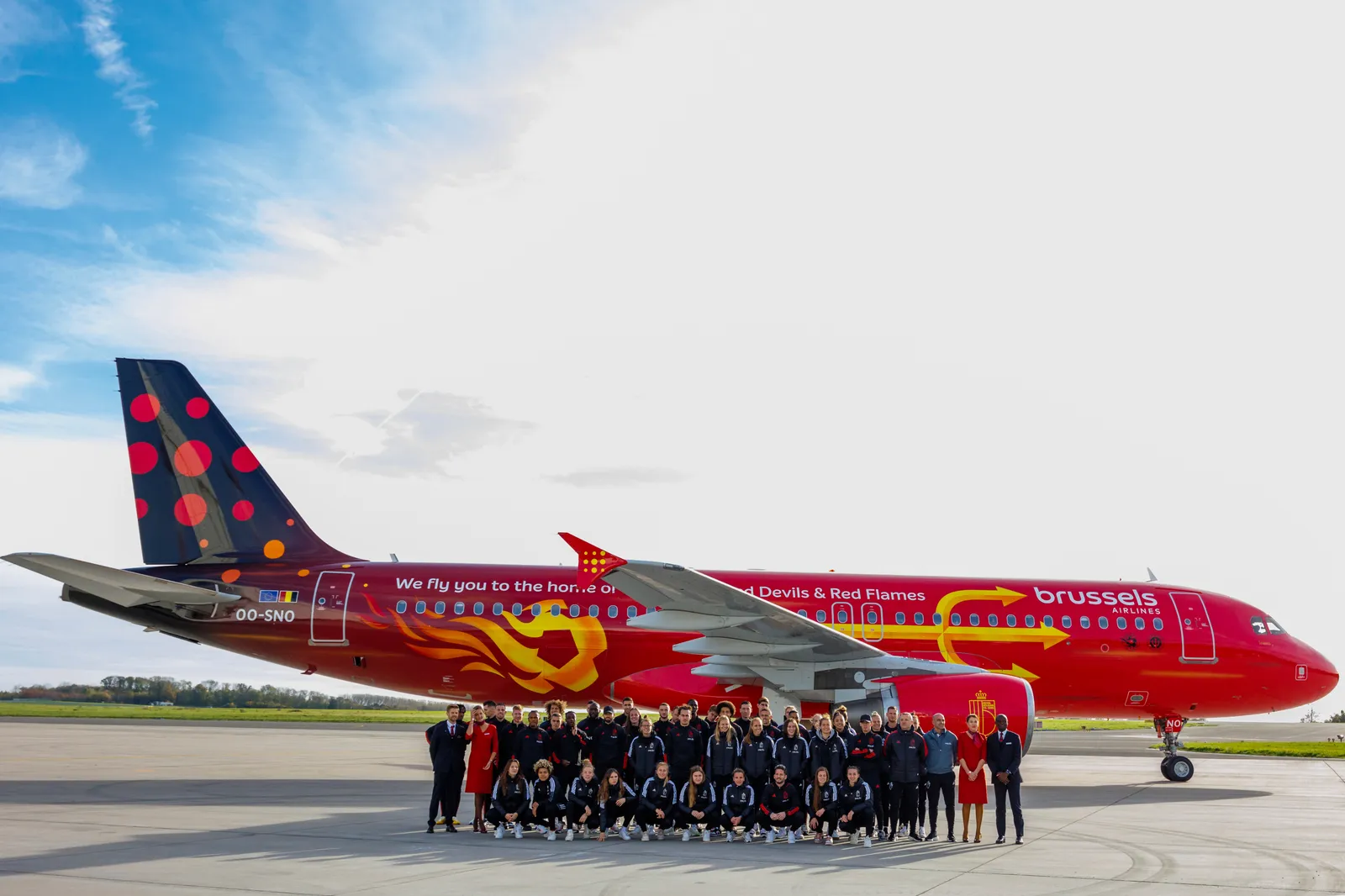
Brussels Airlines is flying a Trident aircraft painted in Belgium's national team colors, including emblems for the Red Devils and Red Flames, to Spanish destinations ahead of the Friday World Cup quarterfinal between Belgium and Spain. The move, described as a joke by the airline itself, creates a subtle branding and attention play for both men's and women's teams.
Ahead of Friday's World Cup quarterfinal between Belgium and Spain, Brussels Airlines is turning its planes into fanfare. The Belgian flag carrier has specially designed a Trident aircraft with Belgium team branding, and it is flying to Spanish destinations including Madrid and Barcelona. The visual is not subtle: a trident references the Red Devils, Belgium's men's national football team, while flames represent the Red Flames, the women's team.
When asked about the move, Brussels Airlines declined to provide any additional commentary, saying via email: "We did not provide any comments, as we think the joke speaks for itself:)." That line matters because it frames the entire strategy as intentionally playful rather than purely informational. In other words, the airline is betting that the meaning will carry itself, and that viewers will supply the intent.
This is happening inside a broader World Cup culture that has fully spilled into Belgium's everyday shopping and media. In Delhaize supermarkets, for example, the tournament is already showing up in Red Devil-themed Jupiler beer cans, football-shaped Leonidas chocolates, and sticker collectables. Belgium’s airline move is just the aviation version of the same thing: theme the moment, make the country feel like it is traveling with its team, and let the brand piggyback on the attention spike around a high-stakes match.
For executives who care about brand, distribution, and customer behavior, the operational details are the point. The airline is not just printing slogans on paper or running a standard ad; it is putting team emblems on a fleet asset and taking that asset into the two markets where the narrative will be most activated. Iberia is doing a parallel move on the Spanish side: Spain's national airline also has a specially designed aircraft that flew the country's national football team across the Atlantic, using an image of Spain's squad alongside the slogan "A team takes off. A country flies." The contrast is interesting because both carriers tie sports identity to national travel identity. Belgium does tridents and flames. Spain does squad imagery and a country-wide travel claim.
There is also a second-order angle here: this is not only about men's football attention. Brussels Airlines says the design was intended to highlight both teams, because "it's high time that the women's team gets as much attention as the men's team." That is a meaningful positioning choice for a flag carrier. Airlines typically operate in a global, competitive marketplace where differentiation is hard and customer expectations are constantly recalibrated by travel experience. Sports-themed aircraft can be a low-friction way to stand out visually, but the message also signals values and market awareness, not just fandom.
From a governance and communications perspective, the "joke speaks for itself" approach is a deliberate choice to limit interpretive risk. By declining to elaborate, the airline avoids getting pulled into threads it does not want to manage, such as whether the design is promotional advertising, corporate sponsorship, or something else under marketing norms. The World Cup context already provides cover for public playfulness, and the airline uses that to keep the narrative simple: you see it, you get it, you move on.
Still, the brand mechanics are real. A specially designed aircraft is a costly asset allocation, even if the incremental marketing cost is not spelled out in the source. The payoff comes from repeated visibility during flight routes and from the global media attention that usually accelerates around World Cup knockout fixtures. For competitors, these moments can raise the baseline of what audiences expect from national carriers: they become part of the match-day ecosystem, not just a transportation utility.
The strategic stakes for other airline executives and board members are straightforward. When a national carrier turns a plane into a moving billboard for both men's and women's teams, it forces peers to ask whether they will be left with a generic brand while attention concentrates elsewhere. And if the move reads as inclusive and culturally on-beat, it may also influence how sponsors and partners think about which themes feel current with audiences in the short term. In a week like this one, where a quarterfinal can swing headlines and viewership rapidly, the travel brand that shows up in the conversation may get the advantage that does not show up on a balance sheet until weeks later.
This story's Key Insights and Take-aways are locked.
Create a free account to unlock Executive Actions for one credit.
Register to UnlockAlways free for Executives Club members. Join the Club
More in Politics

Glacial collapse, not rain, killed 180 in Nepal's Himalayan flood
The Himalaya's extreme geography hid the true cause of Nepal's catastrophic flood, a glacial collapse that turned a geological battleground into a mass-casualty zone.

Iran’s Esmail Baghaei says Oman talks start shipping via Hormuz, not US talks yet
Temporary route plans with Oman aim to restart commerce while Tehran says Washington dialogue is not on the table.

Standards watchdog opens probe into Reform UK deputy leader Richard Tice over interests
The parliamentary standards commissioner says it began an investigation on 28 July into a possible undeclared interest.