

China lands a reusable Long March booster, a first that matches SpaceX and Blue Origin
A barge landing and net-based recovery move China from theory to proof, reshaping the reusability race and satellite ambitions.
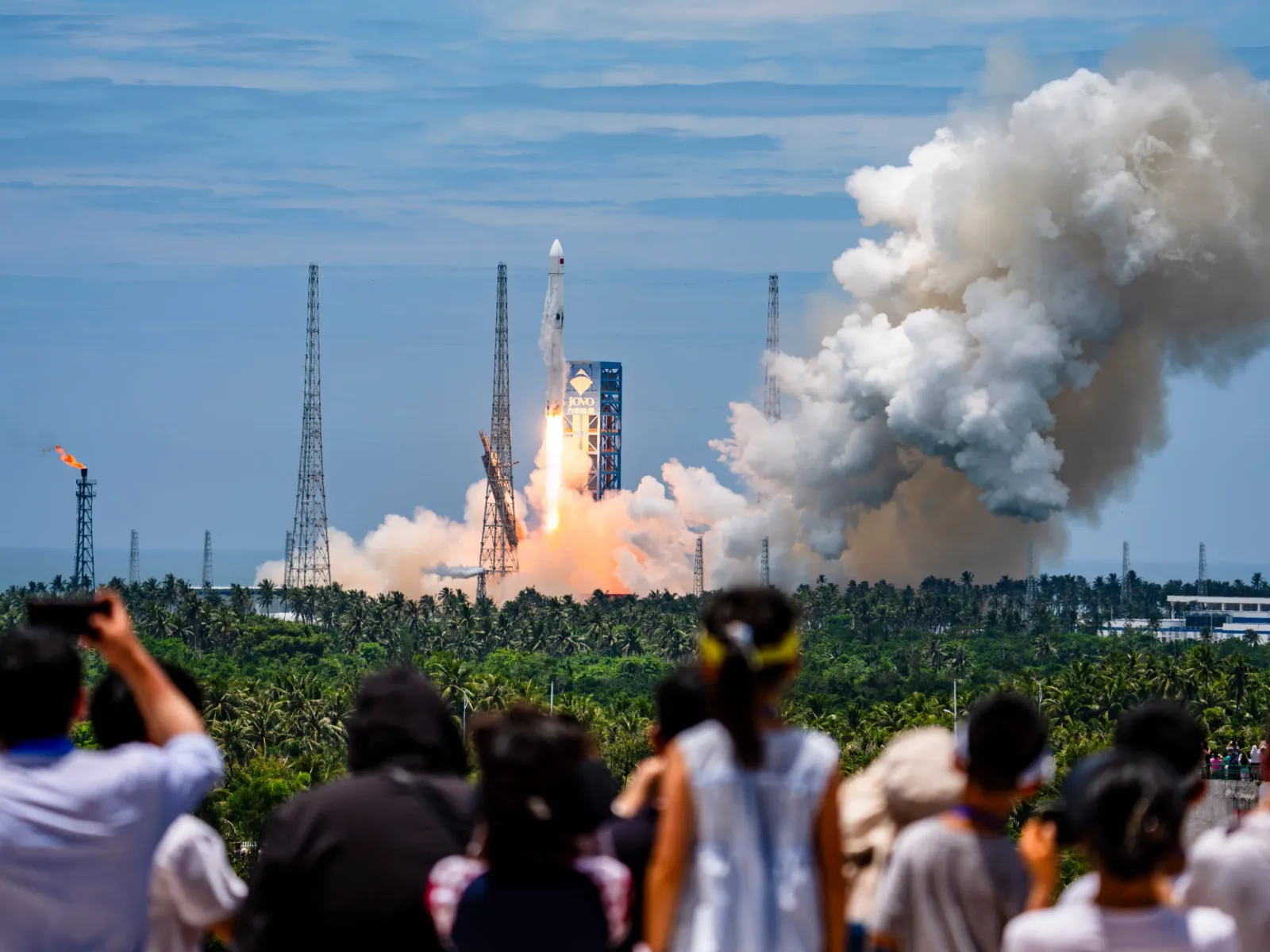
China’s Aerospace Science and Technology Corp successfully landed a reusable booster stage of its Long March-10B rocket on July 10, 2026, after a lift-off from Hainan at 12:15 pm. The breakthrough matters to decision-makers because it raises competitive pressure on reusable launch leaders while fueling China’s push for Starlink-class broadband via SpaceSail.
China has done something only a small club has managed: on July 10, 2026, its Long March-10B rocket successfully landed a reusable booster stage for the first time. The rocket lifted off from a Hainan commercial space launch site at 12:15 pm, then touched down on a barge around six minutes after first-stage separation. Local media reported the stage was captured by a large net, described as the world’s first “net-based recovery.”
This is the key point: landing and reusing a first-stage booster, instead of letting it burn up during reentry, is a milestone that directly lowers the economics of launch. That is exactly the lane pioneered by SpaceX. SpaceX landed its first booster in 2015 and has since launched and successfully recovered Falcon 9 boosters hundreds of times. Blue Origin, meanwhile, scored its first booster landing last November with New Glenn, where the first stage landed on a platform in the Atlantic Ocean. China’s Aerospace Science and Technology Corp now joins those organizations as the only ones to have successfully landed a rocket booster.
To understand why executives should care, zoom out to the reusability arms race. In rocket land, reusability is not a “cool demo.” It is cost structure. If you can reliably recover the stage that does the hard work, you can reduce the per-launch bill and create a pricing and cadence advantage. That is why the Long March-10B’s barge touchdown is more than a headline. It is operational proof that China can close the loop on at least part of an orbital launch.
The recovery method also matters strategically. Local reporting described a net-based capture, reportedly a first-of-its-kind approach. In simple terms: you are not only trying to land. You are trying to land in a way that can be repeated, staged, and scaled. The more repeatable the recovery becomes, the more the economics get better and the more frequently launches can be scheduled without proportional increases in hardware production. For leaders at space companies, regulators, or satellite operators deciding where to place bets, repeated launch capability becomes a supply chain question as much as a technology one.
China is not doing this in isolation. The source notes that China is racing to catch up with SpaceX by launching powerful reusable rockets and building its own Starlink rival. That rival is SpaceSail, a state-backed company that has launched around 200 satellites into orbit since 2024. The scale is still far behind Starlink, which the source says has an estimated 10,000 satellites in low-earth orbit. But the direction is clear: broadband competition is turning into an infrastructure race, and launch cadence is a real constraint when you are placing thousands of satellites.
There is also a capacity gap that keeps the pressure on. The source says China’s reusable Long March rocket cannot carry as much into orbit as SpaceX’s Falcon 9. It lists a max payload capacity of 16 tons for Long March versus 25 tons for Falcon 9, and it compares both to Starship’s planned 100+ tons. In other words, China is proving reusability while still working to close performance gaps. That is a common technology strategy: demonstrate the part that reduces cost first, then iterate on payload and mission architecture.
Even so, the competitive narrative has already shifted. The source includes a post on X in October in which Elon Musk argued that China’s reusable rockets are catching up with SpaceX’s workhorse rocket. Musk wrote that they “have added aspects of Starship, such as use of stainless steel and methalox, to a Falcon 9 architecture,” which he said “would enable it to beat Falcon 9.” He also added that “Starship [is] in another league.” That matters because it shows how even the incumbents are watching the technical trajectory closely. When the market hears that a rival is borrowing design concepts and applying them to a Falcon 9-like architecture, it changes how investors underwrite timelines and margins.
For space execs and board members evaluating strategy, this Long March-10B moment is a reminder that reusability is no longer a competitive moat held by one or two companies. It is becoming a baseline capability that multiple national programs can pursue. The second-order implication is about bargaining power. If China’s launch providers can make reusability routine and scale reliability, satellite operators and constellation builders will have more credible options for placing hardware in low-earth orbit. That can tighten pricing, shift partnerships, and reshape which “constellation plans” are feasible under real launch logistics.
So while China’s landing is literally a booster stage hitting a barge, its real payload is competitive pressure. SpaceX, Blue Origin, and satellite operators watching their throughput and cost assumptions should treat this as proof that the reusability frontier is widening. The winning question now becomes not “who can land once,” but “who can land often, with the reliability and payload performance that makes constellations and enterprise payloads economically inevitable.”
This story's Key Insights and Take-aways are locked.
Create a free account to unlock Executive Actions for one credit.
Register to UnlockAlways free for Executives Club members. Join the Club
More in Business
Elon Musk unveils a flying car, and SpaceX helped build it
The Tesla CEO's showcase at a SpaceX facility signals a future where road and rocket engineering converge.

Apple's $2,000 iPhone Duo opens preorders, taking on Samsung and Google
Apple's first foldable hits the market at a premium price, reshaping a category Samsung and Google have led.

Pope Leo XIV, first American pope, diagnosed with lung cancer
The 71-year-old Chicago-born pontiff underwent successful surgery on his right lung, and his diagnosis raises new questions about his AI-focused papacy and the Vatican's future.