

Chandra finds Milky Way arms are ~10% farther out than we thought
New geometry-based X-ray measurements suggest the outer two spiral arms sit farther from the Galactic Center, reshaping galaxy models.
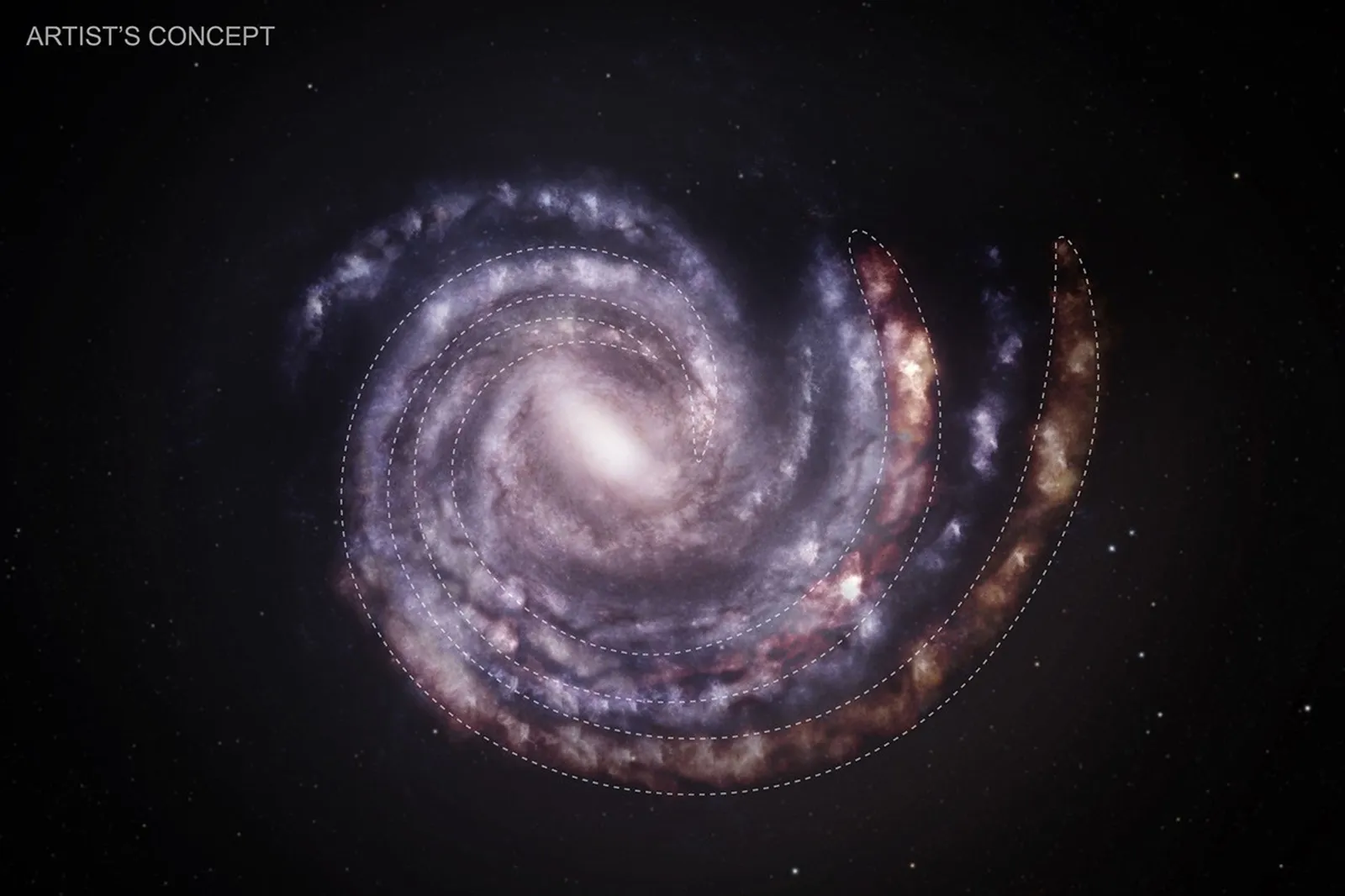
NASA’s Chandra X-ray Observatory, working with ESA’s XMM-Newton, has produced a new paper published Wednesday in Astronomy & Astrophysics based on precise distance measurements to Milky Way dust clouds. The result: the Outer and Outer Scutum-Centaurus arms are about 10% more distant than astronomers previously thought, with downstream implications for estimates like the Milky Way’s mass and how its arms stretch.
NASA’s Chandra X-ray Observatory and ESA’s XMM-Newton have turned up a clean, geometry-driven result with a messy consequence: the Milky Way’s two outermost spiral arms may be about 10% farther from the Galactic Center than astronomers previously estimated.
The study, described in a new paper published Wednesday in the journal Astronomy & Astrophysics, used a distance technique that depends less on assumptions about how the galaxy rotates and more on straight-up geometry. The team measured the distances to dust clouds embedded in the spiral arms by studying “light echoes” from gamma-ray bursts, then mapped where those rings must land in the Milky Way.
Here is the core of how it works. Gamma-ray bursts (GRBs) are some of the brightest bursts of light in the universe, arising from either the collapse of massive stars or the merger of neutron stars. Because they’re located far beyond the Milky Way, the Milky Way dust clouds act like mirrors in space-time: when the GRB happens, its light bounces off dust in spiral arms, and that delayed, scattered X-ray light traces out rings. The diameters of those X-ray rings give distances to Earth, with larger rings generated by dust clouds closer to us.
Astronomers made these measurements using data from both Chandra and XMM-Newton, an ESA mission with NASA contributions. The analysis singled out three different gamma-ray bursts to determine distances to three spiral arms. In order of increasing distances from the Galactic Center, the arms are the Perseus, the Outer, and the Outer Scutum-Centaurus arms. Along the direction of one of the bursts, the researchers found that both the Outer and the Outer Scutum-Centaurus arms are about 10% more distant than previously thought.
The team also went beyond “pointing and measuring” by using the observations to estimate structure within an arm. They found that the dust cloud in the most distant arm is about 3,500 light-years wide. And they argue something important for modelers: their measurements apply to the full thickness of the spiral arm, not just a random, isolated dust cloud that might not represent the arm’s true location.
Why this matters, and why executives should care even if you do not have “astronomy” in your official job title: galaxy structure is foundational. The Milky Way’s spiral arms are fundamental landmarks used to build and validate models of our home galaxy. The researchers explicitly note that revisions of these distances are important because they are “so fundamental for understanding our galaxy.” One second-order implication they outline is mass: a change in how far the arms extend can mean astronomers have to revise estimates of the galaxy’s mass, since mass affects how wide the arms stretch.
There is also a methodological storyline here that boardrooms understand well: the technique is “a very direct way, relying only on geometry,” according to Beatrice Vaia, who led the study while a PhD student in a joint program between Scuola Universitaria Superiore IUSS Pavia and University of Trento in Italy. The key contrast is that many other methods rely on assumptions about how the Milky Way rotates, which become increasingly uncertain in the outer regions. In other words, this approach reduces dependence on the least testable assumptions exactly where uncertainty tends to balloon.
Of course, every precision instrument comes with practical constraints. The researchers used three different gamma-ray bursts to cover three spiral arms, and they acknowledge that bright GRBs that are visible through the plane of the galaxy are rare. Co-author Andrea Tiengo of Scuola Universitaria Superiore IUSS Pavia put it bluntly in the release: over 25 years, “we’ve only found a handful” that they can use, meaning they are relying on the universe to provide the right events. Still, they plan to keep looking.
For context on the mission machinery: NASA’s Marshall Space Flight Center in Huntsville, Alabama manages the Chandra program. The Smithsonian Astrophysical Observatory’s Chandra X-ray Center controls science operations from Cambridge, Massachusetts, and flight operations from Burlington, Massachusetts.
And if you zoom out from the science for a moment, the strategic stake becomes clear: when your reference distances shift, downstream models shift too. In the same way that companies revise assumptions when better data hits the pipeline, astronomers may need to adjust the Milky Way’s structural maps, and those maps are upstream of estimates like the galaxy’s mass and how its spiral arms are expected to behave.
This story's Key Insights and Take-aways are locked.
Create a free account to unlock Executive Actions for one credit.
Register to UnlockAlways free for Executives Club members. Join the Club
More in Science

Alaska's 1,580-foot tsunami had warning signs. Scientists just found them.
Rapid glacier retreat, heavy rainfall, and thousands of tiny tremors preceded Alaska's 1,580-foot tsunami, a warning for every coastal community in a warming world.

The rare mutation that lets high-risk brains dodge Alzheimer's
Scientists found a natural defense against protein buildup, opening a new path to preventive treatments.

3,000 steps a day may halve Alzheimer's decline, study finds
New research links a modest daily walk to less tau buildup and nearly half the cognitive and functional decline, even for those with early signs.