

ChatGPT Work promises hours-long “independent workflows” that still pause for your approval
OpenAI pitches a new tool that runs tasks for hours, plus Scheduled Tasks, but requires sign-off on important actions.
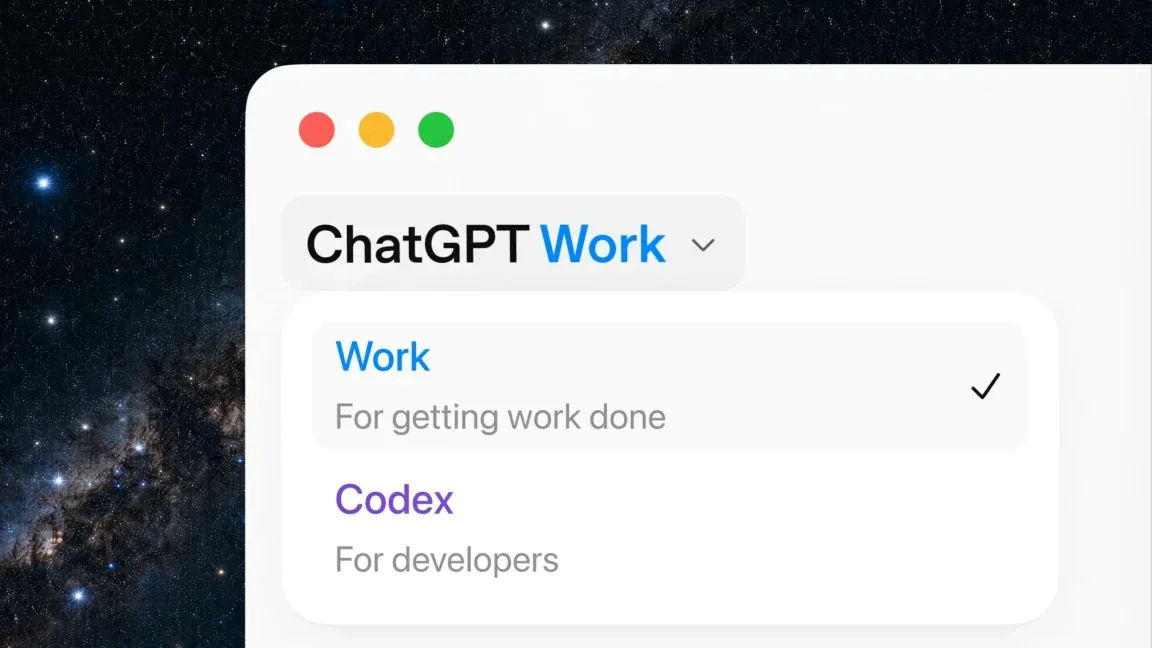
OpenAI is launching ChatGPT Work, a rebranded Codex experience, and says it can “stay with a project for hours if needed” rather than timing out like earlier agent experiments. For decision-makers, the shift changes how teams can plan automation, approvals, and risk controls for work that runs unattended.
Last year, when Ars tested OpenAI’s “Agent Mode” in the Atlas web browser, the biggest complaint was brutally simple: automated tasks tended to stop after a few minutes. That made the tool feel more like a helpful demo than a system you could trust with ongoing or complex work.
Today, OpenAI is betting it fixed that friction with ChatGPT Work, a new tool that the company describes as able to “stay with a project for hours if needed, and turn a goal into finished work.” The premise is straightforward and operational: instead of automation sputtering out, the workflow can keep going long enough to matter, and it can translate a user’s goal into something closer to output you can use.
OpenAI is also framing how it wants users to judge the product. The company says it is challenging users to evaluate ChatGPT Work by “giv[ing] it a task you already know well,” like analyzing a budget or preparing a sales meeting. That is a subtle but important design choice. If you test with a task you understand end-to-end, you can quickly spot whether the system produces real work or just pretty text. It is also a clue to how internal adoption might happen in organizations: teams can start with repeatable, well-scoped processes where “finished work” is unambiguous.
Beyond single tasks, OpenAI claims ChatGPT Work can automate entire workflows, moving through steps that usually require multiple handoffs. The example it gives goes from customer research to a campaign brief to locally tailored marketing assets. The point for operators is that workflows like these are where “agent” tools have historically struggled. They require the model to keep context, remember what step it is on, and continue producing results that match your real-world constraints, not just a single response.
There is one guardrail the company emphasizes at the same time: ChatGPT Work will wait for you to approve important actions. In practice, that turns the tool into something closer to a co-worker with a stoplight system than a fully autonomous process. For businesses thinking about risk, this is where governance lives. You can let the system do the labor of drafting, researching, and structuring, while still forcing humans into decision points that can create liability, misstate information, or trigger costs. It also sets expectations for stakeholders who might otherwise assume “hours-long” means “hands-off.”
OpenAI is pairing ChatGPT Work with Scheduled Tasks, described as a souped-up version of cron jobs. Scheduled Tasks are positioned to “take repetitive tasks off your plate” on a schedule or when a monitored event occurs. Crucially, OpenAI says these tasks can keep going when you are away from your desk and can be monitored from your phone. That changes the operational surface area. Instead of treating automation as something you run on demand, you start thinking like a systems owner, with schedules, monitoring, and escalation paths.
This matters in the broader competitive and regulatory context because “autonomous for hours” is exactly the category regulators and enterprise security teams tend to scrutinize. Even when there is no new law named in the release, the direction is clear: more capability, less supervision, and more real-world actions that can be consequential. The company’s insistence on approvals for important actions is one way to align with what compliance teams typically want, which is human control over high-stakes steps.
For executives and boards, the strategic stake is simple: automation that lasts changes both productivity math and accountability. If agents can genuinely run for hours, teams will be tempted to hand them larger chunks of work, including pre-production stages that shape downstream decisions. That shifts what you measure, too. It is not only “how fast did it respond,” but “how consistently did it run,” “how often did it wait,” “what approvals were triggered,” and “what did it produce by the time you checked.” ChatGPT Work and Scheduled Tasks are OpenAI’s attempt to make agents operational, and the winning organizations will be the ones that pair that capability with crisp workflows, clear approval points, and monitoring discipline.
This story's Key Insights and Take-aways are locked.
Create a free account to unlock Executive Actions for one credit.
Register to UnlockAlways free for Executives Club members. Join the Club
More in Technology

Google quietly links your phone number to every Android account on your SIM
Adding a SIM now ties your phone number to all Google accounts - and future accounts inherit it. Here's the security and privacy stakes.

Hijacker AI 'Skynet mode' runs 100,000 attack steps against exposed models
Symantec caught a criminal AI agent that borrows other models, steals data, and mines crypto; the only relief is no confirmed victims yet.

Nvidia's AI-financier shift faces its first big test as neoclouds stumble
A rout in neocloud stocks is forcing investors to weigh Nvidia's hidden exposure as both supplier and lender to the AI buildout.