
Chipotle CBO Fernando Machado tells Cannes Lions to “strike back” at AI hacks
His argument, plus Cannes creator momentum and tightened claims standards, is reshaping how marketers prove impact.
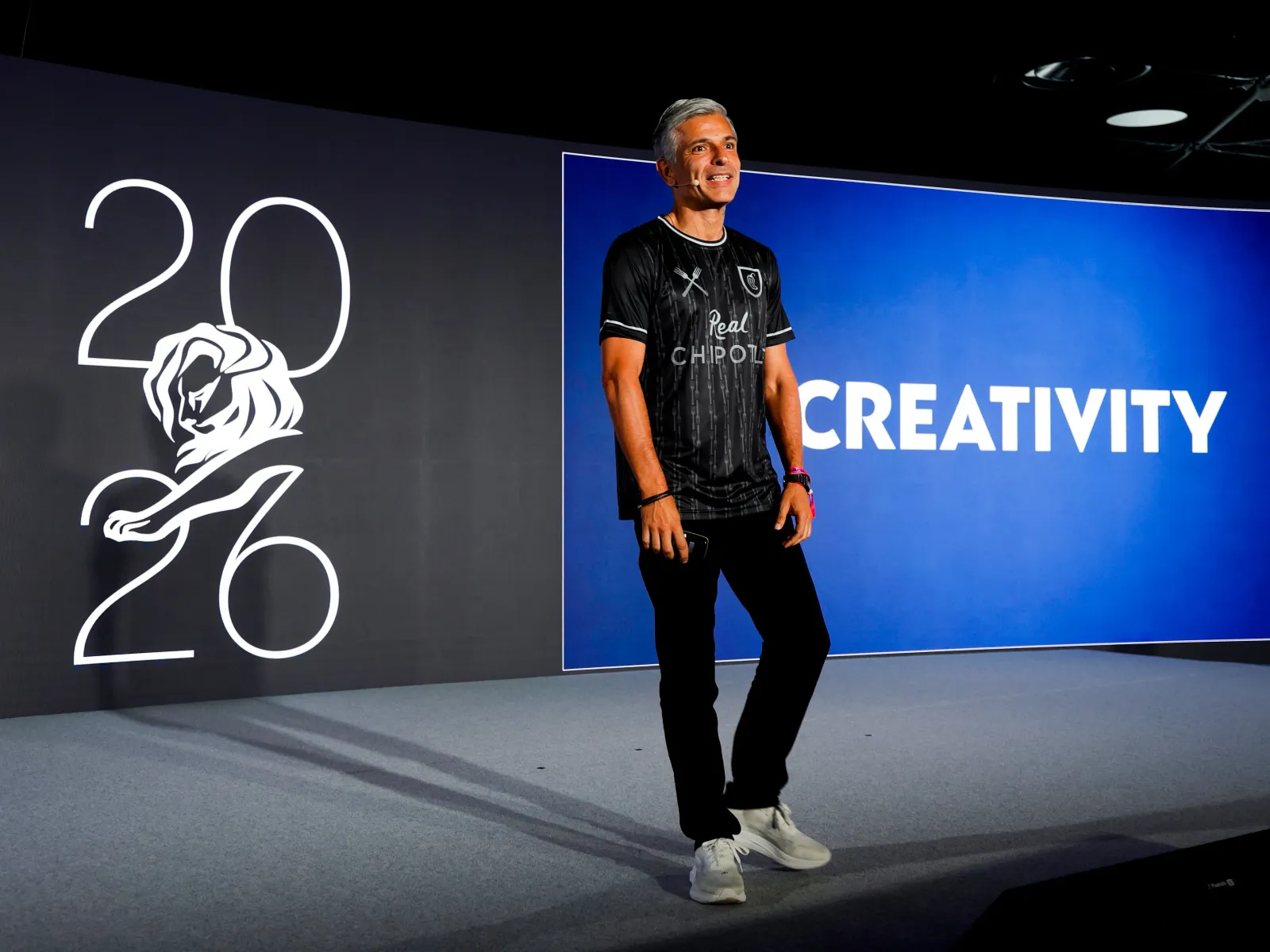
Fernando Machado, Chipotle's chief brand officer, used Cannes Lions to deliver a talk titled “Creativity Has to Strike Back,” pushing back against AI-driven shortcuts. The festival also leaned into creator-led marketing and spotlighted the need for measurable, verifiable creative effectiveness.
Fernando Machado, Chipotle's chief brand officer, didn’t show up at Cannes Lions to debate AI as a sci-fi curiosity. He delivered a talk titled “Creativity Has to Strike Back,” and made the case that the ad industry has gotten too fixated on optimization, dashboards, and AI hacks meant to speed production and cut costs.
His comparison lands because it is brutally intuitive: using AI to write a brief for an agency or to choose a creative idea is like “thinking I could play guitar well because I'm good at 'Guitar Hero.'” In other words, the output can look competent, but it is not the same as judgment, taste, and the human work that turns an idea into something people actually want.
That message arrived while Cannes conversations were still dominated by a question that did not exist last year in the same way: AI effectiveness versus last year's confident, sometimes vague prognostications. Across the festival, marketers talked more about where AI helps and where it fails. PMG CEO George Popstefanov told me he is hearing “a lot more about, 'it cannot do this,' which is great,” framing the moment as a grounding exercise after the first wave of hype. EY CMO John Rudaizky echoed a different form of caution, saying AI can create an illusion of accuracy and comprehensiveness. He is not yet sold on using AI for synthetic testing in market research.
If you lead a marketing org, this is a boardroom issue, not a creative-arts debate. Synthetic testing, market research inputs, and performance forecasting can directly affect budgets, how fast teams iterate, and what leadership signs off on. When leaders describe AI as producing confident-looking answers, the risk is not just a bad campaign. It is decision drift: organizations optimizing against the wrong signals because they think the model is being precise.
Cannes also surfaced proof that the “prove it” pressure is moving from marketing lore into hard requirements. Submissions were down 25% from last year, and Cannes Lions organizers tightened entry requirements after scrutiny around whether big claims in case studies could be verified. That matters because Cannes is not just a stage. It is where brands test narratives with peers, where agencies learn what regulators and juries will tolerate, and where leadership can point to awards as credibility. If the bar tightens, teams will spend more time on documentation, attribution, and the chain from idea to outcome.
Even the “creative effectiveness” headline demonstrates the shift toward measurable change. AXA France won the “creative effectiveness” Grand Prix Lion award for its “Three Words” campaign. The campaign showed that the insurer had changed its policies to add the words “and domestic violence” to the list of covered cases. Jane Wakely, PepsiCo's chief marketing and growth officer, told the jury that “Creative effectiveness really matters,” and that the point should be driving business impact, not winning awards. Havas added another data point to the connection-versus-production debate when it released a study at Cannes: 84% of brands suffer “indifference” from consumers, based on research spanning more than 2,400 brands and including 1,000 consumer interviews. Mark Sinnock, chief strategy officer of Havas' creative group, said “Indifference is a real issue,” and argued that creativity can create connection and desire.
Now stack creator momentum on top of that. Cannes Lions leaned into what the industry is calling the “creator takeover,” with entire tracks and spaces dedicated to influencer marketing craft. The clout is growing because marketers want new ways to reach consumers with content people actually want to watch, and because creator-led distribution changes the game. An April report from the Interactive Advertising Bureau projected US creator ad spend to reach $44 billion this year. Former ad exec and founder of MakeLoveNotPorn, Cindy Gallop, told me there is “a completely new energy coming in,” adding that creators and marketers are entering a relationship where people are making what they want to happen rather than just filling a brief.
But the creator boom is also surfacing a more transactional reality. At a “friends' dinner,” one marketing exec was reportedly sent a sharp reminder when 10 or so creators left before the €8,300 (about $9,400) check arrived. The takeaway from the attendee who helped foot some of the bill was blunt: “Influencers are not your friends.” For executives, this is a governance and contract question as much as a marketing channel question. If the creative process involves more external partners with their own agendas, leadership needs clarity on roles, deliverables, measurement, and risk.
The strongest second-order signal might be that creators are not only promoting products. The biggest names are moving into Hollywood-adjacent territory and building media companies. “Insecure” star Issa Rae’s Hoorae Media, for example, is landing deals including a podcast and the TikTok micro drama “Screen Time.” Becky Owen, CMO of Billion Dollar Boy, framed the moment as maturity: the creator economy is “a sophisticated media solution capable of building genuine cultural IP.” Meanwhile, at BI's CMO breakfast, big-time YouTuber Adam Waheed, known as Adam W, described performance as coming from understanding the partnership is two-way: it is a collaboration with pushback, and meeting in the middle is the operating model.
So for marketing leaders and boards, the through-line at Cannes is simple: the industry is renegotiating what “impact” means and how you verify it. AI might speed drafts, but the festival is telling you the hard part is still human. Creators might distribute, but the credibility still has to be earned, tracked, and defended. In a world where submissions drop 25% and entry rules tighten after unverifiable claims, the teams that win will be the ones that pair faster production with stronger evidence, and sharper creativity with proof that it moved something real.
This story's Key Insights and Take-aways are locked.
Create a free account to unlock Executive Actions for one credit.
Register to UnlockAlways free for Executives Club members. Join the Club
More in Business

A flaw in PHP just forced governments to pull their own sites offline
European agencies from Belgium to Germany took websites dark to patch a critical weakness in the language behind almost 70% of the web, and the blast radius extends far beyond government portals.
BioWare shuts down, Mass Effect 5 dead after $55B EA buyout
The legendary RPG studio's closure lands months after a $55 billion investment group buyout of EA, raising tough questions for gaming's biggest acquirers.
Musk barred from the room as Tesla, SpaceX boards weigh $3.5 trillion merger
The CEO of both companies is a 'conflicted party' watching independent directors negotiate a tie-up that would create a $3.5 trillion giant he would own about a third of.