
Chris Williams captures Earth’s orange sunrise as ISS loops 16 times in 24 hours
A June 26, 2026 photo turns station orbital mechanics into a daily reality check for space programs and investors.
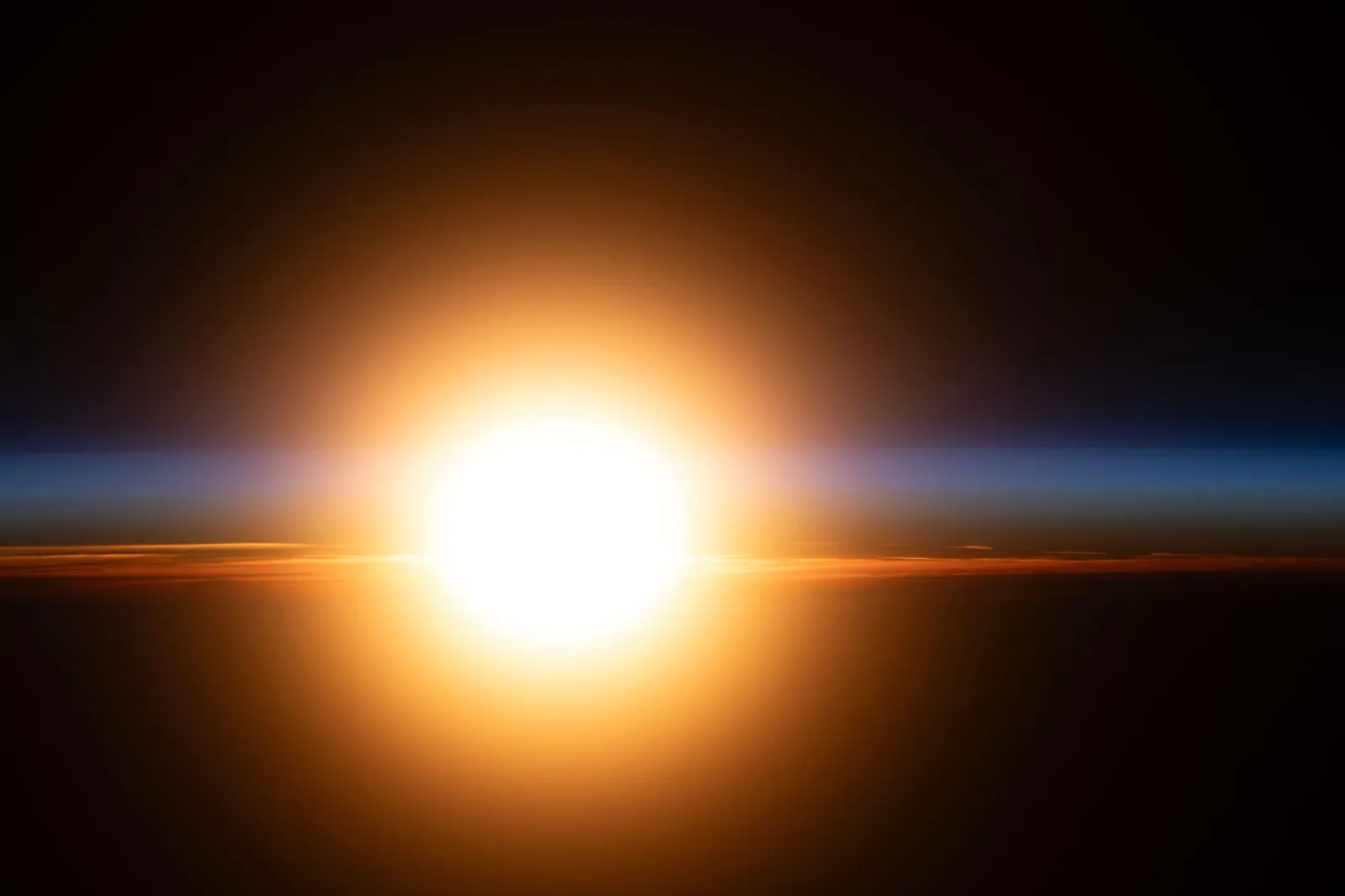
NASA astronaut Chris Williams photographed an orbital sunrise from the International Space Station on June 26, 2026. The image comes with a concrete reminder: in 24 hours, the ISS makes 16 orbits, passing through 16 sunrises and sunsets.
Chris Williams, a NASA astronaut, took the photograph that shows an orbital sunrise lighting up Earth’s atmosphere with a vivid orange sunburst. He captured it from the International Space Station as it orbited 264 miles above the Caucasus Mountains on June 26, 2026.
That “single image” detail actually carries a bigger operational truth: in 24 hours, the ISS makes 16 orbits of Earth. Each orbit brings the station through another sunrise and sunset cycle, so in one day there are 16 separate transitions of lighting, viewing geometry, and atmospheric conditions. This isn’t just pretty. It is the rhythm of how an orbiting laboratory repeatedly moves across different slices of Earth’s environment and the sky.
If you are an executive, board member, or investor watching the space ecosystem, those numbers matter because orbit is a constraint and a capability at the same time. The ISS is not a one-off launch and forget platform. It is a continuously operating system whose schedule, power demand, communications windows, and observation possibilities all ride on orbital mechanics. When the station is about 264 miles above Earth, it is far enough to see large-scale curvature and atmospheric glow, yet close enough that the day-night transitions are still frequent and dramatic. That combination is why orbital observations can support everything from Earth science to technology demos, and why “how often you pass” can be as important as “how good the resolution is.”
There is also a regulatory and governance angle, even for something as visual as an orbital sunrise. NASA’s astronaut and mission operations live inside a web of international coordination, safety requirements, and compliance norms that are baked into how the ISS is operated. The source here is straightforward: it credits NASA/Chris Williams and identifies the date. But behind that credit is the reality that space operations, especially crewed ones, require consistent procedures for commanding, monitoring, and contingency handling. Frequent passes mean frequent opportunities to support objectives, but they also mean frequent times when teams must be ready for changing conditions.
Second-order implications flow from the simple fact that the station encounters 16 sunrises and 16 sunsets every 24 hours. Lighting changes can affect how instruments interpret data, how targets are visible, and how operations teams schedule imaging and downlink priorities. Even when the mission goal is not “take a sunrise photo,” the underlying illumination and viewing geometry can still influence observational quality and timing. In practice, programs plan around those cycles because orbit is non-negotiable, and the schedule has to be engineered around physical reality.
There is a similar lesson for capital allocators and leaders in adjacent sectors. The ISS, as an orbiting laboratory, demonstrates a template for what it takes to operate in space at scale: repeated, predictable movement; continuous monitoring; and the ability to extract useful information or test technologies across a steady cadence. If you are funding or overseeing development in Earth observation, communications, or crewed systems, the headline takeaway is that performance is often measured in consistency, not just peak moments. The sunrise is the aesthetic cue. The operational cadence is the substance.
Finally, for peers making decisions in aerospace and space-adjacent businesses, this is a reminder that daily operational reality can be surprisingly quantified. “Good Morning, Earth!” is the vibe, but the business takeaway is the mechanics: on June 26, 2026, the station was 264 miles up over the Caucasus as it turned through another sunrise, and the entire platform would repeat that orbital loop 16 times in the span of a day. That repetition is what turns a platform from a mission into an infrastructure. Infrastructure is where governance, safety, engineering, and economics all start to converge.
This story's Key Insights and Take-aways are locked.
Create a free account to unlock Executive Actions for one credit.
Register to UnlockAlways free for Executives Club members. Join the Club
More in Science

Alaska's 1,580-foot tsunami had warning signs. Scientists just found them.
Rapid glacier retreat, heavy rainfall, and thousands of tiny tremors preceded Alaska's 1,580-foot tsunami, a warning for every coastal community in a warming world.

The rare mutation that lets high-risk brains dodge Alzheimer's
Scientists found a natural defense against protein buildup, opening a new path to preventive treatments.

3,000 steps a day may halve Alzheimer's decline, study finds
New research links a modest daily walk to less tau buildup and nearly half the cognitive and functional decline, even for those with early signs.