
CNN’s Todd Blanche path to AG approval isn’t a sure thing for Senate math
Democrats may already be set, and Cornyn and Tillis could decide Blanche’s fate on specific answers.
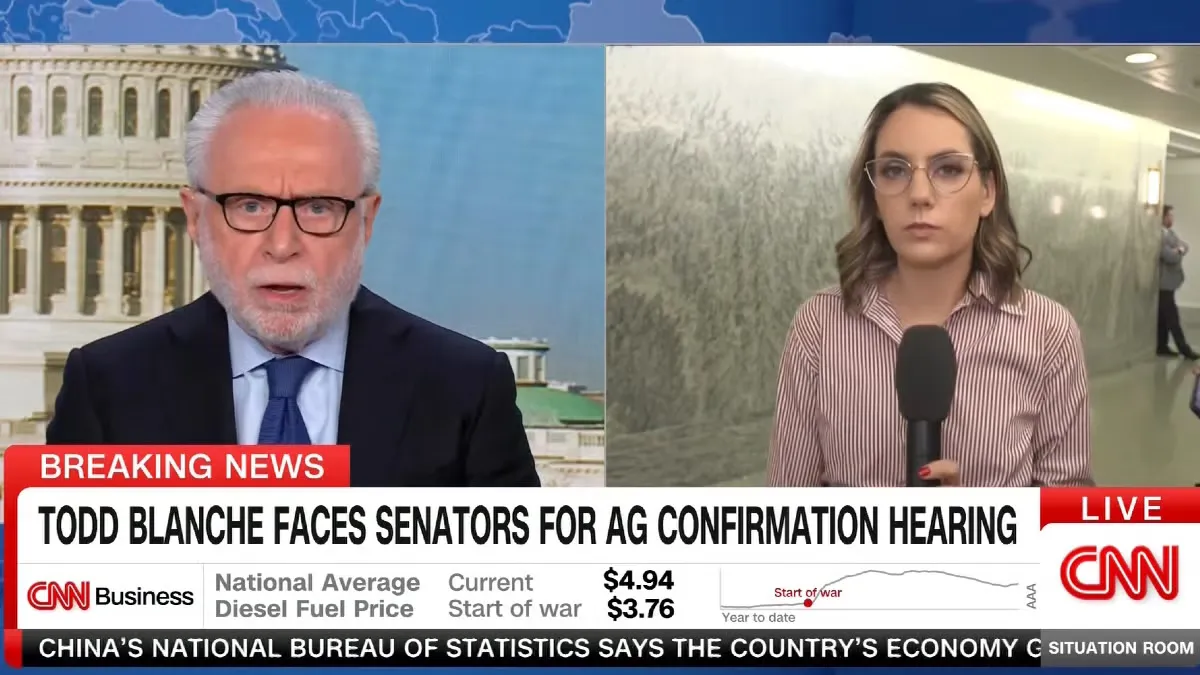
CNN correspondents reacted to Acting U.S. Attorney General Todd Blanche’s Judiciary Committee hearing, arguing his attorney general nomination is still not a sure thing. The consequence for decision-makers is simple: a handful of swing votes, plus perceived loyalty to President Trump, could determine whether he survives committee.
Acting U.S. Attorney General Todd Blanche just went through his Judiciary Committee hearing. CNN, through correspondents including Lauren Fox and Kevin Liptak, is making the case that this still is not a “sure thing” and that the real battle is Senate math, not messaging.
Fox laid out the core problem early: “This is going to be a huge math problem potentially for Todd Blanche as he seeks to get this job.” She said that based on conversations with Democrats, “Most Democrats going into that meeting... their minds were already made up.” In other words, the nomination is not being treated like a blank slate where persuasion can easily swing votes. Instead, the question becomes how many Republicans will follow party alignment, and whether any of them will break ranks.
Fox then zoomed in on two named potential decision points: Senators Thom Tillis and John Cornyn. She suggested both could end up voting against Blanche despite being Republicans. In Fox’s framing, Cornyn’s questioning is the tell. She pointed to Cornyn’s focus on President Trump’s seemingly abandoned $1.8 billion political weaponization fund, arguing that the exchange may show “where the Texas senator's concerns lie.” Fox said Cornyn “made clear that he wants assurances that this weaponization fund is completely dead,” and she added, “I'm really unclear right now whether or not those assurances were clear enough for him to warrant his support.”
The operational takeaway from Fox’s segment is blunt: committee survival requires keeping the wrong doors from closing. She said, “Blanche cannot lose Sen. Cornyn or Sen. Tillis on this committee in order to get through this committee.” That creates a narrow margin for error, because even one unexpected “no” from either senator could derail the path forward. Fox’s conclusion followed the same logic: “There's still a lot of work to do. This is not a nomination that, at this point, is a sure thing.” For anyone watching congressional confirmations like a governance risk, the headline here is that uncertainty is still the base case, not a residual possibility.
CNN Senior White House reporter Kevin Liptak echoed that frame and added an incentive angle that matters inside political institutions: the Trump administration is paying close attention to Cornyn and Tillis because both are described as being “currently on deck to lose their senate seats in this year's fall midterms.” Liptak’s point was that, unlike some other Republicans, Cornyn and Tillis “don't have this loyalty obligation to President Trump that some of these other Republicans have.” In plain English, this is about insulation and vulnerability. When election risk is high and loyalty to the president is not enforced by personal or party dynamics, senators can feel more freedom to vote according to their own political calculus.
Liptak also highlighted a specific moment from Wednesday’s hearing that CNN watchers expect to be replayed. He described Louisiana Sen. John N. Kennedy asking whether Blanche was “President Trump's friend.” Liptak said Blanche “seemed to have a slip up” by answering, “I am President Trump's lawyer,” before correcting himself to say, “I was President Trump's lawyer.” Liptak argued that this exchange will be used “as evidence of just how close Todd Blanche is to President Trump,” especially “at a moment when I think he's trying to show senators that he isn't necessarily a Yes Man for everything that the president is doing.”
That is where the story widens beyond one hearing. Confirmations are usually treated like a credentials check, but they are also credibility tests under spotlight. If senators believe the nominee is too tightly tethered to the president, they may interpret that as reduced independence for a role that requires judgment under pressure. If senators believe the nominee cannot clearly close off a controversy, they may see risk in a future as attorney general, when the job includes handling politically sensitive cases. In this case, Fox’s emphasis on assurances about a “completely dead” $1.8 billion political weaponization fund ties the nomination directly to a perceived accountability issue, not just to general competence.
For executives, investors, and founders, the second-order impact is practical: legal and enforcement leadership influences how uncertainty gets priced across sectors. When the attorney general slot is contested, stakeholders across industries tend to hedge against changing enforcement posture, shifting priorities, and unpredictable timelines. Even if no new law is passed from a hearing alone, the confirmation process can reshape the near-term governance environment. CNN’s “not a sure thing” framing is therefore more than political theater. It signals that the committee vote, and the broader Senate trajectory, could hinge on a small number of senators making a high-stakes call about both the facts on the record and the trust behind the answers.
This story's Key Insights and Take-aways are locked.
Create a free account to unlock Executive Actions for one credit.
Register to UnlockAlways free for Executives Club members. Join the Club
More in Politics

LA County: DOJ's 20,000 'noncitizen' voter list is 'unreliable,' includes U.S.-born
Preliminary review by Los Angeles County election officials finds errors in the federal list, raising the stakes for voter roll integrity ahead of November.

Trump's $1.5B Pentagon chip investment lands in North Carolina
A $1.5 billion defense infusion for North Carolina chipmaking signals a new era of Pentagon-backed reshoring - here's what it means for the industry.

Nigeria confirms first Ebola case in Abuja, a woman just off a Uganda flight
Health Minister Muhammad Ali Pate says the patient flew in from Uganda, putting Africa's latest outbreak on Nigeria's doorstep.