

Colobus congoensis is new to science, but its “1200 km” closest cousin shifts evolution math
The Congo’s orange-lipped, roar-and-snort monkey is described in PLOS One, and its DNA redraws African primate timelines.
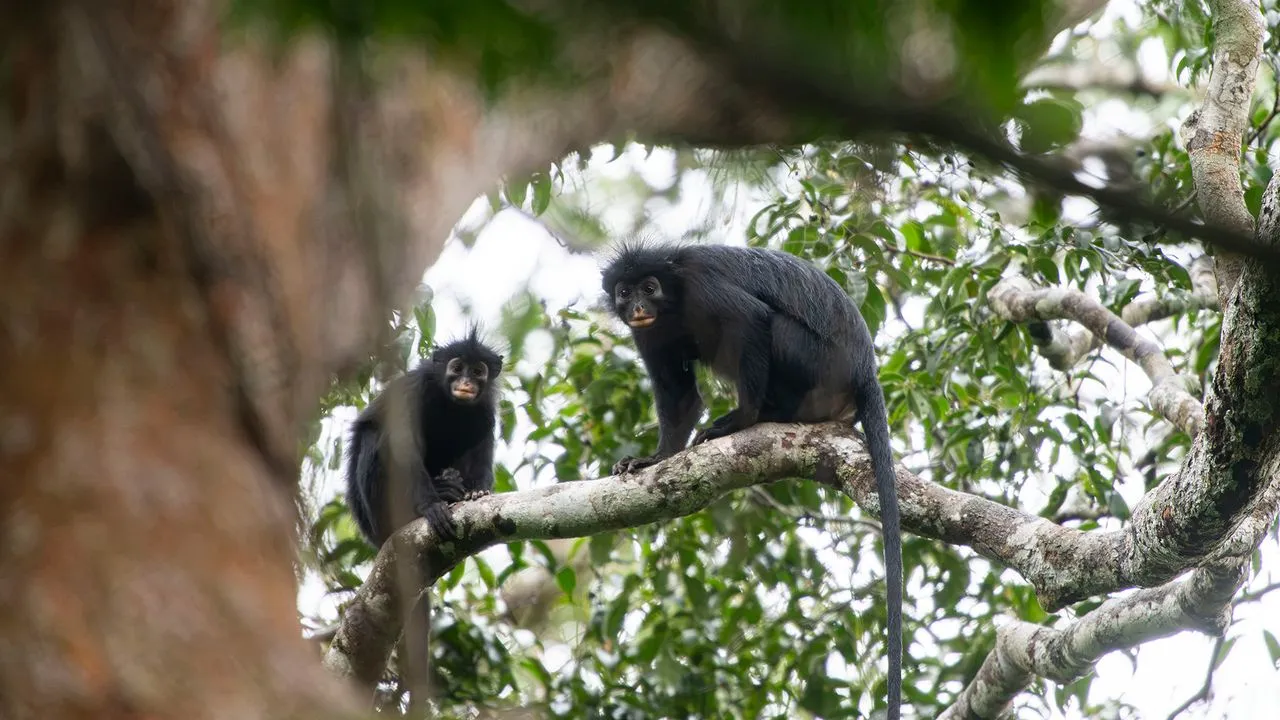
Researchers described Colobus congoensis, the “likweli” monkey from Lomami National Park in the Democratic Republic of the Congo, in PLOS One on July 15. Its DNA analysis shows an unusually distant closest living relative, forcing a rethink of African monkey evolution.
Deep in the Congo rainforest, scientists have named a new monkey species to science: Colobus congoensis, also known locally as “likweli” in Kilanga and “kasaba nkoni” in some Mituku communities. It is glossy black with a conspicuous orange patch around the mouth and nose, bare gray skin that looks like a mask on the cheekbones, and a white fur patch around the anus. It also makes deep, loud roars punctuated by distinctive snorts, and those vocalizations help distinguish it from other colobus monkeys.
Here is the part that matters beyond wildlife trivia. DNA analysis confirmed Colobus congoensis is previously unknown to science, and the researchers found its closest living relatives are black colobus monkeys (Colobus satanas) living about 750 miles (1,200 km) away in Cameroon, Gabon, and Bioko Island. Study co-author Kate Detwiler estimates those lineages diverged between 5.78 million and 3.44 million years ago, calling it the longest known split between species within the Colobus genus. Translation for busy decision-makers: this one “new species” discovery is also a new constraint on how primate evolution played out across African forests.
The story starts with the hard reality of fieldwork. In 2008, conservationists in Lomami National Park, within the Congo Basin in the DRC, photographed an unidentified monkey, but it was partially obscured. Then in 2018, a similar-looking animal was captured on camera, prompting study co-author Junior Amboko, a Lomami National Park researcher and a Florida Atlantic University anthropologist, to track down the mystery. To understand what local people might already know, Amboko and colleagues showed pictures to residents from 52 villages around the park. People in only eight villages recognized the monkey, and the recognizers were hunters, who know the economic value of animals or how much food each animal can provide, even if they did not know much scientifically.
The researchers’ survey window, between 2018 and 2022, generated 114 sightings across an estimated natural range of about 660 square miles (1,700 square kilometers), isolated between the Lomami and Lualaba rivers. The monkeys were observed in groups ranging from one to 20 individuals. This is not a “they found one and called it a day” situation. For executives and investors who track credible discovery cycles, this is a classic pattern: earlier clues, repeated confirmation, and a local knowledge loop that narrows where to search. And it comes with a warning label, too. In the Congo Basin, habitat loss and a small geographic range can turn biological rarity into conservation urgency faster than institutions can respond.
To validate that it truly was a distinct species, the team combined field evidence with genetics. They took samples and sequenced DNA from monkeys killed by hunters and destined for the illegal bushmeat trade, then compared results with what is available in museum collections and genetic datasets, plus information for other colobus monkeys across genetics, skulls, teeth, and pelts. Detwiler said her lab was “shocked” by how divergent the key area of the mitochondrial genome was from other colobus monkeys. Based on the analysis, researchers think Colobus congoensis diverged up to 5.78 million years ago.
Even before you get to the conservation recommendation, there is a second-order implication: geographic separation can erase evolutionary signals until someone looks closely enough. The monkeys live in the same forest as the Angola colobus (Colobus angolensis), but the closest living relatives are black colobus monkeys located roughly 1,200 km away in West Africa. In other words, the “nearest neighbor” in evolution is not necessarily the one that shares the same immediate ecosystem. Linder, an anthropologist and president and co-founder of the nonprofit The Forest Collective, who was not involved in the study, called the discovery remarkable because it is not very common these days to find a new, never-before-documented primate species, let alone a relatively large monkey species.
The policy and market-adjacent stakes show up in the recommendation that C. congoensis be classified as endangered on the IUCN Red List, given the small geographic range, rare sightings, and increasing habitat loss. For boards and leadership teams, the lesson is not “support primatology.” It is how quickly ecosystems can reach a tipping point when legal protection and surveillance lag behind biological reality, especially when threats involve illegal bushmeat trade. The discovery also spotlights Lomami National Park itself. Another previously undescribed monkey, the lesula (Cercopithecus lomamiensis), was reported in 2012 by a team that included Detwiler, which reinforces the park’s value as a discovery engine for biodiversity.
Finally, the bigger “why now” context. The Congolian rainforest across this part of Africa is the world’s second-largest tropical forest after the Amazon, and about 60% of it is in the DRC. Amboko describes it as a “paradise for biodiversity,” and adds there might be more undescribed primate species there. If researchers can document two big new primate species from one region, the implication for anyone funding conservation, building sustainability commitments, or underwriting nature-risk strategies is straightforward: the unknown is large, and it is getting smaller as land use pressures increase.
Colobus congoensis is officially described in PLOS One on July 15. But the real disruption is how its DNA and behavior (those orange-lipped roars and snorts) force a recalibration of African monkey evolution timelines and geographic relationships. In conservation, biology rarely offers second chances. This one arrives with names, measurements, and a genetic case strong enough to change how we map the past, while warning how fragile the present can be.
This story's Key Insights and Take-aways are locked.
Create a free account to unlock Executive Actions for one credit.
Register to UnlockAlways free for Executives Club members. Join the Club
More in Science

Alaska's 1,580-foot tsunami had warning signs. Scientists just found them.
Rapid glacier retreat, heavy rainfall, and thousands of tiny tremors preceded Alaska's 1,580-foot tsunami, a warning for every coastal community in a warming world.

The rare mutation that lets high-risk brains dodge Alzheimer's
Scientists found a natural defense against protein buildup, opening a new path to preventive treatments.

3,000 steps a day may halve Alzheimer's decline, study finds
New research links a modest daily walk to less tau buildup and nearly half the cognitive and functional decline, even for those with early signs.