

Colombia’s de la Espriella turns a yellow soccer jersey into a campaign uniform, judge banned it
A Bogotá judge barred Abelardo de la Espriella from wearing Colombia’s national team shirt before June 21, but it arguably boosted his populist brand.
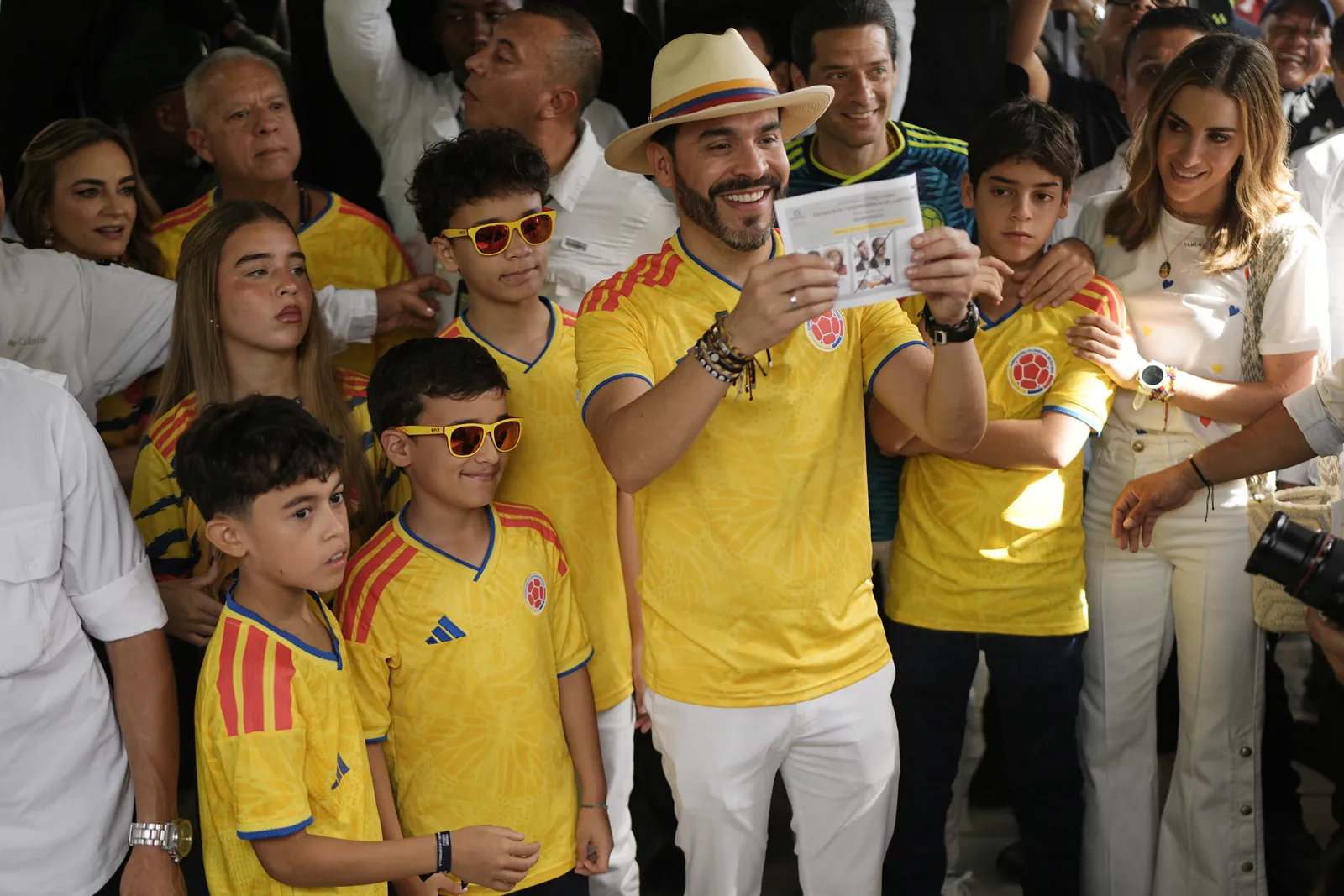
Abelardo de la Espriella, a MAGA-friendly right-wing presidential candidate in Colombia, made Colombia’s national soccer jersey a defining feature of his campaign. A Bogotá judge banned him from wearing the jersey while campaigning before the June 21 vote, after supporters rallied behind his law-and-order message.
Colombia’s right-wing presidential campaign just spent more time arguing about a soccer shirt than about most policy proposals. Abelardo de la Espriella, described in the reporting as MAGA-friendly, made Colombia’s national soccer jersey a defining feature of his victorious bid. And then a Bogotá judge stepped in, banning him from wearing the jersey while campaigning before the June 21 vote.
That ban did not shut the symbol down. Politico reports that POLITICO spoke with two experts after hearing fans in Miami on Saturday night vociferously in support of de la Espriella and his unflinching law-and-order policies. The experts argue the episode fits a broader playbook: populist movements use patriotic imagery and sports symbols to blur the line between backing a nation and backing a political project. Eduardo Gamarra, professor of politics and international relations at Florida International University, put it bluntly: “In my view, he was very deliberately politicizing the national team’s shirt.” He adds that the Colombian jersey is one of the few symbols that can claim to belong to all Colombians across region, class, and ideology. That, he says, is exactly why a populist campaign finds it attractive.
Why does a jersey matter in a presidential race? In most democracies, symbols are a shortcut to emotional trust. A national team shirt already carries decades of shared excitement, especially around major tournaments like the World Cup. So if a candidate can pull that emotion into their own branding, the symbol stops being a neutral backdrop and starts functioning like a loyalty badge. Gamarra’s argument is that de la Espriella transformed “the emotion around the national team into a signal of political belonging.” In other words, the jersey becomes less about football and more about identity alignment.
This is not presented as a one-off Colombian oddity. Gamarra explicitly compares the pattern internationally. He points to the United States, saying that MAGA politics turned the American flag and other patriotic symbols into markers of partisan identity. He also cites Venezuela, saying that Chavismo understood the power of national colors, patriotic imagery, and sporting symbols such as the Vinotinto. The common mechanism across cases is the same: if a political movement can claim the symbols that people already associate with the nation, it can frame dissenters as outsiders. That makes the campaign narrative harder to contest without sounding like you are questioning “the country itself,” not just the candidate.
But Gamarra says the more surprising part is not that de la Espriella tried to politicize the shirt or even that it worked. The surprise, he argues, is how ineffective opposition groups were in defending the jersey as a shared national symbol. He says they “allowed a symbol that should belong to the whole country to be claimed by one political camp.” That detail matters for executives and board members who think they are not in the business of politics, because it is a reminder that ownership of narratives can become a governance issue. Once a symbol is treated as partisan, neutral stakeholders, customers, and employees may be forced to pick a side. And when that happens, reputational risk can spread beyond the headline.
Julian Gerez, assistant professor of criminology, law and society and political science at the University of California, Irvine, adds another layer: he argues the strategy worked for reasons that go beyond nationalism. According to Gerez, de la Espriella used the national team’s shirt, traditionally a symbol of unity and celebration, to associate his campaign with strong patriotism. Then Gerez shifts to brand design. He says de la Espriella is a multimillionaire lawyer, yet his image depends on appearing as “a man of the people.” Wearing a suit jacket would be the obvious mismatch. The jersey and hat, he argues, are tools that help portray the desired identity.
There is also an unintended feedback loop. Gerez says the leftist candidate Ivan Cepeda’s campaign, ironically, made the tactic more effective by coming out against the shirt’s use. He explains that criticism increased awareness of the jersey as linked to de la Espriella’s campaign, which led to “stronger defiance among his supporters in wearing the jersey.” This is a classic second-order effect: attempts to suppress a symbol can amplify it, especially if supporters interpret suppression as proof of influence or threat. Executives who deal with regulation, communications, or brand governance will recognize the logic. Messaging battles are rarely zero-sum on their face; they often reallocate attention to the very thing you tried to limit.
So what does this mean for decision-makers who do not spend their days tracking election theatrics? First, national symbols can behave like assets with contested ownership, and the legal system may intervene, but legal intervention does not automatically reverse public meaning. Second, opposition responses can unintentionally strengthen the association they try to break. Third, the line between “support for the nation” and “support for a political project” is not purely ideological anymore; it can be engineered through high-visibility cultural objects like sports uniforms. In an era where political brand equity can be built with cultural shorthand, de la Espriella’s jersey is a reminder that governance, reputational strategy, and public trust are always one headline away from becoming identity management.
This story's Key Insights and Take-aways are locked.
Create a free account to unlock Executive Actions for one credit.
Register to UnlockAlways free for Executives Club members. Join the Club
More in Politics

Glacial collapse, not rain, killed 180 in Nepal's Himalayan flood
The Himalaya's extreme geography hid the true cause of Nepal's catastrophic flood, a glacial collapse that turned a geological battleground into a mass-casualty zone.

Iran’s Esmail Baghaei says Oman talks start shipping via Hormuz, not US talks yet
Temporary route plans with Oman aim to restart commerce while Tehran says Washington dialogue is not on the table.

Standards watchdog opens probe into Reform UK deputy leader Richard Tice over interests
The parliamentary standards commissioner says it began an investigation on 28 July into a possible undeclared interest.