

Critical Role’s Vox Machina planned “De Rolo’s Eleven” like Ocean’s, then let it implode
A heist plot built for precision gets weaponized by family drama, forcing improv and exposing what changed in a year apart.
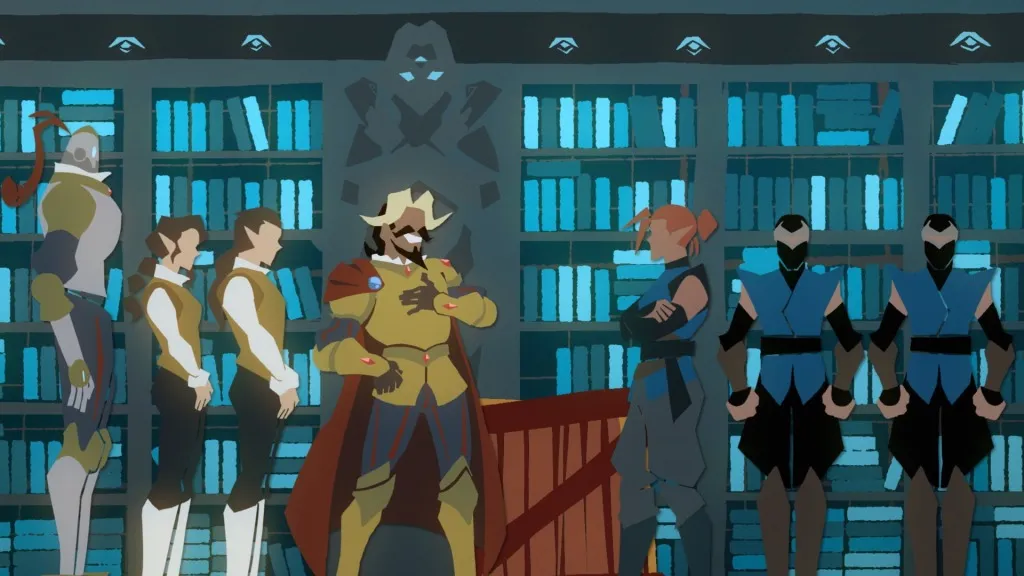
Critical Role, via Prime Video series The Legend of Vox Machina, uses the fourth season episode “De Rolo’s Eleven” to stage a Steven Soderbergh’s Ocean’s Eleven-style heist. For decision-makers in creative and streaming businesses, it’s a case study in why structured set pieces plus human disconnection outperform “perfect plans.”
In the second three-episode drop of season four, Critical Role’s The Legend of Vox Machina drops “De Rolo’s Eleven,” a nonstop, Ocean’s Eleven-style riff that starts with a plan and ends with “of course it goes to shit.” The episode follows Vox Machina as they try to steal a scroll from the Cobalt Soul, the hyper-devoted monks who are “dang near impossible” to outsmart. The scroll, in theory, contains intel on the Whispered One, an entity so feared that no other information about him exists anywhere else in Exandria. The high concept is basically: can a team of lovable, slightly out-of-sync oafs pull off a precision crime against a knowledge order built to catch precisely that kind of nonsense?
It also happens to be written by Liam O’Brien and fellow executive producer and star Marisha Ray, and it is executed like a heist that knows it is being watched. Percy (Taliesin Jaffe) plays his Danny Ocean analog role with pure enthusiasm, delivering the “heist speech” he says he wanted to give his entire life. Meanwhile, Pike (Ashley Johnson) brings Die Hard energy to the proceedings. Titmouse expands the episode’s visual toolbox with brand new animation styles, including a retro illustration sequence for the plan that Jaffe describes as going all out for “’60s pop.” The result is a joke machine with a heartbeat: silly, intricate, and warm, but also structured enough that every screw-up actually lands.
The episode’s engine is a very particular kind of writing discipline. O’Brien explains the team’s priorities as first making heist thrills feel right, then treating the plan like a Rube Goldberg machine, where each piece affects the next. That matters because “great heist movies” typically have two tracks: the clean blueprint and the inevitable moment when reality breaks the blueprint. Here, “De Rolo’s Eleven” leans into both. It builds the excitement around the plan’s components, then uses the plan’s failure as the delivery system for improvisation that still gets the characters to the end. In other words, it does not just depict chaos. It choreographs chaos.
And the chaos has a very specific business-like target: after a year apart, Vox Machina is reuniting, but it is not operating like a single organism. Vex (Laura Bailey) and Vax (Liam O’Brien) are the most visible fracture. Their relationship, emotionally loaded and structurally central, creates the hardest disconnect, but the splinters run in multiple directions. The series has already shown that season four must bridge the gap created when the team previously went their own ways after defeating the Chroma Conclave, and then the group returned through Keyleth’s ceremony in last week’s “The Coronation.” What “De Rolo’s Eleven” adds is the proof that reconnection takes time, effort, and minor disasters. A heist is the perfect format for that, because a heist turns interpersonal mismatch into a plot mechanic.
The show makes that mismatch literal through Grog (Travis Willingham), the barbarian who is “not exactly known for his brains.” The plan requires comprehension of the scroll’s ancient text, so a potion intended for Pike gets the wrong recipient due to a “slight mix-up.” Grog suddenly gains the alternate personality Bailey gleefully refers to as “Smart Grog,” sparking a comedy of errors that is funny on the surface and revealing underneath. If you are thinking about this like an operator, the second-order effect is clear: the heist plot gives the writers a way to test competence under stress. It also gives the characters a way to stop pretending they are fully in sync when they are not.
Then the episode flips the tone without losing its grip. Snuck between laughs are two earnest admissions from the twins, suddenly thrust together again with the “talisman of truth” that is the scroll. Vex reveals she and Percy secretly married in their year apart from Vox Machina, inviting none other than her brother. Immediately after, Vax lets slip that he thinks he’s dying from the Matron’s blight, then has a quick realization about what he really means, but not before the concern lands. It is described as the first time half-elf rogue Vax acknowledges the concern, having otherwise been focused on supporting Keyleth on the final trial of her Aramenté. For a story, this is the emotional payoff of the heist framework. For an industry, it is also the proof that high-concept comedy can carry real character information when the episode is built with that purpose in mind.
In executives’ terms, the interesting part is not just that a fantasy show can do an Ocean’s-like caper. It is that “De Rolo’s Eleven” treats structure and improvisation as a competitive advantage. The Cobalt Soul setting provides a “regulatory body” vibe without needing real-world analogies. They are trained, hyper-devoted monks, literally built to make intelligence theft hard. So Vox Machina’s creative team has to make the attempt both entertaining and plausible within the show’s world logic: the plan has to be clever enough to deserve failure against an institution, but the characters have to be messy enough that the failure tells you something. The episode’s ending point is also clearly set: threats to Exandria are not getting smaller, and Vax’s blight seems to only grow. That turns the heist episode from a reset into an escalation.
If you are a founder, investor, or operator watching streaming and scripted entertainment, the lesson is portable. Audiences keep coming back when the show is doing two things at once: executing craft at a high level and using that craft to metabolize change in the characters, not just deliver plot. “De Rolo’s Eleven” works because it commits to the heist genre mechanics, then weaponizes the human stuff they cannot control. It is the kind of reunion that does not smooth over the rough edges. It makes the rough edges part of the ride.
This story's Key Insights and Take-aways are locked.
Create a free account to unlock Executive Actions for one credit.
Register to UnlockAlways free for Executives Club members. Join the Club
More in Entertainment

Entertainer Russell Brand denies 7 sex charges amid accuser's 'couldn't breathe' claim
The alleged victim's account sharpens the reputational and legal stakes for Brand, his platforms, and any business tied to a public figure under criminal scrutiny.

Russell Brand's accuser 'bewildered and confused' as he denies 7 sex charges
The criminal case against the comedian is a live test of how media companies manage talent risk when serious allegations go public.

'It's a Magic Trick': Ballet Experts Say Rosalía's SNL Pose Is Impossible
Three ballet experts tell Rolling Stone Rosalía's gravity-defying SNL stillness shouldn't be possible - and why the debate is now part of the show.