

Dark matter’s extra attraction makes it heavier at first, then effectively lighter
A hidden force can cluster dark matter while simultaneously weakening its gravity as the Universe expands, reshaping cosmic timelines.
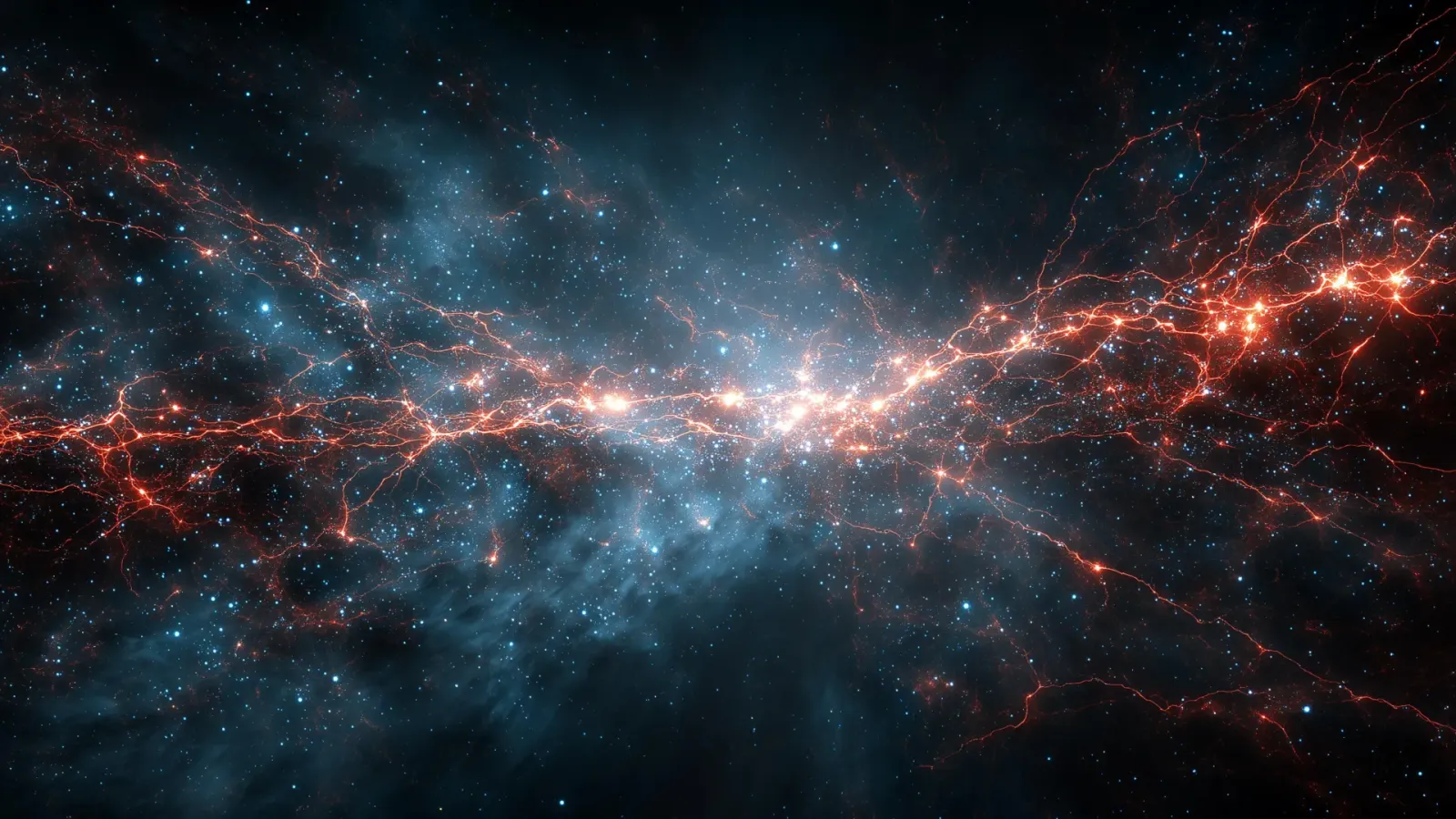
Dark matter particles may exert a hidden force on one another, adding attraction that helps them cluster. But the same effect makes dark matter effectively lighter as the Universe expands, which usually slows the growth of cosmic structure.
Dark matter may have a secret force that tugs on itself, and the consequence is even weirder than scientists expected. The extra attraction helps dark matter particles cluster together, encouraging clumps to form. But there is a second effect hiding in plain sight: as the Universe expands, that self-attraction can make dark matter effectively lighter, which weakens its gravitational influence.
That combination matters because gravity is the engine of structure formation. If dark matter loses effective gravitational pull as expansion proceeds, it typically slows the growth of cosmic structure rather than accelerating it. In other words, the same underlying behavior that initially looks like it should “build more stuff faster” can, over time, do the opposite.
Let’s translate what this means in plain English. Think of dark matter as the scaffolding the Universe uses to gather gas, galaxies, and larger cosmic patterns. If dark matter attracts itself more strongly than previously assumed, you might expect an efficiency boost: particles fall into the same regions, and those regions grow denser. That early clustering is the “attraction helps” part. It is intuitive, and it is the part researchers would naturally highlight first because it feels like a straight shot toward faster structure growth.
But the story turns on the next step: how dark matter behaves as the Universe stretches. The research summarized by ScienceDaily points to a scenario where the hidden force not only changes how dark matter clumps, but also changes how heavy it effectively is in an expanding cosmos. “Effectively lighter” is not just a metaphor. In cosmological modeling, effective mass connects to how strongly dark matter contributes to gravity across time. If the Universe expansion makes dark matter lighter in this effective sense, the gravitational pull that organizes matter becomes weaker.
So the net result is usually slower structure growth. That is the counterintuitive punchline. Extra attraction does two things at once. It encourages clustering locally. At the same time, it reduces dark matter’s gravitational impact globally as expansion proceeds. The global effect tends to dominate for structure formation over cosmic timescales, which is why the expectation flips from “accelerate” to “usually slows.”
Why should decision-makers outside cosmology care about a hidden self-interaction in dark matter? Because this is a reminder that models and assumptions can have non-obvious second-order effects. In tech, markets, or regulation, the first-order effect is the one everyone can see. The second-order effect is where timelines get rewritten. This ScienceDaily summary is basically a cosmic version of that lesson: an attractive interaction produces clustering, but the effective change in mass modifies gravitational strength in a way that can reverse the outcome scientists expect.
There is also an investment and governance angle, even if the arena is not Wall Street. Public funding for fundamental physics, how research programs are prioritized, and what kinds of theoretical models get attention all depend on whether a proposed mechanism points toward sharper predictions. If adding a “secret force” does not accelerate structure growth, then it narrows what kinds of signatures researchers should chase and how they interpret observational data. That affects what experiments target, how data is analyzed, and how uncertainty is communicated.
For boards and leaders in research institutions, the strategic takeaway is similar: demand clarity on the whole causal chain. If a mechanism has both a stabilizing and a destabilizing channel, the headline “it clusters more” is not enough. You have to ask, what happens as the system evolves? In this case, the system is the expanding Universe, and the evolution turns extra attraction into reduced effective gravitational impact. That distinction is the difference between a theory that suggests earlier structure formation and one that implies the opposite.
Bottom line: dark matter particles might attract each other through a hidden force, which helps clustering, but it also makes dark matter effectively lighter as the Universe expands, weakening gravity. In the usual outcome described here, that means cosmic structure grows more slowly rather than faster. The Universe is not just building; it is also, in this scenario, quietly changing the rules of the building material.
This story's Key Insights and Take-aways are locked.
Create a free account to unlock Executive Actions for one credit.
Register to UnlockAlways free for Executives Club members. Join the Club
More in Science

Alaska's 1,580-foot tsunami had warning signs. Scientists just found them.
Rapid glacier retreat, heavy rainfall, and thousands of tiny tremors preceded Alaska's 1,580-foot tsunami, a warning for every coastal community in a warming world.

The rare mutation that lets high-risk brains dodge Alzheimer's
Scientists found a natural defense against protein buildup, opening a new path to preventive treatments.

3,000 steps a day may halve Alzheimer's decline, study finds
New research links a modest daily walk to less tau buildup and nearly half the cognitive and functional decline, even for those with early signs.