
DARPA wants greeting-card chips to rewrite themselves, without host tools or cross-compilers
A DARPA RFI lays out a resource paradox fix for battlefield computing: tiny, cheap, self-modifying systems that can self-program on-device.
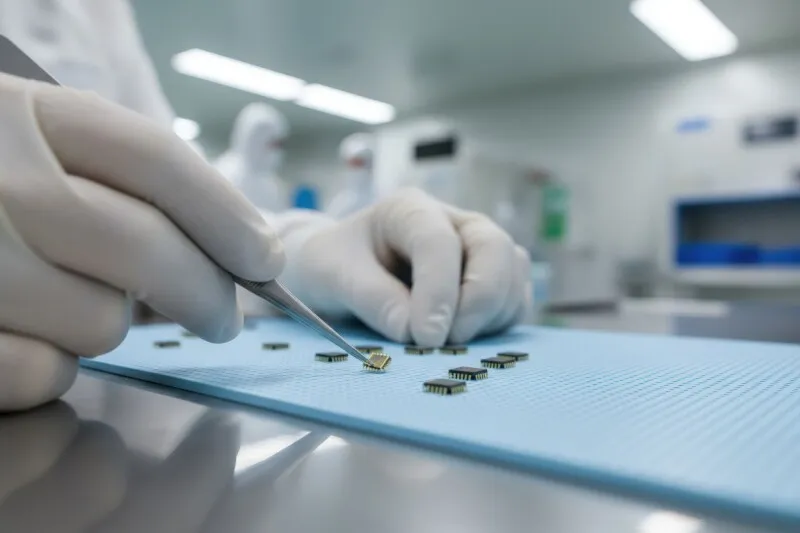
DARPA has issued an RFI for new low-resource computing paradigms inspired by musical greeting cards and the 80th anniversary of ENIAC. The agency is targeting microscale, low-power, low-memory systems that can autonomously self-program and self-modify entirely on-device, without relying on external cross-compilation toolchains or host machines.
DARPA has a new RFI out that reads like science fiction if you only picture computers as big, power-hungry boxes. But the core idea is painfully pragmatic: the agency is asking for “low-resource computing (LRC) paradigms and processes” designed for microscale devices that look more like the tiny chip-and-battery combos inside greeting cards and children’s books than like a server farm. The inspiration is explicit. DARPA points to musical greeting cards that play jingles and to the 80th anniversary of ENIAC (Electronic Numerical Integrator and Computer) as it frames its problem.
The problem DARPA calls out is a “resource paradox” at the low end of computing. The RFI says the physical and financial cost of computation has plummeted so far that it is “routinely embedded in disposable novelties.” In plain English, you can buy or build chips cheaply enough that you can hide computing in cheap objects. Yet those objects still do not become broadly useful computing platforms. Why? DARPA says the computation itself has become “virtually free,” while the physical resources required to sustain, house, and power it have become the critical bottleneck. That framing is the hook for decision-makers: the bottleneck is no longer algorithmic cost or even chip cost. It is power, memory, reliability, and the engineering needed to make something work in hostile real-world conditions.
So DARPA is not trying to miniaturize a datacenter. It is looking for concepts that handle constraints like operating with little power and memory, tolerating unreliable components, and requiring little technological sophistication. The RFI also gets very specific about how the systems should be built. DARPA says it wants systems that can be made using low-precision manufacturing techniques, legacy fabrication processes, and/or what it calls “primitive technological ecosystems.” Translation: it wants approaches that can survive when manufacturing is messy and the environment is not optimized for cutting-edge hardware.
That leads to a second major theme: logistics and operating conditions. DARPA says responses need to address at least one of those core constraint areas, and ideally also one (though optional) of the agency’s logistical predicaments. The RFI describes constraints common to where the US military typically operates, including low-trust environments where data sources and system components may not be trustworthy. It also flags privilege risk, specifically operating with the minimum necessary privileges to avoid root access concerns. There is a human-factors angle too: user experiences should be simple enough for an average grunt to understand. This is battlefield computing, which means it is not enough for the system to be clever. It has to be usable under stress.
But the biggest technical ask is the self-hosting, autonomy portion. DARPA says it is seeking cheap, tiny, and reliable devices that are still “capable of native, user-directed, autonomous self-programming and self-modification without reliance on external cross-compilation toolchains or host machines.” It further requests architectures that let the system “adapt, recompile, or generate its own operational code entirely on device.” This is not DARPA asking for soldiers to run websites or configure services on laptops in the field. The RFI is explicit that it is about autonomous systems.
If you are an executive or board member, the non-obvious takeaway is how this shifts the value chain. In conventional development, teams write code in a comfortable environment, compile it elsewhere, then deploy binaries to devices. DARPA is basically asking whether the device can close the loop itself. The second-order effect is that future contracts, procurement thinking, and risk models could start to treat software update and security as an on-device capability, not only a lifecycle management problem. That has implications for governance as well: if a device can generate operational code on-device, you will care a lot about how policies are expressed, how changes are constrained, and how the system behaves when inputs or components are compromised. The RFI’s mention of low-trust environments and minimum privileges is a strong signal that DARPA understands security cannot be bolted on later.
There is also a market context angle hiding in the greeting-card metaphor. DARPA notes that greeting cards that play music have chips whose processing speed and memory capacity vastly exceed those of ENIAC. That comparison is not just trivia. It is a reminder that the capability is already there at a tiny scale, but turning it into reliably useful, autonomous computing is the hard part. If DARPA’s program works, the battlefield version of “tiny, cheap computing” could bleed into broader civilian and enterprise device categories where power and memory are limited and update logistics are painful. Think edge devices, industrial sensors, and any system where sending code back and forth through a pipeline is expensive or fragile. The RFI ends with a hint of how wild the outcome could be, suggesting that someday even an average electronic greeting card might “host a mini AI” if the program proves successful.
For peers in tech, defense, and robotics, the strategic stake is straightforward: DARPA is trying to turn a “resource paradox” into an engineering advantage by focusing on microscale self-programming without host tooling. Even if this does not produce production-ready systems immediately, it can reshape what “feasible” looks like for autonomy at the edge. The companies and investors watching now are not just betting on better chips. They are betting on a new architecture of computation where the device carries the intelligence and the means to modify itself, under tight power budgets and messy real-world conditions.
This story's Key Insights and Take-aways are locked.
Create a free account to unlock Executive Actions for one credit.
Register to UnlockAlways free for Executives Club members. Join the Club
More in Technology

Nvidia's $89B data center quarter: the 9 companies cashing in
The AI buildout is minting fortunes beyond GPUs, and memory, cloud, and cooling suppliers are riding the same wave.

Google quietly links your phone number to every Android account on your SIM
Adding a SIM now ties your phone number to all Google accounts - and future accounts inherit it. Here's the security and privacy stakes.

Hijacker AI 'Skynet mode' runs 100,000 attack steps against exposed models
Symantec caught a criminal AI agent that borrows other models, steals data, and mines crypto; the only relief is no confirmed victims yet.