
Defcon badge creator bunnie Huang embeds an inspectable security key chip
A removable, open source chip turns Defcon’s badge into hardware people can audit, not just wear.
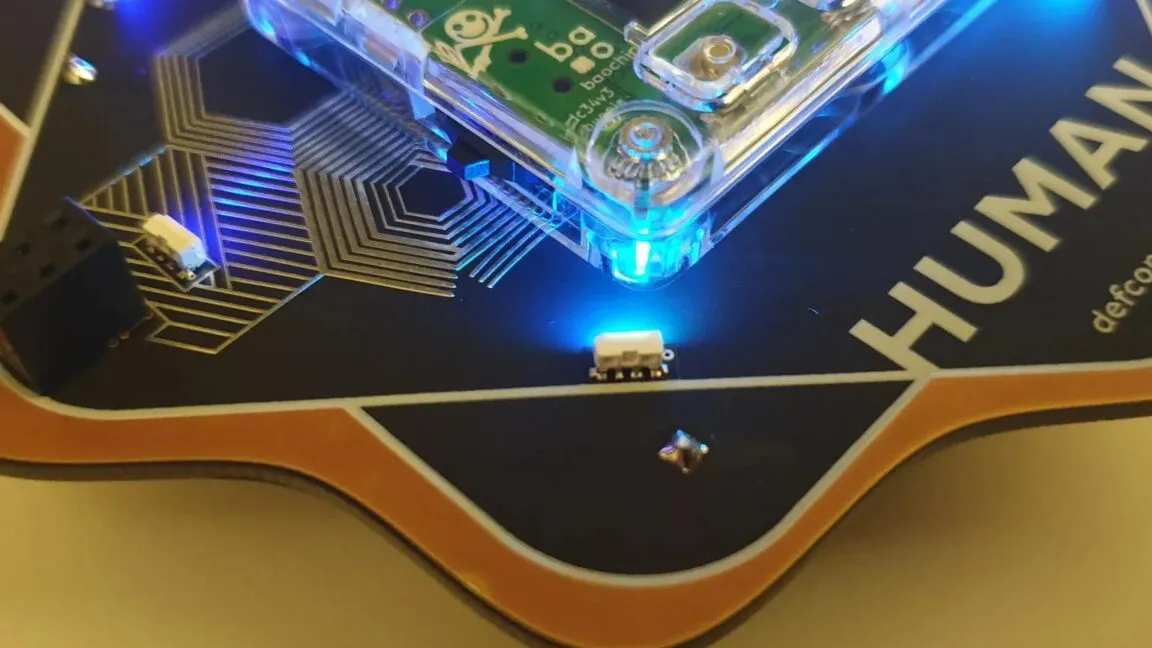
Defcon asked legendary hardware hacker Andrew “bunnie” Huang to design its new badges, featuring an open source chip Huang created. For decision-makers, it signals a security shift toward transparency that badges, and eventually products, can verify.
Defcon has always treated its conference badges like the main event. Attendees don’t just learn new vulnerabilities and hacking techniques. They also walk away with an elaborate, electronic badge full of puzzles, crypto challenges, hidden Easter eggs, and even mechanical gear trains of a watch. But this year, the badge’s inside matters more than its outside. Defcon asked legendary hardware hacker Andrew "bunnie" Huang to create the badges, and the standout feature is not just the design on the surface. It is an innovative open source chip Huang designed, intended to move the “state of security, transparency, and trustworthiness” in computing.
The key detail: the badge includes a removable chip that hackers can inspect, rather than treating the hardware as a black box. That means participants can examine what the chip does, how it does it, and what they can verify, instead of only solving outward-facing puzzles. The removable approach also points to a practical reality Defcon loves: you can analyze, test, and keep using the badge after the inspection. In other words, this is a security concept you can hold, open, and stress-test.
For executives, the interesting angle is that Defcon is quietly modeling a behavior businesses have struggled with for years: security that is demonstrably inspectable. In many modern systems, “trust” gets outsourced to opaque components. Vendors ship devices, platforms, and chips with assurances, but the actual security properties are often hard for third parties to validate at the hardware level. Defcon’s badge flips that incentive structure. It makes transparency the deliverable. Huang’s chip is open source, and the badge’s removable nature is built for inspection, which is exactly what defenders and auditors need when they want confidence that the system behaves as claimed.
There is also a distribution strategy hiding in plain sight. Defcon’s audience is not a random user base. It is a concentrated community of people who already know how to probe systems for weaknesses. That means any security transparency initiative benefits from an ecosystem built to test it hard. If the chip is designed to advance security and trustworthiness, the badge format provides a kind of live fire exercise, but with a twist: the hardware can be inspected, then put back into use. That matters because many security proofs get derailed by reality. Teams can show diagrams and claims, but operational behavior and integration often reveal what breaks.
Context matters here. Hardware security and software security are frequently discussed as if they are separate worlds, but the reality is that modern computing security is a supply chain problem. Chips sit at the start of many trust relationships. If you cannot inspect a component, you cannot confidently reason about who controls what, what assumptions are baked in, and what happens when something goes off script. Defcon’s badge is a small object, but it is an idea with real scaling potential: when security design expects transparency, it changes how ecosystems evaluate hardware.
Regulatory scrutiny is another pressure point. While the source doesn’t mention specific regulators or filings, the theme is aligned with a broader global push toward verifiability, auditability, and accountability in security. Governments and large enterprises increasingly want assurance that systems can be assessed, not just asserted. When badges become audit-friendly hardware, they echo the direction many compliance-driven environments want to go: evidence over marketing, verification over hand-waving.
The second-order implication for boards and C-suites is not that everyone should buy a Defcon badge chip. It is that the bar for “trustworthiness” is moving toward what can be examined. If open source hardware and inspectable components make it easier for a community to test and validate security properties, then the market expectation shifts. Customers, auditors, and internal security teams will increasingly ask why their critical systems cannot provide the same level of inspection and transparency. And once the expectation is set in a high-signal venue like Defcon, it stops being a niche preference and starts looking like baseline security maturity.
So the strategic stake is simple. Defcon’s badge is a proof of concept for inspectable security hardware: designed by bunnie Huang, using an innovative open source chip, and built with a removable component that hackers can inspect and still keep using. If you run security programs, own product risk, or oversee technology governance, this is a reminder that “trust” is becoming something you demonstrate. The people who can inspect hardware will always have an advantage over the people who must accept it on faith.
This story's Key Insights and Take-aways are locked.
Create a free account to unlock Executive Actions for one credit.
Register to UnlockAlways free for Executives Club members. Join the Club
More in Technology

doubleAI's Maxwell rewrites code while it runs, claims 38x speedups
The Tel Aviv startup's code execution model formally verifies optimizations, turning AI into an agent for the hardware itself.
Saudi military official paid to fly OpenAI bugging suspect's family out, prosecutors say
A court filing says a Saudi military official funded the family's exit and Riyadh offered bail, putting foreign-influence risk squarely on AI boards.

AI researcher's 26,000-word claim: Neural nets aren't tangled after all
Nick Cammarata's Goodfire post has the AI world split - if he's right, monitoring frontier models just got a lot easier.