
Detectorist mistook Magnus Barefoot coin for a button, researchers called it the first of its kind
A 900-year-old silver coin near Utstein Monastery was worn as jewelry, then revealed a griffin and rare cross motif.
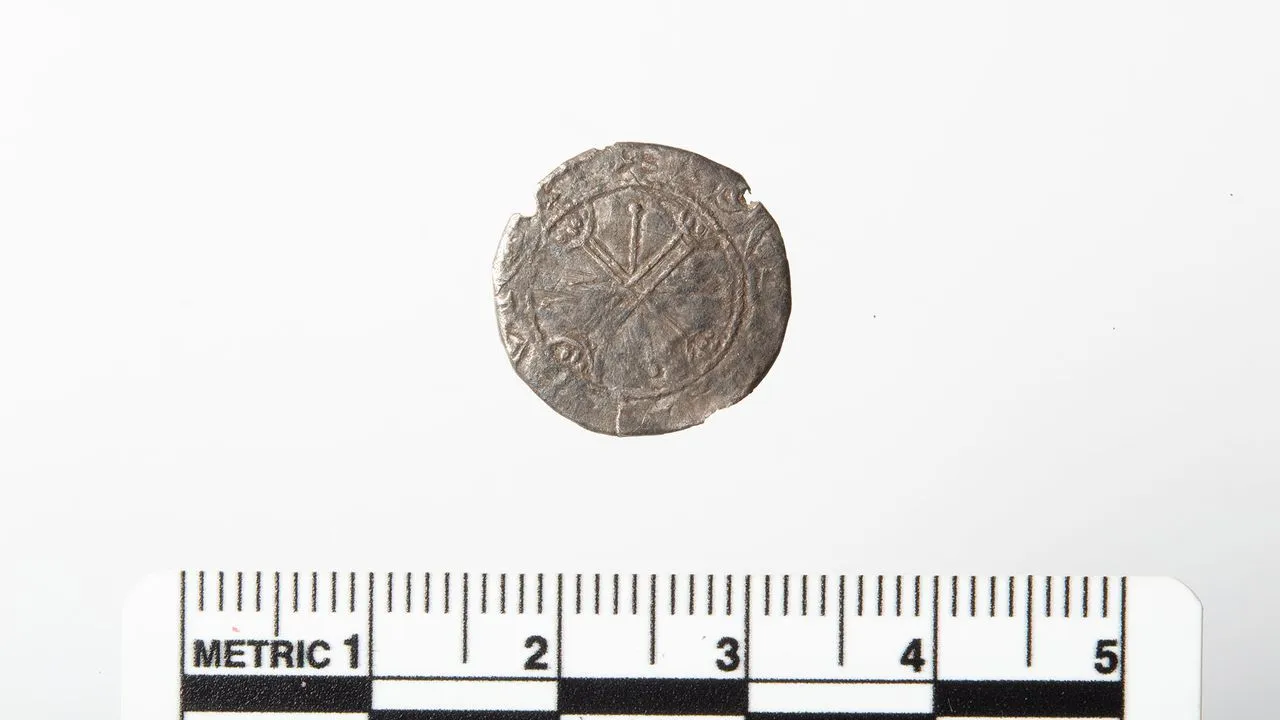
In April 2025, Norwegian metal detectorist Morten Eek brought home what looked like a button, but University of Stavanger Museum of Archaeology researchers identified it as a 1093-1103 silver coin from Magnus Barefoot. The find is the first coin of its type discovered on Norwegian soil, reshaping how scholars think about Barefoot's coinage.
A Norwegian metal detectorist dismissed a rare 900-year-old silver coin as a “button” before researchers realized what it really was. The object was found in April 2025 in a field near Utstein Monastery in southwest Norway, and it turned out to be linked to Magnus Barefoot, also known as Magnus Berrføtt, the ruler often described as Norway’s last Viking king.
Here is the key stake, and why the story matters beyond archaeology trivia. A December 2025 translated statement from the University of Stavanger Museum of Archaeology says the coin is the first of its type ever discovered on Norwegian soil. That single sentence upgrades a local field find into a data point that can change scholarly views on how Magnus Barefoot’s coinage was minted and circulated.
So how does a genuine medieval coin end up in a pile of modern buttons, coins, and scrap metal? According to the museum and reporting, detectorist Morten Eek found the item in the plow layer, about 4 to 6 inches (10 to 15 centimeters) below the surface. One side looked bright and silvery, while the other side was covered by copper and had a dark spot in the middle, creating a distinctly button-like appearance. Eek stored it with other buttons and worn modern coins he had collected.
The “turn” happens only after months, when Eek shows his finds to fellow metal detectorists. They noticed the silver side looked like a medieval coin, and its design resembled an illustration in the 1865 reference work " Norge's Coins from the Middle Ages," by C.I. Schive. At that point the group contacted the University of Stavanger Museum of Archaeology, where researchers took a closer look. The experts were immediately interested because the coin appeared to have been altered after it was minted.
That alteration is the part that turns this from a cool artifact into a measurable puzzle. The museum reports that someone had placed a copper plate over one side, and folded the coin’s outer edge around it. Two rounded notches on the edge suggest a chain or loop may have been attached, which implies the coin was later worn as jewelry. Researchers could potentially have removed the copper plate to see what lay underneath, but they did not, because doing so would have damaged the object’s fragile state. The museum representatives describe the unique transformation as revealing “something about people’s relationship to what was initially a coin,” basically: the story of where money goes after money stops being money.
To understand what was hidden under the copper, the team X-rayed the coin. The scan revealed a griffin motif, a mythical creature with the body of a lion and features of a bird of prey. The museum notes that the motif has sometimes been interpreted as the lion of St. Mark, a Christian symbol, but also emphasizes that the animal on these coins closely resembles a griffin. In medieval Christian art, griffins were used to symbolize Christ’s dual nature, both human and divine. The visible side also displayed a “cross-over-cross” motif, with double-lined arms and small semicircles or bowl shapes at the ends.
That pairing is what makes the coin rare in a very specific, not hand-wavy way. The statement says that two-sided coins with the motif combination of griffin and cross over cross are only known from four copies. One is from the Sandur hoard found in the Faroe Islands in 1863, and three others are from Denmark’s Mørstad hoard, found this past spring, containing nearly 5,000 coins. In other words, this find adds a new instance to a tiny, already well-defined set. The museum representatives say the rarity “may tell us something about the extent of Magnus Berrføtt’s minting.” And broader context helps: the museum reports that about 100 coins, spread across 12 discoveries, are known from Magnus Barefoot’s reign, making every new example valuable for understanding how coins were produced and circulated in Norway in the late Viking Age and early Middle Ages.
If you want the human backdrop, Magnus Barefoot’s reign runs from 1093 to 1103. He became king in 1093 after the death of his father, Olav Kyrre (Olaf III of Norway), whose reign was remembered as relatively peaceful. Barefoot’s reputation was not peaceful. Like his grandfather Harald Hardrada, the Norwegian king killed at the Battle of Stamford Bridge in 1066, Barefoot built his reputation through warfare. The museum notes he campaigned overseas and sought to extend Norwegian power across western sea routes, including the Isle of Man and parts of the Irish Sea. He was associated with the saying that a king was meant “for honor and glory, and not a long life.” He died around age 30 in 1103 when he was ambushed and killed during a campaign in Ireland.
But the coin also points to more than military ambition. The museum reports that it reflected one of Barefoot’s domestic reforms: earlier Norwegian rulers had reduced the silver content of their coins, and Barefoot restored a high silver standard, with coins that were around 90% silver. Whether the Utstein Monastery coin was lost during his lifetime is impossible to know. But since it was later turned into jewelry, it may have circulated for years or even generations after it stopped being used as money.
For decision-makers in the broader sense, the second-order lesson is simple: small, “misclassified” discoveries can rewrite scarcity assumptions. In markets, boards, and regulated systems, you often only discover the real model after you uncover the hidden side. Here, the hidden side was literal, revealed by X-ray. The find’s significance is already clear in the record: first of its kind in Norway, tied to a tight motif set known from only four copies elsewhere, and anchored to a reign window of 1093 to 1103. If you manage risk, allocate budgets, or oversee information governance, this is a reminder that the first pass can be wrong, but the second pass can be everything.
This story's Key Insights and Take-aways are locked.
Create a free account to unlock Executive Actions for one credit.
Register to UnlockAlways free for Executives Club members. Join the Club
More in Science

Alaska's 1,580-foot tsunami had warning signs. Scientists just found them.
Rapid glacier retreat, heavy rainfall, and thousands of tiny tremors preceded Alaska's 1,580-foot tsunami, a warning for every coastal community in a warming world.

The rare mutation that lets high-risk brains dodge Alzheimer's
Scientists found a natural defense against protein buildup, opening a new path to preventive treatments.

3,000 steps a day may halve Alzheimer's decline, study finds
New research links a modest daily walk to less tau buildup and nearly half the cognitive and functional decline, even for those with early signs.