
Euclid finds 31 ancient quasars, including one from 670 million years after Big Bang
The ESA telescope just more than doubled the census of the Universe’s earliest black-hole beacons.
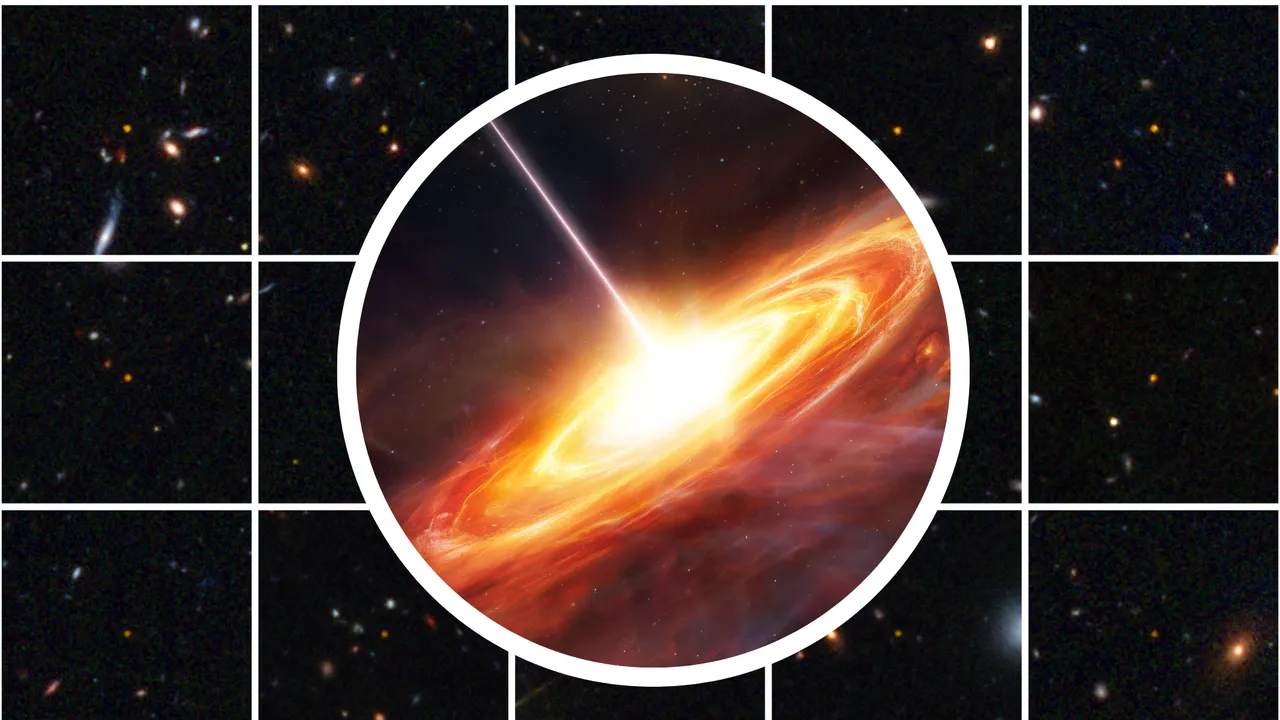
The European Space Agency’s Euclid space telescope has discovered 31 black-hole-powered quasars in the early universe, including the most ancient and distant ever seen, shining 670 million years after the Big Bang. For decision-makers in frontier science, this is a new, data-driven baseline for how supermassive black holes formed and scaled rapidly near the universe’s dawn.
Using the European Space Agency’s Euclid space telescope, astronomers have discovered a treasure trove of 31 black-hole-powered quasars in the early universe. The headline act is the most ancient and distant quasar ever seen, shining with the light of a trillion suns just 670 million years after the Big Bang. That timing matters because it lands in the universe’s “epoch of reionization,” when the so-called dark ages drew to a close, letting light travel more freely across the cosmos.
This is not a “found a needle” story. It is a census problem finally getting solved at scale. Euclid, launched in 2023, has already pulled off an hitherto unprecedented haul of early quasars, including fainter examples that were previously hard to spot at vast distances. In just a single year of observations, Euclid has detected more than three times the number of quasars that earlier work took around a decade to find, reaching counts that let researchers study quasars as a population rather than isolated curiosities.
To understand why this is so exciting, you have to know what a quasar is doing. Quasars form when supermassive black holes, with masses millions or even billions of times that of the sun, are surrounded by swirling disks of matter called accretion disks. As the disks gradually feed these black hole giants, the intense gravity and resulting friction make the surrounding material glow so brightly that the quasar’s luminosity can exceed the combined light of every star in its host galaxy. At nearby distances, that might still be distinguishable. At the edge of the observable universe, it gets brutally complicated because quasars’ light can be hard to tell apart from the light of more proximate stars.
That ambiguity is the core reason the “hunt for the earliest quasars has been on for decades.” Scientists are trying to answer how supermassive black holes grew so rapidly so shortly after the Big Bang, and these new detections provide a direct way to test that timeline. Team leader Daming Yang of Leiden University in the Netherlands said in a statement, “These early quasars date back to the Universe's infancy.” He added that by finding and studying them, researchers can “better understand how these enormous systems formed and grew so quickly - one of the greatest mysteries in astrophysics.”
The dataset is also notable for its spread across time. Of the 31 new quasars, 12 existed when the universe was around 770 million years old. But the two that stand out most are the quasars designated EUCL J172902.75+641018.1 and EUCL J125308.55+705432.3. These are around 13 billion light-years away and existed just 670 million years after the Big Bang, which makes them the most ancient quasars ever documented. In other words, the instruments did not just catch “early.” They caught “earliest,” and they did it with enough additional objects to stop treating each discovery like a one-off.
This is where the story becomes bigger than astronomy nerds. Antonio La Marca, a European Space Agency (ESA) Research Fellow on the Euclid team, said in the statement, “This finding more than doubles the number of quasars we know of that are so ancient.” He also described the Euclid team’s work as taking a true “census” of quasars at the dawn of the Universe for the first time. When teams use words like “census” and “census” becomes literal, it changes what downstream research can do: you can model populations, compare brightness distributions, and test whether current theories about black hole growth hold up when the sample stops being tiny.
The 31 quasars also map cleanly onto a specific cosmic era. The epoch of reionization lasted from around 680 million years after the Big Bang to 1.1 billion years after the Big Bang. During this period, the universe’s “dark ages” ended as photons and light particles became free to traverse the cosmos. As ESA Euclid Project Scientist Valeria Pettorino put it in the statement, “Ancient quasars are rare discoveries.” She added they are “interesting in themselves, but also time machines that enable us to explore the early universe and understand how the first generation of galaxies came to be.” For executives and boards funding frontier missions or evaluating science technology roadmaps, this is a clear example of how instrument capability translates into a sharper scientific baseline.
Euclid’s work is part of the Euclid Wide Survey, which will eventually cover around one-third of the total sky from Earth. The immediate result is a snapshot; the longer-term payoff is coverage, depth, sharp imaging, and unique space-based infrared vision working together to pick out rare, extremely distant objects far more efficiently than before. Pettorino said, “Euclid's capabilities are unrivalled,” describing how the telescope’s combination of features lets teams search across huge areas of sky and capture much fainter light. And while this discovery is about black holes and early galaxies, the broader mission context includes the “dark universe,” with dark energy and dark matter among the most pressing cosmic mysteries scientists hope Euclid can shed light on.
The team’s research was published on Monday (July 6) in the journal Astronomy & Astrophysics. The practical strategic stake is simple: when you can more reliably find the earliest quasars and measure them as a population, you tighten the constraints on the universe’s timeline, and that ripple effect hits every theory that tries to explain how the biggest structures arrived early.
This story's Key Insights and Take-aways are locked.
Create a free account to unlock Executive Actions for one credit.
Register to UnlockAlways free for Executives Club members. Join the Club
More in Science

Alaska's 1,580-foot tsunami had warning signs. Scientists just found them.
Rapid glacier retreat, heavy rainfall, and thousands of tiny tremors preceded Alaska's 1,580-foot tsunami, a warning for every coastal community in a warming world.

The rare mutation that lets high-risk brains dodge Alzheimer's
Scientists found a natural defense against protein buildup, opening a new path to preventive treatments.

3,000 steps a day may halve Alzheimer's decline, study finds
New research links a modest daily walk to less tau buildup and nearly half the cognitive and functional decline, even for those with early signs.