

Don Pettit shared a KCl crystal photo. Microgravity turns cubes into “hopper” stair-steps
NASA astronaut Don Pettit posted potassium chloride crystal growth on the ISS, revealing how gravity reshapes crystallization into ordered layers.
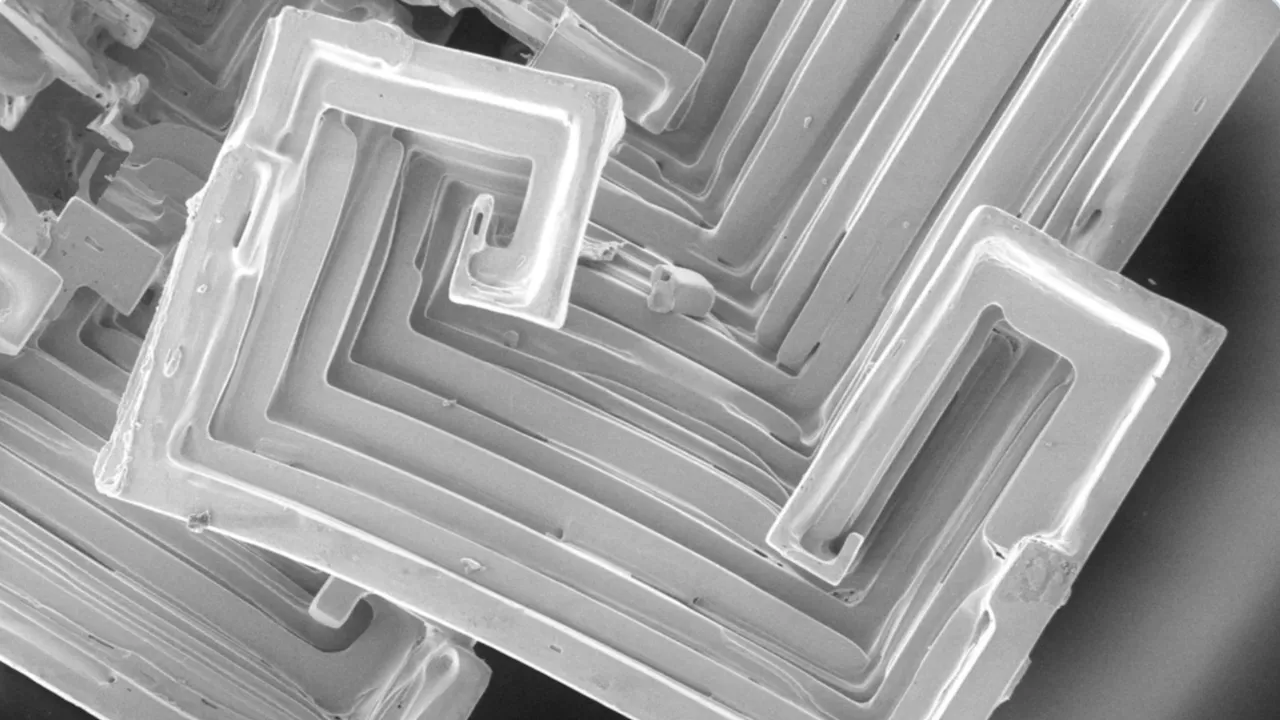
NASA astronaut Don Pettit shared an ISS image and video of potassium chloride crystals forming in microgravity, creating a stair-stepped “hopper” pattern. For decision-makers, it is a clear reminder that space-grown materials can reduce defects and surface behaviors that terrestrial manufacturing cannot easily replicate.
NASA astronaut Don Pettit posted an ISS image and accompanying video on July 18 showing a potassium chloride crystal growing into an “impossible-looking” scroll of pyramid-like, stair-stepped layers. Under a microscope, it does not resemble the kind of crystal growth most labs expect. Instead, it looks almost too orderly, like a tiny futuristic sculpture.
The reason is straightforward and weird in exactly the way science should be: microgravity changes what dominates inside a growing crystal. In orbit, the gravitational pull is roughly a million times weaker than on Earth. Live Science reports that chemist Anne Wilson, a professor of chemistry and biochemistry at Butler University, explained that when gravity fades into the background, other forces become far more pronounced. She pointed to molecular attraction and polarity as two influences that suddenly take over once gravity stops dictating the outcome.
That shift explains why potassium chloride can crystallize in shapes that are nearly impossible to reproduce in a terrestrial lab. On Earth, crystals eventually get heavy enough to sag, break, or settle at the bottom of their container. In microgravity, they keep growing outward from where they started. Wilson also noted that potassium chloride naturally forms cube-shaped crystals. The difference is where and how those cubes grow once buoyancy and settling are no longer doing their usual backstage work.
Here is the key behavior: the crystals experience what scientists call “hopper growth.” In this regime, the outer edges and corners grow at faster rates than the flat faces. That edge and corner advantage creates the step-like, pyramid-like structure seen in Pettit’s ISS footage. The result is a hollow center under the microscope, because the growth is biased toward the boundaries and away from the faces. Wilson further described that the pattern is not unique to potassium chloride. Ordinary table salt can form the same type of hopper structure too.
The video also matters, because it is essentially a real-time map of how the crystal builds itself. Live Science describes the timelapse as recording growth inside a thin water film. Look closely and the patterns emerge as new corners appear during growth. As those new corners form, the crystal can change direction entirely, producing the elegant scrolling effect captured in Pettit’s post. This is not just aesthetic. It is what microgravity does when it lets molecular and polar forces drive the “rules,” instead of letting gravity steadily pull everything into the same direction.
So why should operators, investors, and boards care about a salt crystal looking like it was designed by a sci-fi architect? Because space-based microgravity experiments can produce materials with fewer defects than what typically forms on Earth. That matters for manufacturing supply chains and next-generation hardware. The source ties this directly to the possibility of refining manufacturing processes for semiconductors and other advanced materials. In practical terms, if microgravity reveals what an “ideal” structure looks like, companies can use that as a benchmark to improve yield, performance, or reliability when translating processes back to Earth.
And the ISS is not just a museum for cool visuals. The source notes that astronauts spend significant time running experiments that would be near-impossible on Earth. It references recent work using the station’s newly upgraded Cold Atom Laboratory to create and study a fifth state of matter called the Bose-Einstein condensate. It also points to last year’s demonstration where moss spores exposed to space for nine months continued to grow after being returned to Earth. Together, these examples underscore the same theme as the potassium chloride hopper growth: the environment changes what biology and materials can do, and those differences can become useful when scaled, standardized, or engineered.
For executives, the strategic stake is timing and competence in understanding “transferability.” The ISS gives researchers a clean system where gravity is suppressed, and the crystal behavior becomes legible. The risk on the other side is assuming Earth-based manufacturing will automatically replicate those outcomes. The opportunity is using space-grown observations to sharpen process control, reduce defects, and better predict how microstructure forms when gravity is not constantly biasing the chemistry. Pettit’s post is a reminder that even something as simple as a common salt can behave in ways that do not show up in terrestrial labs, and that second-order knowledge can feed into real-world product quality and performance.
For those who fund, partner with, or build around science platforms, this is a board-level story: microgravity is not just a curiosity. It is a testbed where “normal” rules shift, and where materials can reveal their hidden default behaviors.
This story's Key Insights and Take-aways are locked.
Create a free account to unlock Executive Actions for one credit.
Register to UnlockAlways free for Executives Club members. Join the Club
More in Science

Alaska's 1,580-foot tsunami had warning signs. Scientists just found them.
Rapid glacier retreat, heavy rainfall, and thousands of tiny tremors preceded Alaska's 1,580-foot tsunami, a warning for every coastal community in a warming world.

The rare mutation that lets high-risk brains dodge Alzheimer's
Scientists found a natural defense against protein buildup, opening a new path to preventive treatments.

3,000 steps a day may halve Alzheimer's decline, study finds
New research links a modest daily walk to less tau buildup and nearly half the cognitive and functional decline, even for those with early signs.