
Dwayne Johnson says Kevin Hart is booked for years, derailing Broadway Odd Couple
Johnson reveals a two-and-a-half to three-year push to revive The Odd Couple with Hart fell short.
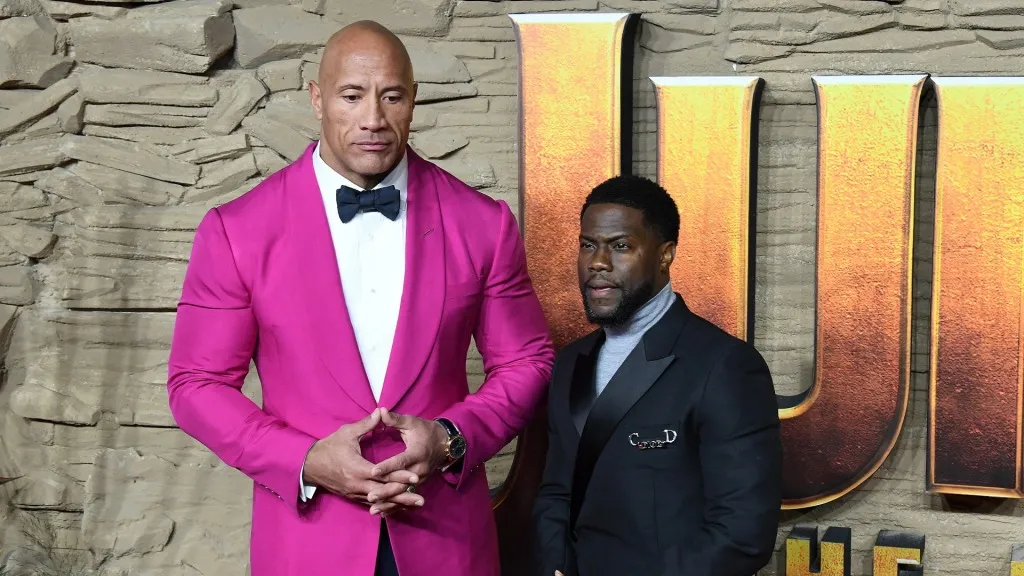
Dwayne Johnson says he and Kevin Hart, along with producer Jeffrey Seller, have been working for the past two and a half to three years to launch a Broadway revival of Neil Simon's The Odd Couple. Johnson now says Hart is so booked for the next three to five years that the show cannot move forward yet.
Dwayne Johnson is openly disappointed about one very specific Broadway problem: Kevin Hart is too booked to star in his long-planned debut on the Great White Way. Johnson told People that he, Hart, and producer Jeffrey Seller have been trying for “the past two and a half to three years” to get a Neil Simon revival off the ground, with Johnson and Hart in the lead roles. His reason for the delay is blunt, and it sounds personal rather than strategic. Johnson says Hart is “so booked for the next three to five years,” calling it “his schedule” and a “reality,” which Johnson says he “totally get[s].”
So the big question for anyone tracking mainstream entertainment talent is not “Will this happen someday?” It is “What happens to the momentum when one of the headline producers of cultural gravity goes unavailable for multiple years?” Johnson answers that too, in the same People interview, by saying he will not let the dream go, even if the exact casting and timeline do not align. In other words: the Broadway plans did not collapse because of creative disagreement, financing, or a regulatory constraint. They stalled because the calendar belongs to a performer whose brand is driving the rest of their year.
To understand why this matters beyond celebrity gossip, you have to remember how Broadway openings actually get built. A Broadway revival of a Neil Simon property like The Odd Couple is not simply a creative choice, it is a logistical one. You are coordinating star availability, rehearsal lead time, touring schedules, and the production calendar itself, plus the fact that once a show has a public timeline, the market starts valuing whether you can hit it. When a top-billed performer is unavailable for three to five years, you do not just miss opening night. You risk losing the window where marketing narratives still feel current and where momentum from announcements remains intact.
Johnson’s comments also underline how talent scheduling now behaves like capital allocation. Hart, for his part, has remained a massive draw even when he is not in constant traditional movie releases, and Johnson’s People discussion frames Hart as “so booked” that the schedule controls the project rather than the other way around. Johnson adds context with a reference to what Hart and Johnson will be promoting instead: Johnson mentions “We do Jumanji,” and that they will “promote that at the end of the year.” This is the operational reality of modern stardom. The “next” thing is always competing for attention, and productions that depend on specific stars have to choose between waiting for alignment or rebuilding the plan.
The business dynamic here is also worth noting for executives used to board-level planning: the project involves not just actors, but a producer. Johnson names producer Jeffrey Seller as part of the effort to launch the show. Seller’s involvement matters because producers typically help bridge the gap between creative aspiration and production feasibility. When the bottleneck is a star schedule, even the best runway planning can get overtaken by a performer’s broader demand. Put differently: a Broadway revival can be ready creatively and commercially, and still be hostage to a calendar that belongs to someone who is currently booked elsewhere.
Johnson also does not specify which roles he and Hart had discussed, leaving the casting chessboard open. He does not say whether Johnson would play Oscar, or whether Hart would embody Felix, or whether they had planned to swap parts. The source does not confirm any of those details. But the fact that Johnson leaves the roles unspecified is telling: the “plan” seems to be larger than a single casting decision. It was about launching a Broadway debut for Johnson with Hart as the marquee counterweight. That is why the delay feels like more than a scheduling inconvenience. It is the delay of a carefully packaged entry into a different stage of showbiz credibility.
And the knock-on effects for decision-makers are real. If you are an investor, producer, or operator in entertainment, a long delay can change what kind of partnership you can sustain, how you price risk, and how you time announcements and marketing. Talent availability can also affect team retention, because crews, designers, and development partners build their own calendars. When one element slips by years, everything downstream has to be re-synced, which can quietly increase costs even if no one announces a “budget blowout.”
Johnson frames it as respect rather than resentment, saying he “loves” Hart “to death,” understands the schedule, and “respect[s] him for that,” while also insisting “I’m not letting that dream go.” For peers in adjacent roles, the strategic lesson is clear: even when the concept is strong and the talent chemistry exists, you still need a Plan B for timing. In a world where top-tier performers can be booked three to five years out, production timelines are less like forecasts and more like negotiations with reality.
This story's Key Insights and Take-aways are locked.
Create a free account to unlock Executive Actions for one credit.
Register to UnlockAlways free for Executives Club members. Join the Club
More in Entertainment

12TB Steam 'teraleak' goes beyond Valve: GTA 3, Mafia 2 prototypes exposed
A 12-terabyte dump of Steam data reveals prototypes and builds of third-party classics like GTA 3 and Mafia 2, plus unreleased Valve content, rewriting game history.

LinkedIn's romance problem: 1 in 4 workers say dating on it is fair game
A new survey shows a quarter of U.S. employees treat the professional network as fair game for romance, even as LinkedIn bans it and removes hundreds of thousands of offending posts.

Enhypen's first No. 1 album breaks K-pop's Billboard 200 streak
The K-pop group's 98,000-unit debut tops the chart while Dolly Parton's catalog reentry shows how death reshapes streaming.