

Ebola hits two new DRC provinces, aid workers warn response can't keep up
The Democratic Republic of Congo reports new spread, raising operational and moral stakes as health systems strain.
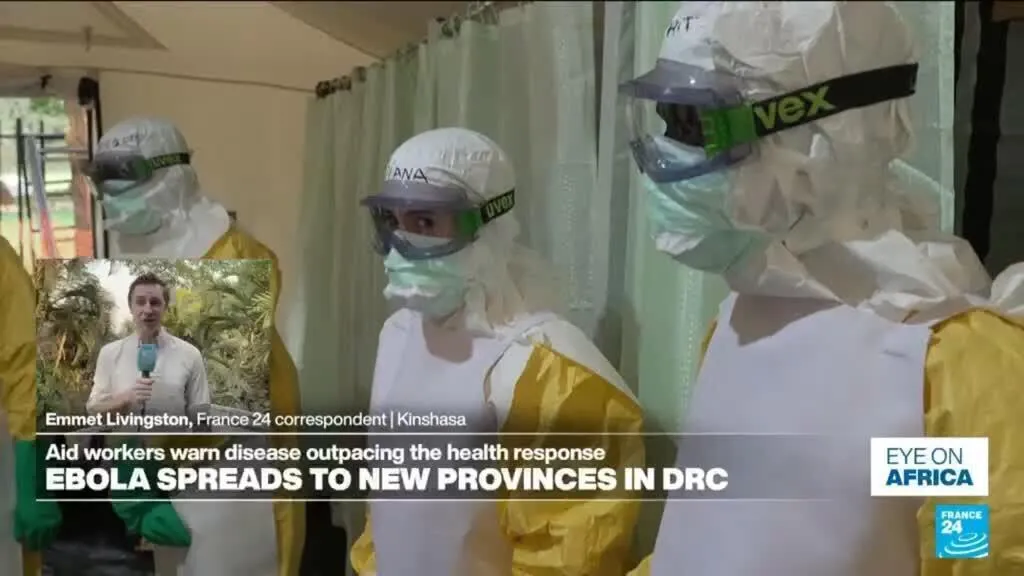
Ebola is continuing to spread in the Democratic Republic of Congo, with two new provinces reporting new cases, according to France 24. Aid workers warn the outbreak is outpacing the health response, a situation that demands urgent coordination from decision-makers.
Ebola is continuing to spread in the Democratic Republic of Congo, and two new provinces have registered new cases, according to France 24. Aid workers on the ground warn that the disease is moving faster than the health response can manage it.
Those two facts matter together. New provinces mean new geographies, new logistics, and more opportunities for transmission across transport routes, households, and local health facilities. If the response is already behind, the clock gets sharper with every additional location. France 24 correspondent in Kinshasa, Emmet Livingstone, reports this as a continuing spread, not a slowdown.
This is the kind of emergency that punishes the lag between “preparedness” and “execution.” In outbreaks, early containment depends on rapid detection, fast confirmation, immediate contact tracing, and reliable isolation and treatment capacity. Even when teams exist, they can be overwhelmed by the operational reality of reaching communities in time, maintaining safe care processes, and sustaining protective equipment and staffing. When aid workers say Ebola is outpacing the health response, they are basically describing a widening gap between what outbreak control requires and what the system can deliver right now.
For executives and boards, the headline is also a governance problem. Public health crises are not just humanitarian events; they are complex multi-actor operations. Governments coordinate with local authorities, international health organizations, and humanitarian agencies, each with their own reporting lines, procurement timelines, and compliance requirements. When Ebola expands into additional provinces, the coordination surface area expands too. What worked in one region becomes harder to replicate elsewhere if funding, staffing, and infrastructure do not scale at the same rate.
There is also a funding and continuity angle that often hides in plain sight. Response capacity requires sustained inputs: logistics for teams and samples, transport for patients, security and community engagement so people actually participate, and systems for monitoring contacts. If those inputs are constrained, the outbreak can turn into a moving target. “Outpacing” is a blunt way aid workers describe the consequences: interventions may arrive after transmission has already occurred, turning containment into an ongoing scramble rather than a planned campaign.
Second-order effects ripple beyond the clinics themselves. In regions with active Ebola transmission, trust and behavior become part of the response, because communities have to accept changes like safe burial practices, isolation procedures, and screening at local points of contact. When the disease spreads into new provinces, those relationships have to be rebuilt quickly under pressure. That is difficult when teams are stretched thin across multiple areas, and when rumors or fear spread at the same speed as the virus.
There is a business and operational lesson here for anyone used to managing distributed systems. Health response is a network, not a single facility. When the network nodes increase, the stress on communication channels, supply chains, and workforce availability increases too. Executives in logistics, manufacturing, travel, and communications should recognize the underlying pattern: if the system is behind, scaling demand in the middle of a crisis can create compounding failures. In Ebola terms, that means more provinces with more cases, more need for rapid care, and more difficulty delivering consistent response quality.
Finally, the strategic stakes are immediate. France 24 reports continuing spread in the DRC and highlights two new provinces with new cases, while aid workers warn the response is being outpaced. That combination suggests the outbreak is not just persisting; it is expanding while control efforts struggle to catch up. For decision-makers watching from boardrooms, donor committees, or partner organizations, the implication is clear: success depends on speed, coordination, and scaling what works fast enough to avoid falling further behind as geography expands.
This story's Key Insights and Take-aways are locked.
Create a free account to unlock Executive Actions for one credit.
Register to UnlockAlways free for Executives Club members. Join the Club
More in Politics

LA County: DOJ's 20,000 'noncitizen' voter list is 'unreliable,' includes U.S.-born
Preliminary review by Los Angeles County election officials finds errors in the federal list, raising the stakes for voter roll integrity ahead of November.

Trump's $1.5B Pentagon chip investment lands in North Carolina
A $1.5 billion defense infusion for North Carolina chipmaking signals a new era of Pentagon-backed reshoring - here's what it means for the industry.

Nigeria confirms first Ebola case in Abuja, a woman just off a Uganda flight
Health Minister Muhammad Ali Pate says the patient flew in from Uganda, putting Africa's latest outbreak on Nigeria's doorstep.