
Niger Delta residents in Billé protest toxic flammable gas leaks, demand government action
Communities say months of ground gas leaks are poisoning water, killing fish, and threatening livelihoods.
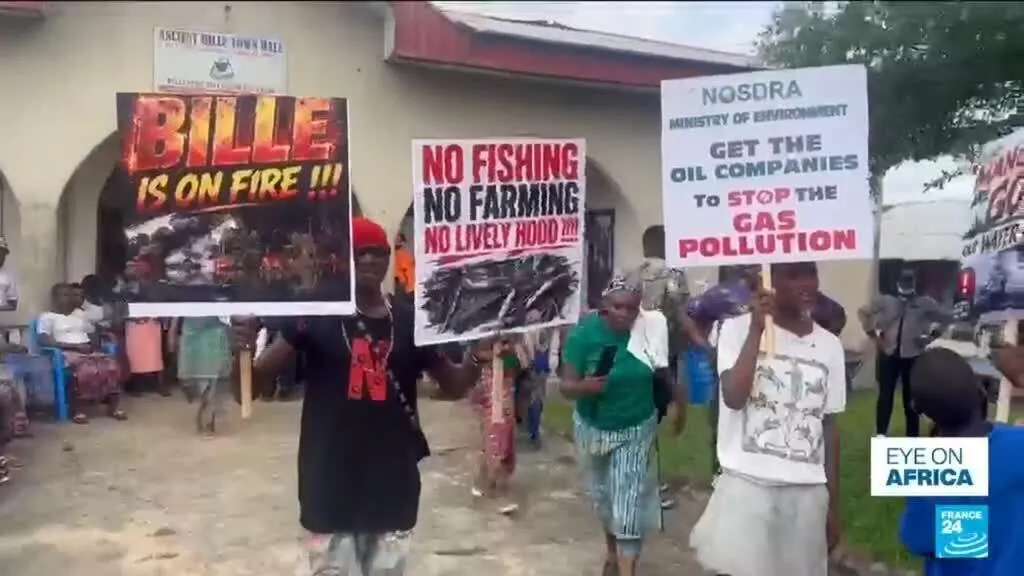
Residents in Billé, a Niger Delta town, have taken to the streets to demand government action over toxic, flammable gas leaks they say have been occurring for months. The consequences are acute for water quality and aquatic life, which local residents rely on for their livelihoods.
In Nigeria's Niger Delta town of Billé, residents have taken to the streets to demand government action over what they describe as catastrophic pollution. For several months, the community has complained of toxic, flammable gas leaking from the ground. They say the leaks are contaminating local water supplies and destroying aquatic life, the fish and other sea life that many people depend on for their livelihood.
This is not being framed as a one-off incident. France 24 reports the Billé protests as the latest in a long series of environmental disasters in the Niger Delta. The reporting also notes that these disasters have largely been blamed on Western oil companies. For decision-makers, that is the core issue: this is not just an environmental story, it is a risk story. When pollution becomes a months-long, recurring pattern, communities start organizing, regulators face public pressure, and corporate reputations, operating licenses, and legal exposure tend to rise together.
To understand why the Niger Delta is a persistent flashpoint, it's helpful to zoom out on how the region has been shaped by extractive industry for decades. Oil and gas infrastructure sits close to dense communities, waterways, and fishing grounds. When something goes wrong underground, the harm does not stay contained. It can move through soil and water, damage ecosystems, and eventually hit household income. In practical terms, that means a leak is not just an environmental problem. It is a livelihoods problem. And because aquatic life is part of the local economic foundation, the damage can become a compounding cycle: fewer fish means less money, which can reduce the ability to recover while exposure continues.
The specific details in the report matter too. Toxic, flammable gas leaking from the ground raises two separate but intertwined hazards. First is health and environmental contamination, via water contamination and the downstream destruction of aquatic life. Second is the danger of flammability, which increases the sense of urgency for immediate containment and safety planning. Even without additional technical data in the story, the combination of toxicity and flammability is the kind of scenario that typically forces governments to treat both environmental remediation and public safety as immediate priorities. For executives, the second-order implication is straightforward: when hazards overlap, stakeholder tolerance runs out faster. Communities do not wait for slow investigations when there is both livelihood damage and a fire or explosion risk.
The report also points to an important political and accountability dimension. Residents are demanding government action, which signals that they do not see the current status quo as protective enough, and that they expect authorities to intervene more forcefully. In many jurisdictions, communities facing ongoing environmental harm eventually shift from complaints to street-level mobilization, because administrative processes can appear unresponsive. That shift is not just civic drama. It can become a governance signal that changes how agencies allocate attention, how quickly enforcement actions are pursued, and how much weight is given to documented community impact.
For Western oil companies, the mention that environmental disasters in the Niger Delta have largely been blamed on them is a reminder that trust is a strategic asset. When blame crystallizes into a pattern, companies can face a multi-front risk stack: public pressure, regulatory scrutiny, contract and stakeholder friction, and potential legal action. Even in the absence of new legal claims in this specific article, repeated incidents tend to drive escalation. Boards and senior leaders should assume that community narratives, once established, can become durable and hard to dislodge, especially when they relate to visible outcomes like contaminated water and dead or disappearing aquatic life.
This story's Key Insights and Take-aways are locked.
Create a free account to unlock Executive Actions for one credit.
Register to UnlockAlways free for Executives Club members. Join the Club
More in Politics

LA County: DOJ's 20,000 'noncitizen' voter list is 'unreliable,' includes U.S.-born
Preliminary review by Los Angeles County election officials finds errors in the federal list, raising the stakes for voter roll integrity ahead of November.

Trump's $1.5B Pentagon chip investment lands in North Carolina
A $1.5 billion defense infusion for North Carolina chipmaking signals a new era of Pentagon-backed reshoring - here's what it means for the industry.

Nigeria confirms first Ebola case in Abuja, a woman just off a Uganda flight
Health Minister Muhammad Ali Pate says the patient flew in from Uganda, putting Africa's latest outbreak on Nigeria's doorstep.