
Evenepoel beats Pogacar to win Tour stage 15 after Vingegaard crashes out
A Tour de France turning point: Remco Evenepoel takes stage 15 as Jonas Vingegaard abandons after a crash.
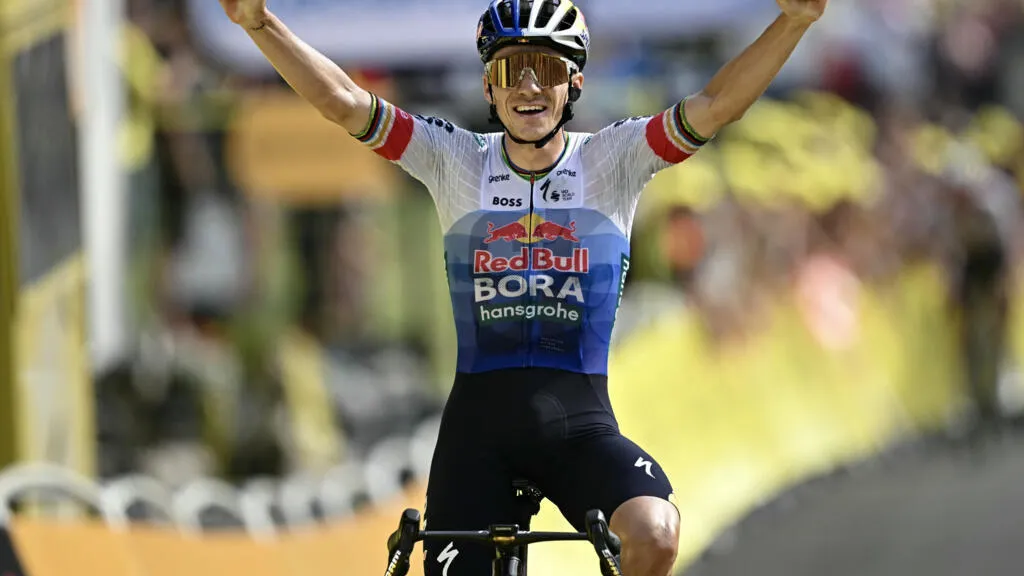
Belgian Remco Evenepoel beat race leader Tadej Pogacar to win stage 15 of the Tour de France on Sunday. Jonas Vingegaard, second overall, was forced to abandon following a crash.
Remco Evenepoel won stage 15 of the Tour de France on Sunday by beating race leader Tadej Pogacar to the finish line. The move landed in the middle of a high-stakes week because Jonas Vingegaard, second in the overall rankings, was forced to abandon after a crash.
For anyone tracking the “who is really in control” question of cycling’s biggest stage race, this is the clearest kind of disruption: the rider who was closest to the top of the standings disappears from the equation in an instant. Evenepoel still had to execute on the road, but the strategic reality right after the crash was immediate. With Vingegaard out, the race leader’s margin, the chasing calculus, and the pacing strategy all get rewritten in real time.
Stage 15 matters because the Tour is not just about one day. The general classification is built from accumulated time, and each stage changes how teams allocate energy for the next hour, the next day, and the next sprint for positioning. When the overall contender with the No. 2 spot goes down, the teams behind him do not merely “adjust.” They re-plan. They may change how long they keep pressure on the front, how they decide who chases moves, and when they choose to bank time rather than fight for stage glory.
That is where Evenepoel’s win becomes more than a headline. Beating Pogacar, the race leader, to the line is a direct scoreboard for who had the legs and the timing when it counted. Pogacar leads the race, but stage wins are also signaling devices, telling competitors that a rider can close down gaps, survive late surges, and still arrive with enough power to out-finish the person holding the biggest target on their back.
The crash and abandonment adds a layer that corporate watchers recognize instantly: sudden downside risk. In finance, operations, and strategy, the goal is to manage variance you can control, then prepare for the variance you cannot. A crash is the cycling version of a black swan with a crash helmet. Evenepoel still wins on the road, Pogacar still gets beaten on the day, but Vingegaard’s absence means the race’s “base case” stops being valid. Teams that were prepared to support a second place contender now have to reconsider what “support” even means.
Second order effects are also about incentives inside teams. A team managing a top-tier general classification contender typically balances protection, pacing discipline, and tactical support. When a leader is removed from contention, riders who were previously constrained by time preservation suddenly have more freedom, because preserving the overall strategy is no longer the dominant objective. That can shift how teammates ride, how attacks are treated, and which riders decide to gamble for stages rather than defend margins.
Even beyond team dynamics, this kind of episode changes how competitors interpret the rest of the Tour. If Vingegaard can be forced to abandon following a crash, then resilience, route familiarity, and decision-making under stress become more than abstract talking points. For riders and teams, it is a reminder that the difference between “real contender” and “already gone” can be one split-second moment on a wet road edge, in a crowded sprint, or after a misjudged move.
For decision-makers watching from the outside, the analogy is straightforward: contingency planning is not optional when the event can end your plan instantly. Today’s disruption removes an overall contender, and it elevates another rider, Evenepoel, who can beat the race leader, Pogacar, when the clock and the road demand it. The Tour becomes a living demonstration of how quickly advantage can flip, and why organizations built for calm execution still need playbooks for chaotic days.
This story's Key Insights and Take-aways are locked.
Create a free account to unlock Executive Actions for one credit.
Register to UnlockAlways free for Executives Club members. Join the Club
More in Entertainment

12TB Steam 'teraleak' goes beyond Valve: GTA 3, Mafia 2 prototypes exposed
A 12-terabyte dump of Steam data reveals prototypes and builds of third-party classics like GTA 3 and Mafia 2, plus unreleased Valve content, rewriting game history.

LinkedIn's romance problem: 1 in 4 workers say dating on it is fair game
A new survey shows a quarter of U.S. employees treat the professional network as fair game for romance, even as LinkedIn bans it and removes hundreds of thousands of offending posts.

Enhypen's first No. 1 album breaks K-pop's Billboard 200 streak
The K-pop group's 98,000-unit debut tops the chart while Dolly Parton's catalog reentry shows how death reshapes streaming.