
Exosatellite candidate rivals Jupiter as scientists argue what counts as an exomoon
A Nature study finds a likely satellite around a brown dwarf, but it may not meet moon rules.
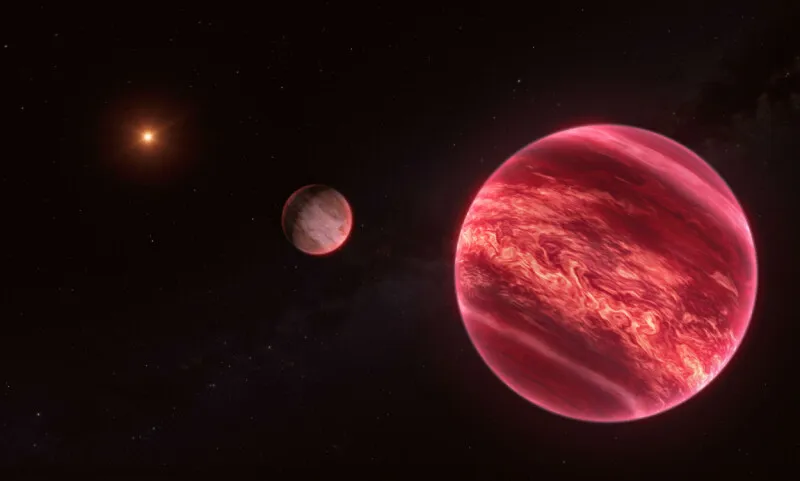
Kevin Hoy and collaborators report in Nature evidence of satellites around a companion brown dwarf using a radial velocity technique. The uncertainty over “exomoon” definitions matters for anyone tracking how quickly astronomers can confirm smaller exomoon candidates.
Scientists think they’ve found the first plausible exomoon outside our Solar System, but the discovery arrives with an awkward catch: the object is so massive it’s basically Jupiter-sized, orbiting a brown dwarf that itself orbits a star. In other words, this is a moon-like claim wrapped in a taxonomy fight. The research, published in Nature, centers on a system about 73 light-years from the Sun in the southern celestial hemisphere.
The key person is Kevin Hoy, a PhD student affiliated with Universidad Diego Portales and the European Southern Observatory in Chile. Hoy helped identify an “exosatellite” that completes an orbit every 170 days, with a minimum mass of about nine-tenths that of Jupiter. If astronomers decide the system’s definitions permit calling it an exomoon, it becomes a landmark step toward making exomoon detections less elusive. If they don’t, it’s still a technique win: the first time, according to the paper, this method has produced evidence of satellites around a companion brown dwarf.
Why brown dwarfs complicate everything is not a side detail, it’s the whole plot. Brown dwarfs sit in a definitional gap between gas giant planets like Jupiter or Saturn and the smallest stars. They do not sustain hydrogen fusion like the Sun and other main-sequence stars. They can fuse deuterium, which is a heavier isotope of hydrogen. That physical middle ground makes it hard to classify what their companions “should” be called, especially when you start applying Solar-System language such as planet and moon to a setup that includes three levels: a satellite, its host brown dwarf, and a wider star it all ultimately hangs around.
This matters because the object Hoy’s team found is, by mass, decidedly unmoon-like. The exosatellite is at least as massive as Jupiter, and the brown dwarf it orbits is around 30 times the mass of Jupiter. Hoy put it plainly in a statement included with the research: the system is “somewhat hard to define using Solar-System-based words like 'planet' and 'moon'.” The exosatellite is “clearly massive enough to be a planet,” but it does not orbit a star. It orbits an object that orbits a star. Being the third wheel is what makes them “want to call it a moon,” even if it is “nothing like the small, rocky moons we have in our system.”
The detection approach is itself a story about incentives and leverage in observational astronomy. The researchers employed the radial velocity method made famous by Michel Mayor and Didier Queloz, which discovered 51 Pegasi b in 1995, the first exoplanet found orbiting a Sun-like star. Radial velocity works by tracking gravitational “wobble” in a host object, usually a star. In this case, the host is a brown dwarf. Something orbiting it should induce a measurable wobble, and modeling of the data indicates at least one orbiting satellite.
The modeling also leaves room for instability, which is where the confirmation process gets real. Models for two satellites are possible, but highly unstable. The paper’s framing suggests that the evidence is strong enough to propose a satellite, but still not crisp enough to collapse every alternative into a single, uncontested classification. The authors note that it is uncertain whether the candidate will fulfill the presently undefined criteria for qualifying as an exomoon. Even with that uncertainty, they call the result a “marked step towards that first uncontroversial detection,” because advancing technology should allow the same method to be applied to less massive targets.
For execs and investors watching frontier science, the second-order implication is straightforward: definitions drive adoption. When a field lacks clean criteria, progress can look messy, and messaging gets tangled between discovery and classification. Here, the discovery is real, the technique is validated, and the boundary problem is philosophical and practical at once. The Universe did not suddenly start obeying Jupiter-moon vibes just because humans want tidy categories. But the technique that worked here, especially on a brown dwarf system, can help astronomers find candidates that are closer in mass and behavior to moons we already know.
So the stakes are bigger than “one more dot on a star map.” If astronomers can tighten the criteria and keep improving radial velocity sensitivity, exomoon hunting moves from elusive to repeatable. And because exomoons are a bridge between planetary science and the broader search for worlds that might host interesting conditions, better confirmation methods can accelerate the entire pipeline. Even at roughly Jupiter’s mass, this is not “forest moon of Endor” material. Finding something more like the moons in our own neighborhood will require sharper instruments. But thanks to Hoy and this Nature paper, the path to the first less-controversial exomoon detections just got clearer.
This story's Key Insights and Take-aways are locked.
Create a free account to unlock Executive Actions for one credit.
Register to UnlockAlways free for Executives Club members. Join the Club
More in Science

Alaska's 1,580-foot tsunami had warning signs. Scientists just found them.
Rapid glacier retreat, heavy rainfall, and thousands of tiny tremors preceded Alaska's 1,580-foot tsunami, a warning for every coastal community in a warming world.

The rare mutation that lets high-risk brains dodge Alzheimer's
Scientists found a natural defense against protein buildup, opening a new path to preventive treatments.

3,000 steps a day may halve Alzheimer's decline, study finds
New research links a modest daily walk to less tau buildup and nearly half the cognitive and functional decline, even for those with early signs.