

First adult T rex footprints found - 23-foot trackway from 66.5M years ago
The first known adult T rex trackway offers unprecedented insight into the predator's movement and behavior.
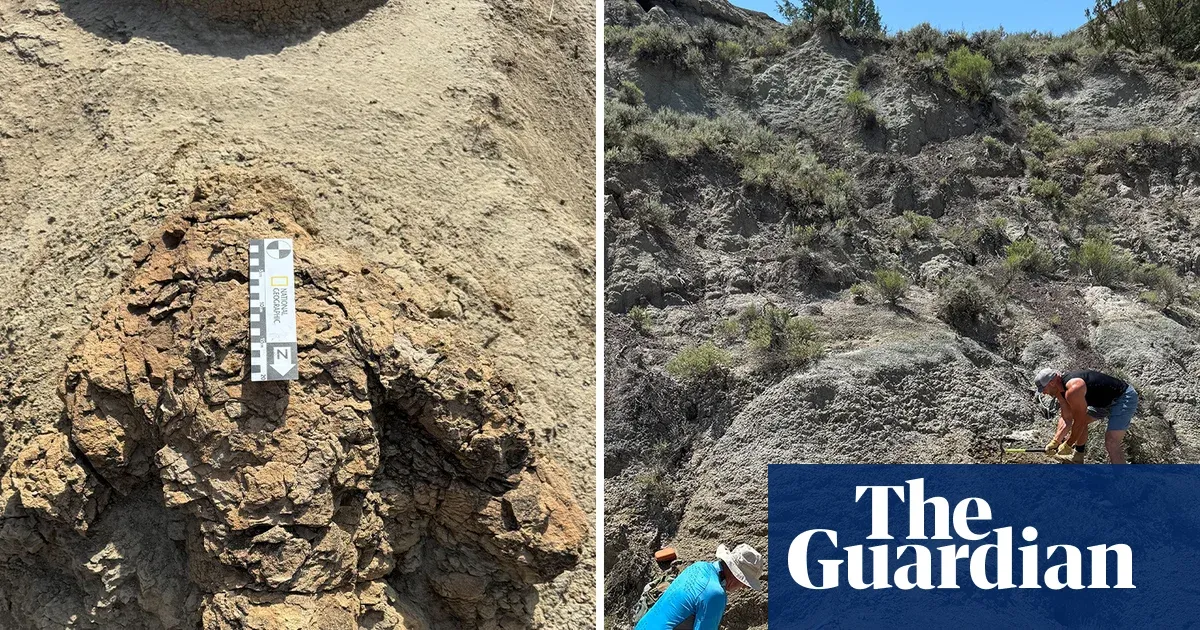
A team of scientists from the Denver Museum of Nature and Science and Liverpool John Moores University identified the first known series of adult Tyrannosaurus rex footprints in North Dakota, a 23-foot trackway dating back 66.5 million years. This discovery provides unprecedented insight into T rex locomotion and highlights the ongoing value of paleontological research for public engagement and scientific understanding.
The first known series of footprints from an adult Tyrannosaurus rex has been found in North Dakota, a 23-foot-long trackway of four three-toed prints that dates back 66.5 million years. The discovery, made in the Hell Creek Formation in the south-west of the state, was identified last year by researchers from the Denver Museum of Nature and Science in Colorado and Liverpool John Moores University in the UK. This is a landmark find: while T rex bones have been excavated for over a century, footprints from the adult apex predator have never been found in a series. The trackway consists of two left and two right prints, offering a rare glimpse into how the animal moved across the ancient landscape.
Footprints are far rarer than bones in the fossil record. They require specific conditions: soft sediment that can capture the impression, then rapid burial and hardening into rock. For a massive animal like T rex, which could weigh up to nine tons, the ground would need to be just right to preserve its steps without being destroyed by its weight. The fact that these prints survived 66.5 million years is a testament to the unusual circumstances of their preservation. The Hell Creek Formation is already famous for its dinosaur fossils, including T rex skeletons, but this is the first time adult footprints have been found there. The trackway's location and the spacing of the prints could offer clues about the animal's gait, speed, and behavior, though the researchers have not yet published detailed analysis.
The collaboration between the Denver Museum and Liverpool John Moores University highlights the international nature of paleontological research. The team's work in North Dakota is part of a broader effort to understand the ecosystem at the end of the Cretaceous period, just before the asteroid impact that wiped out the dinosaurs. This discovery adds a new dimension to that picture, shifting focus from static bones to dynamic movement. For scientists, the trackway is a time capsule of behavior, potentially revealing how T rex walked, whether it dragged its tail, and how it distributed its weight. Such details are impossible to glean from skeletons alone, making this find a rare and valuable addition to the field.
The significance extends beyond academia. For museums and science communicators, this discovery is a golden opportunity. Major fossil finds consistently capture public imagination, driving attendance and funding. The trackway could become a centerpiece exhibit, and the story of its discovery - from field identification to scientific analysis - offers a compelling narrative for visitors of all ages. Natural history museums around the world have seen spikes in visitorship after high-profile paleontological announcements, and this one is likely to follow suit. The Denver Museum of Nature and Science, which led the field work, is well-positioned to leverage the find for educational programming and donor engagement.
For leaders in scientific institutions, the find underscores the value of sustained investment in field research. It also demonstrates the power of cross-border collaboration, as researchers from different countries pooled expertise to make a discovery that will shape our understanding of one of history's most iconic predators. The trackway also raises questions about what else might be hidden in the Hell Creek Formation. If adult T rex footprints can survive, other trackways - perhaps from juveniles or other species - may be waiting to be uncovered. This could spur renewed interest in the region, attracting additional research funding and potentially leading to more discoveries.
The timing is also notable. With the rise of generative AI and virtual reality, museums have new tools to bring such finds to life. A 3D scan of the trackway could be shared online, allowing global audiences to explore it virtually. This aligns with a broader trend in science communication, where digital engagement complements physical exhibits. For decision-makers in the cultural sector, investing in such digital assets can extend the reach of a discovery far beyond the museum walls, creating educational value and brand visibility.
Ultimately, this discovery is a reminder that the past still has surprises to offer. For executives and leaders, it illustrates the importance of patience and long-term thinking in research. The trackway was likely formed in a matter of seconds, but it took 66.5 million years to be found. The scientists who identified it were not chasing headlines; they were conducting systematic fieldwork. That persistence paid off in a way that will resonate for decades. As the team continues its analysis, the trackway promises to yield new insights into T rex biology, behavior, and the world it inhabited. For now, it stands as a testament to the power of curiosity and collaboration.
This story's Key Insights and Take-aways are locked.
Create a free account to unlock Executive Actions for one credit.
Register to UnlockAlways free for Executives Club members. Join the Club
More in Science

Diamond's melting point was 1,300 degrees too high. A laser just fixed it.
New laser experiments correct diamond's melting point, aligning with theory and sharpening models for fusion and ice giant planets.

Panama Canal restricts ships for the second time ever as El Niño drought bites
Drought-driven cap on Panama crossings is the second-ever restriction in canal history; freight delays, rerouting and higher costs come next.

Pig kidney keeps man alive 9 months in world-first bridge to human transplant
A genetically modified pig kidney kept Tim Andrews off dialysis for a record nine months, proving xenotransplantation can buy time for patients awaiting human organs.