
France euthanized Félicette, the first cat in space, two months after her flight
Félicette's 1963 flight made France a space-race player, but her euthanasia and a crowdfunded statue reveal how high-risk programs are remembered.
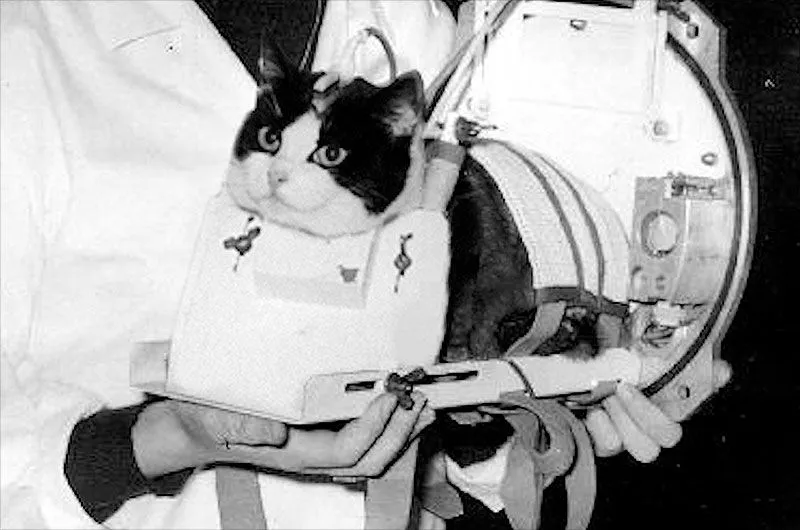
France's CERMA launched Félicette, a Paris stray, on Oct. 18, 1963, making her the first cat in space; she was euthanized two months later for brain study. The program's fatal second flight and a 2019 crowdfunded statue show how quickly high-risk research can be abandoned and later memorialized.
On Oct. 18, 1963, a stray tuxedo cat from Paris named Félicette became the first and only cat in space. She rode a French Véronique AG1 rocket 130 miles above Earth and parachuted safely back to the ground. But her survival was short-lived: two months after recovery, scientists euthanized her so they could study her brain. That decision, buried in the archives of France's early space program, is the reason Félicette's story is equal parts triumph and tragedy.
Félicette was not the original choice for the mission. A cat named Felix was supposed to fly, but he escaped on launch day, so Félicette took his place. The flight was France's bid to join the space race, which at the time was dominated by the United States and the Soviet Union launching primates, dogs, and humans. France's cat program did not last long. A second cat launched on Oct. 24 veered off course, and when it was found a day later, it had died from the journey. After that, CERMA, the French aerospace medicine center, switched its research to flying monkeys.
For context, animal astronauts were the original test pilots of the space age. Before humans rode rockets, dogs, monkeys, and other creatures were sent to measure the biological effects of launch, weightlessness, and re-entry. France's choice of a cat was unusual, but the science was the same: gather data, then study the body. Félicette's brain was the prize, which is why she was euthanized rather than retired to a quiet life. It was a clinical decision, but one that reads very differently today.
Félicette might have remained a footnote in space history if not for a crowdfunded campaign nearly 60 years later. In 2019, a bronze statue of her was unveiled at the International Space University in Strasbourg, France. European astronauts Helen Sharman, Paolo Nespoli, and Reinhold Ewald were on hand for the reveal. She has also been memorialized on postage stamps issued by Chad and Comoros, both former French colonies. The statue and stamps turned a forgotten cat into a permanent symbol.
For executives and boards, Félicette's story is a case study in program risk and public memory. France's cat program was a small, high-stakes experiment that ended after a single fatal follow-up. The pivot to monkeys shows how quickly organizations abandon a line of research when results turn sour. But the more interesting lesson is the afterlife of the program: the government did not build the statue. A crowd of private citizens did, nearly six decades later. That is a reminder that public sentiment can rewrite the legacy of any decision, no matter how obscure.
The ethical questions raised by animal spaceflight are not just historical. They echo into modern debates about testing, research, and the use of living subjects in high-risk environments. For leaders in aerospace, biotech, and beyond, Félicette's story is a prompt to ask: what are we willing to sacrifice for progress, and how will that choice be remembered? The answer may come from an unexpected place, like a crowdfunding page or a postage stamp.
Félicette's record as the only cat to fly in space is secure. Her flight was a technical success, her death a clinical footnote, and her memorial a testament to the power of collective memory. For anyone building something ambitious, the takeaway is simple: the story you leave behind is not always the one you write. Sometimes it is written by the people who remember you, and they may choose to honor you in ways you never imagined.
This story's Key Insights and Take-aways are locked.
Create a free account to unlock Executive Actions for one credit.
Register to UnlockAlways free for Executives Club members. Join the Club
More in Science
Ultracold atoms just created a 'fractional Fermi sea' that breaks quantum rules
A new quantum state challenges decades of theory and hints at 'super-Fermions,' with real stakes for quantum computing and materials science.

Bangladesh's 202,000 measles cases are a 'real warning' to other nations
The world's worst measles outbreak is spreading as routine vaccination falters. Here is why every country's immunization program should pay attention.

CEOs spend 75% of workdays in meetings. Science says talk less
A three-decade review of meeting science finds the most effective leaders listen more than they speak - and that cutting aimless meetings is the fastest productivity win.