
Friday wildfire evac forces temporary shutdown of NASA Deep Space Network station near Madrid
A fast-moving Spain wildfire hit the Madrid communications complex, suspending operations and triggering safety assessments before restart.
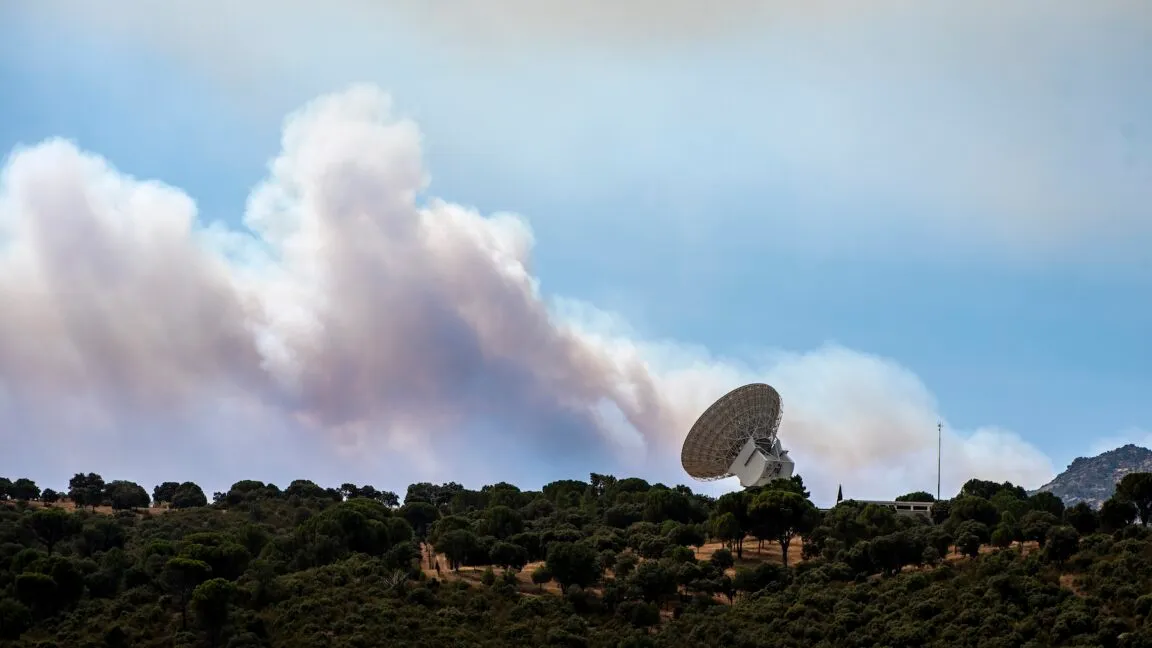
NASA confirmed its Madrid Deep Space Communications Complex in Spain was evacuated Friday due to ongoing wildfires. The disruption temporarily suspended operations at one of NASA's Deep Space Network tracking stations that supports more than 40 missions.
A fast-moving wildfire forced the evacuation of NASA’s Deep Space Network Madrid tracking station on Friday, temporarily suspending operations at one of the agency’s most important deep-space listening posts. The site, located in the hills nearly 40 miles (65 kilometers) west of central Madrid, was evaluated Friday “due to ongoing wildfires in the region,” according to a NASA spokesperson.
In practical terms, that means the station stopped contributing to the Deep Space Network’s global coverage, at least temporarily, while crews and safety teams assess risk. Photos and video from the area showed flames and smoke plumes rising over the ground station’s antenna array, which sits on a large engineered footprint anchored by a 230-foot-diameter (70-meter) radio dish and a collection of smaller 112-foot (34-meter) antennas.
Why this matters to anyone who lives in the world of mission-critical infrastructure is simple: deep-space communications are not a “best effort” service. NASA’s Deep Space Network is designed to provide global coverage by coordinating tracking stations as Earth rotates, bringing planets, stars, and deep space probes in and out of view. The Madrid complex works in concert with similar facilities in California and Australia, which is the structural reason a single location disruption does not automatically mean a mission goes dark. Still, a temporary shutdown is a real operational hit, even if the network can reallocate coverage across time and geography.
The station is part of NASA’s Deep Space Network, which supports more than 40 missions spanning from the Moon to the edge of the Solar System. That includes Artemis, the James Webb Space Telescope, and NASA’s twin Voyager spacecraft. These are not “nice-to-have” programs where you can shrug and wait for clear skies. The Deep Space Network is the connective tissue between spacecraft that are millions or billions of miles away and mission teams on Earth, translating signals into commands, measurements, and scientific data.
There is also a broader reason this story lands with extra weight in boardrooms and executive suites: it is a reminder that climate-driven disruptions are increasingly physical, immediate, and operational, not just theoretical risk. Here, the cause is not a mechanical failure or an IT outage. It is a wildfire impacting the safety and accessibility of a heavily instrumented facility. Even though this event is localized, it echoes a growing pattern across industries where essential assets are exposed to fast-moving natural hazards, and continuity plans get stress-tested in real time.
The source also hints at the governance and process dimension. The NASA spokesperson said any potential damage will be assessed when it is safe to do so. That phrasing matters. It signals a controlled restart process after safety conditions improve, rather than an instant return to normal operations. For executives overseeing mission schedules, data pipelines, or customer commitments, this is the difference between “we think it is fine” and “we verify it is safe.” In other words, it is a safety-first operational decision that can ripple into timelines, though the source does not specify how long operations might be suspended.
For leaders at space-adjacent companies and contractors, the second-order implication is that ground segment reliability is becoming part of resilience strategy, not just engineering. The Deep Space Network’s multi-site design is meant to provide coverage as objects move relative to Earth, but disasters can still force site evacuations and pauses at specific nodes. That can affect scheduling, antenna time allocation, and the rhythm of communications with multiple missions. Even if other stations pick up the slack, the event still forces operational recalibration, and that kind of recalibration costs time and attention.
And for decision-makers more generally, this is also a case study in what “continuity” actually looks like. It is not only redundancy in the abstract, it is redundancy under stress. When the Madrid site is unsafe, the network’s value is tested by how well the California and Australia facilities can coordinate while personnel are evacuated and equipment risk is assessed. This is the kind of quiet, high-stakes dependency that rarely makes headlines until a wildfire turns the lights out at the antenna farm.
The strategic stake is that deep-space missions and the teams that support them operate on tight windows, and communications are the bridge across distance. When that bridge gets temporarily interrupted by a natural disaster, executives in space, telecom, and any infrastructure-heavy sector should treat it as a clear signal: resilience must include safety logistics, not just technical backups. Friday’s evacuation near Madrid is a vivid reminder that space is not isolated from Earth’s most chaotic weather. It is connected to it.
This story's Key Insights and Take-aways are locked.
Create a free account to unlock Executive Actions for one credit.
Register to UnlockAlways free for Executives Club members. Join the Club
More in Technology

doubleAI's Maxwell rewrites code while it runs, claims 38x speedups
The Tel Aviv startup's code execution model formally verifies optimizations, turning AI into an agent for the hardware itself.
Saudi military official paid to fly OpenAI bugging suspect's family out, prosecutors say
A court filing says a Saudi military official funded the family's exit and Riyadh offered bail, putting foreign-influence risk squarely on AI boards.

AI researcher's 26,000-word claim: Neural nets aren't tangled after all
Nick Cammarata's Goodfire post has the AI world split - if he's right, monitoring frontier models just got a lot easier.