
Gold-smashing experiment finds a 5-sigma dip that could unlock matter's secret phase
A billion gold collisions at Brookhaven's RHIC revealed an unexpected dip in particle flow, a possible first glimpse of the long-sought critical point in nuclear matter.
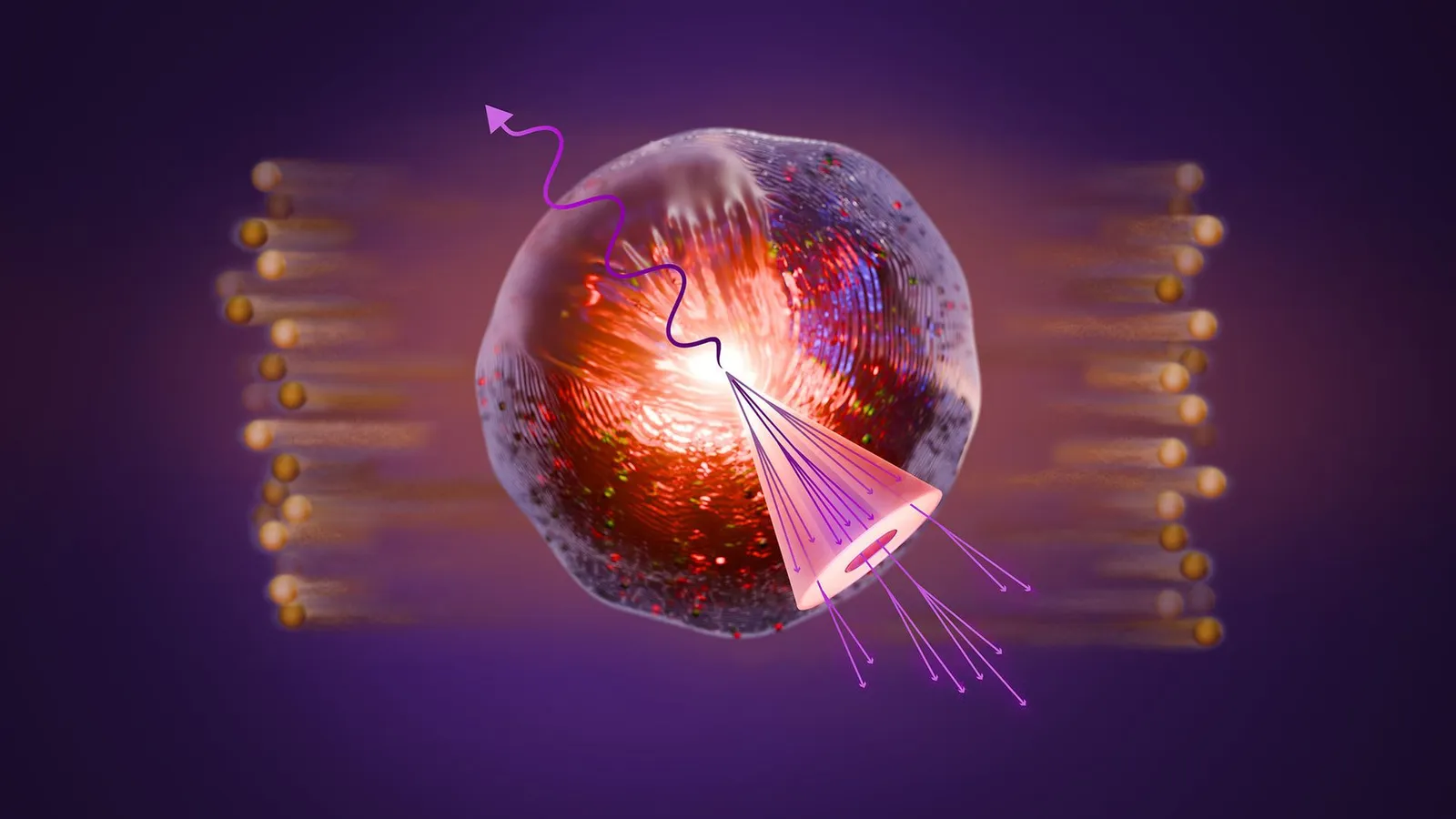
Physicists at Brookhaven National Laboratory's STAR experiment smashed gold nuclei and found a 5-sigma dip in particle correlations, a possible sign of the long-sought critical point in nuclear matter. If confirmed, the finding would reshape understanding of how the universe's first matter condensed into protons and neutrons, with implications for cosmology and neutron-star physics.
Smash a billion gold nuclei together at nearly the speed of light, and you expect a smooth curve. Instead, physicists at Brookhaven National Laboratory's STAR experiment got a dip, and that dip could be the closest thing yet to a hidden phase change in the matter that built the universe. The team, which published its findings Sept. 22 in Physical Review Letters, measured how particles sprayed sideways from roughly 1 billion collisions at the Relativistic Heavy Ion Collider (RHIC). They expected the size of collision-to-collision variations to change smoothly as they dialed the energy up and down. It didn't. The variations dipped, shrank, then grew again, a departure so pronounced that it would occur by random chance only about once in 3.5 million tries.
That 5-sigma signal is the threshold physicists usually demand before treating a result as real, and it points to a landmark that has been theorized for decades: the critical point of nuclear matter. At that special set of conditions, matter changes the way it transforms from one form to another, think of the moment when the boundary between liquid water and steam disappears. The STAR team is careful to call the dip a 'tantalizing hint, not proof,' and study co-author Rutik Manikandhan, a postdoctoral physics scholar at The Ohio State University, told Live Science that effects unrelated to a critical point could still explain part of the signal. But the fact that a widely used computer simulation with no critical point reproduced the overall trend but not the dip makes the anomaly harder to wave away.
To understand why this matters, you need to know what the early universe looked like. For the first few microseconds after the Big Bang, ordinary matter didn't exist. Protons and neutrons, which are made of quarks held together by gluons, had melted into a hot soup of free quarks and gluons called a quark-gluon plasma. As the universe expanded and cooled, that soup condensed into the protons and neutrons that make up everything today. Physicists want to map exactly how that condensation happens, and the tool they use is the equation of state of nuclear matter, the rulebook that links pressure, temperature and density. For water, that rulebook tells you when it freezes, boils or expands. For nuclear matter, it governs the cores of neutron stars and other extreme environments.
The critical point is a key landmark in that rulebook. At extremely high temperatures, matter melts smoothly and gradually into quark-gluon plasma. At higher densities, the change may become abrupt. The critical point marks where one kind of transition turns into the other. Recent calculations have suggested that point might sit within reach of RHIC's lower-energy collisions, so the STAR team ran the collider at the bottom of its range, between 3 and 7.7 GeV per pair of colliding protons or neutrons. RHIC can reach 200 GeV, so these were deliberately low-energy, dense collisions. For the lowest-energy runs, the team used a fixed-target setup: a beam of gold nuclei slammed into a thin gold foil inside the detector, producing the densest matter RHIC can make.
In each collision, the team measured transverse momentum, how hard charged particles were flung sideways out of the fireball, and then looked for correlations between pairs of particles. If a fireball is slightly hotter or expands more forcefully, all its particles get an extra sideways kick together, so those correlations reveal how much temperature and flow fluctuate. Close to a critical point, matter's heat capacity is expected to shoot up, making the fireball's temperature harder to budge and weakening the correlations. That is exactly the non-smooth behavior the team saw in the most head-on collisions. Off-center collisions showed only a faint hint of the same feature, too weak to count as evidence on its own.
The stakes go beyond cosmic nostalgia. Because the matter created in these collisions resembles the matter that filled the universe a few microseconds after the Big Bang, mapping how it behaves helps explain how the universe evolved from a hot soup into the protons and neutrons that make up everything today. It also gives theorists a new, precise measurement to test their calculations against. The team's next step is to extract the specific heat of the hot matter from the correlations and compare it with supercomputer simulations that calculate quark and gluon behavior from first principles. They also plan to combine the dip with other measurements, such as fluctuations in the number of protons produced in the collisions. As Manikandhan put it, 'Only when different measurements agree can we say confidently whether a critical point exists.'
For executives and investors, the lesson is less about quarks and more about how scientific breakthroughs actually happen. The dip wasn't the result of a single dramatic event; it emerged from roughly a billion collisions, careful statistical analysis, and a willingness to question a smooth trend. That pattern repeats across fields, from materials science to drug discovery, where the signal that changes the model is often the one that doesn't fit. The STAR team hasn't proven the critical point exists, but it has given theorists a precise target to aim at. That is how a hint becomes a discovery: one measurement at a time, until the anomalies line up.
This story's Key Insights and Take-aways are locked.
Create a free account to unlock Executive Actions for one credit.
Register to UnlockAlways free for Executives Club members. Join the Club
More in Science

Alaska's 1,580-foot tsunami had warning signs. Scientists just found them.
Rapid glacier retreat, heavy rainfall, and thousands of tiny tremors preceded Alaska's 1,580-foot tsunami, a warning for every coastal community in a warming world.
The rare mutation that lets high-risk brains dodge Alzheimer's
Scientists found a natural defense against protein buildup, opening a new path to preventive treatments.

3,000 steps a day may halve Alzheimer's decline, study finds
New research links a modest daily walk to less tau buildup and nearly half the cognitive and functional decline, even for those with early signs.