
GOP hawks push to block Delcy Rodríguez from U.S. earthquake aid access
The Trump administration leads the humanitarian response, and Republicans want interim Venezuela leadership cut off.
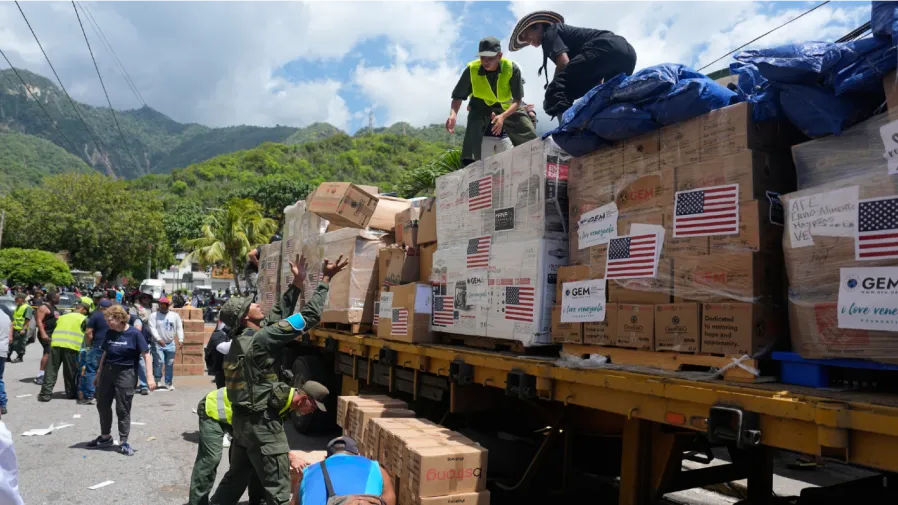
GOP lawmakers who are hawkish on leftist Latin America are urging that Venezuela’s interim President Delcy Rodríguez be excluded from accessing robust U.S. assistance. The push is unfolding as the Trump administration helps lead the global humanitarian response to two massive earthquakes last week.
Two massive earthquakes in Venezuela last week triggered a humanitarian response where the politics are now moving faster than the relief. As the Trump administration helps lead the global humanitarian effort, Republicans hawkish on leftist Latin America are warning that Venezuela’s interim President Delcy Rodríguez must be cut out from accessing robust U.S. assistance.
The core ask is simple and blunt: Rodríguez should not get a seat at the table for U.S.-backed aid channels, even while the U.S. is working to stabilize the immediate disaster environment. The reason is not operational triage. It is leverage. The Hill reports that President Trump has placed little emphasis on a democratic transition in Venezuela, and that stance is colliding with lawmakers who want U.S. resources to be tightly linked to political accountability.
To understand why this becomes a flashpoint so quickly, it helps to know how U.S. humanitarian assistance can become entangled with compliance, eligibility, and sanctions-adjacent policy. Even when aid is meant to be nonpolitical on the ground, the flow of money, logistics, and authorization often runs through entities and officials that the U.S. recognizes, partners with, or permits. In a disaster, “who controls access” can be the difference between rapid distribution and slow, legally constrained bottlenecks. That means hawkish Republicans are not just making a moral argument. They are trying to shape the compliance perimeter around relief.
This is where incentives start to matter. In Washington, lawmakers do not generally get credit for nuance when the situation is already tragic. They get credit for sending signals. By pushing to block an interim leader from accessing robust U.S. assistance, GOP hawks are attempting to create a clear conditionality framework: humanitarian aid should not function as an endorsement of interim authority. For the Trump administration, which is helping lead the global humanitarian response, the pressure is to move quickly without creating a political opening that the hawks believe rewards undemocratic outcomes.
There is also an internal GOP dynamic at play. The Hill headline signals a rift between GOP hawks and Trump-backed regime policy. That tells you this is not a single-policy tweak. It is a coordination problem between factions that may align on disaster response logistics but diverge sharply on Venezuela’s political trajectory. When those factions pull in different directions, it can slow decision-making, complicate interagency approvals, and force humanitarian teams to navigate eligibility rules more carefully.
Second-order implications extend beyond politics. Companies and nonprofits that implement aid programs often depend on stable rules of engagement, including clarity on counterparties and governance. If lawmakers succeed in carving Rodríguez out of access, implementers may need to reroute approvals, change contracting relationships, or increase monitoring to ensure funds do not indirectly benefit excluded authorities. That can raise transaction costs and lengthen timelines. It can also reduce the risk that U.S.-linked support is seen as legitimizing a contested interim leadership.
For executives, boards, and investors watching these decisions, the key is the precedent. When disaster response intersects with contested governance, the compliance posture can become the real “operating constraint.” Relief efforts may still happen, but the pathway changes based on what Washington decides about legitimacy, democratic transition, and eligibility for U.S. assistance. In other words, the humanitarian story becomes a governance story, and governance rules can move faster than logistics.
Zoom out and the strategic stake is clearer. The Hill’s reporting points to President Trump having placed little emphasis on a democratic transition in Venezuela. If that approach holds, hawkish lawmakers may continue to use aid access as a lever to force conditions indirectly. If the administration adjusts, it could reshape how future humanitarian responses are structured when political legitimacy is contested. Either way, the fight now over Delcy Rodríguez is a preview of how U.S. policy may increasingly treat aid access as part of the broader geopolitical and governance toolkit.
This story's Key Insights and Take-aways are locked.
Create a free account to unlock Executive Actions for one credit.
Register to UnlockAlways free for Executives Club members. Join the Club
More in Politics

Glacial collapse, not rain, killed 180 in Nepal's Himalayan flood
The Himalaya's extreme geography hid the true cause of Nepal's catastrophic flood, a glacial collapse that turned a geological battleground into a mass-casualty zone.

Iran’s Esmail Baghaei says Oman talks start shipping via Hormuz, not US talks yet
Temporary route plans with Oman aim to restart commerce while Tehran says Washington dialogue is not on the table.

Standards watchdog opens probe into Reform UK deputy leader Richard Tice over interests
The parliamentary standards commissioner says it began an investigation on 28 July into a possible undeclared interest.