
Hong Wang wins the 2026 Fields Medal, breaking the drought for women in math’s top prize
The I.M.U. names four winners, including Wang at NYU, for solving the Kakeya needle conjecture.
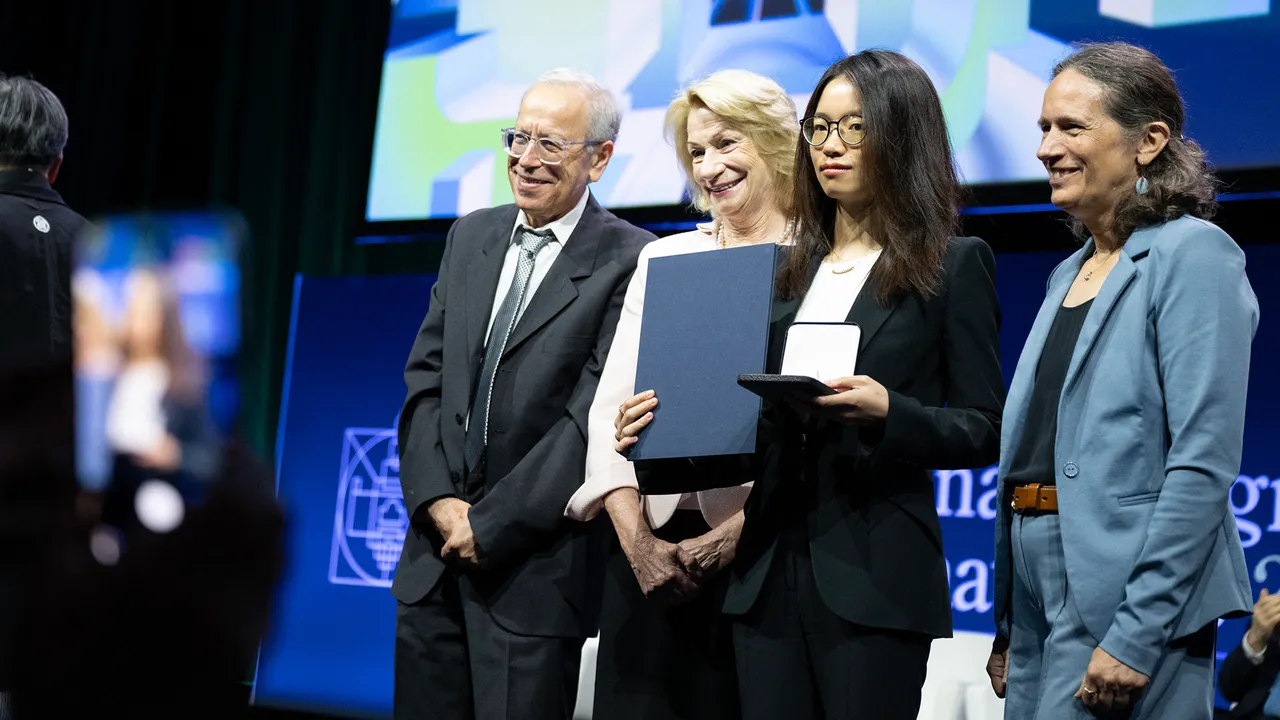
Hong Wang, a professor at New York University, is named among the four 2026 Fields Medal recipients by the International Mathematical Union for her work on the Kakeya conjecture. The decision matters to decision-makers because it signals where elite mathematical breakthroughs are clustering and how rare recognition is for women in the field.
Hong Wang just became the third woman to ever win the Fields Medal in its 90-year history. The International Mathematical Union announced on July 23 that the 2026 award will go to four recipients under age 40, and Wang, a professor at New York University, is one of them for work on a decades-old geometry problem about how a needle can move through 3D space.
The geometry problem has a memorable hook: the Kakeya conjecture asks how little space is needed to rotate a needle so that it points in every possible direction in three dimensions. Wang’s recognition is tied to a new resolution of that conjecture. Mathematicians had chased a solution for roughly 50 years, which is the math equivalent of decades of teams poking at the same locked door. Wang’s win, and the fact that it only took a handful of women to reach this milestone in 90 years, also makes the moment feel unusually high-stakes for anyone watching how talent gets surfaced, funded, and celebrated in elite fields.
So who else is on the 2026 list? The I.M.U. also named Yu Deng of the University of Chicago, recognized for connecting microscopic and macroscopic descriptions of gases. John Pardon of Stony Brook University was recognized for solving major problems in topology and geometry. Jacob Tsimerman of the University of Toronto received the medal for developing powerful new techniques in algebraic geometry that have advanced progress on longstanding mathematical puzzles. The medal is presented every four years to mathematicians under the age of 40, and the 2026 ceremony took place during the International Congress of Mathematicians in Philadelphia.
Now, here is the part that connects a needle-in-3D-space puzzle to the intellectual machinery behind the breakthrough. Wang worked with collaborator Joshua Zahl to prove a precise trade-off. If you track every direction the needle could point as a bundle of thin tubes, there is a relationship between how thin those tubes can be and how much total space they must occupy. The proof required tools from harmonic analysis, a field that studies how complex shapes and signals can be broken down into simpler pieces. In other words, the result is not just about geometry. It is about how to decompose, track, and control structure across scales, which is one reason these “pure math” proofs tend to echo far beyond their original statement.
The pathway to the proof also shows how elite research governance can work even without a corporate boardroom. The source notes that the breakthrough was not a triumphant, immediate victory lap. Wang and Zahl spent months checking their 127-page proof before making it public. Even then, Wang worried the argument might be unclear. That tension matters because it hints at the internal incentives researchers face: get it right, document it deeply, and convince the broader community, all while knowing that the first reading of a long proof can be unforgiving. The paper still drew comparisons to a “once-in-a-century” result, and Quanta Magazine reported it set off a string of honors culminating in the Fields Medal.
For executives, investors, and anyone overseeing research pipelines, this is a useful reminder about the dynamics of recognition and how careers get shaped by bottlenecks. The Fields Medal was first awarded in 1936. So far, 65 men have received it. But no woman received the award in the nearly 80 years before Maryam Mirzakhani’s win in 2014, followed by Maryna Viazovska in 2022. With Wang as the third woman ever to win, the signal is not merely “another winner.” It underscores how long it can take for institutional and cultural systems to produce visibility at the highest level, and how rare that visibility is once it arrives.
There are also second-order implications for adjacent fields that lean on math breakthroughs, even if they are not trying to “solve geometry” per se. When a proof lands using harmonic analysis and delivers a clean trade-off statement, it can change what other researchers think is achievable. Fields Medal announcements tend to be a kind of scoreboard for where deep theory is currently paying off. That makes the list a proxy for the research directions that are most likely to attract attention, mentorship, and funding over the next few years.
Strategically, the takeaway is straightforward. The 2026 Fields Medal is not just a trophy ceremony for mathematicians; it is a publicly validated marker of where the next wave of foundational techniques is emerging. If you are building teams, backing research, or allocating grant dollars, the Kakeya conjecture resolution by Hong Wang, plus parallel advances in gases, topology and geometry, and algebraic geometry, is a reminder to look for the rare combinations: patient, long-horizon work; rigorous documentation; and the right analytical toolkit that turns an old question into a solved one.
This story's Key Insights and Take-aways are locked.
Create a free account to unlock Executive Actions for one credit.
Register to UnlockAlways free for Executives Club members. Join the Club
More in Science

1000 mathematicians pledge to shun AI in their research
A thousand researchers are publicly refusing AI tools, and the reason is a warning for every company betting on AI-generated answers.

Alaska's 1,580-foot tsunami had warning signs. Scientists just found them.
Rapid glacier retreat, heavy rainfall, and thousands of tiny tremors preceded Alaska's 1,580-foot tsunami, a warning for every coastal community in a warming world.

The rare mutation that lets high-risk brains dodge Alzheimer's
Scientists found a natural defense against protein buildup, opening a new path to preventive treatments.