
Hubble reveals LH 95’s crimson star nursery, where blue giants and low-mass infants coexist
NASA’s July 3, 2026 Hubble image shows a stellar association in the Large Magellanic Cloud, plus what it implies about star formation.
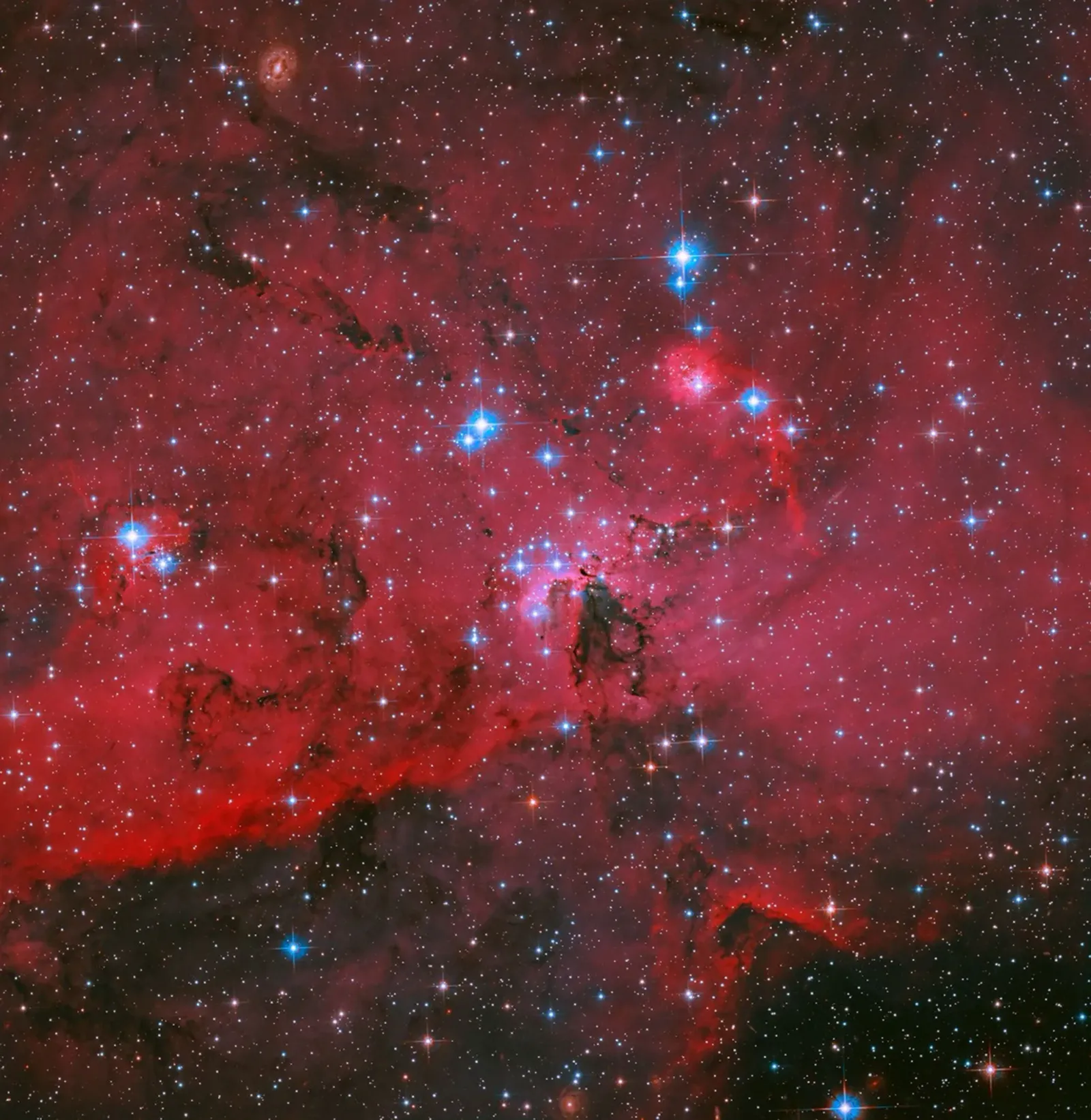
NASA’s Hubble Space Telescope captured a July 3, 2026 image of the stellar nursery LH 95, revealing blue and white stars embedded in glowing crimson gas. For decision-makers, the image is a crisp reminder that stellar nurseries are messy, mixed environments, not tidy factory lines.
On July 3, 2026, NASA’s Hubble Space Telescope turned a distant region called LH 95 into a high-contrast lesson in how stars are born. In the image, blue and white stars shine against a crimson background of glowing gas, and the scene is not a single type of stellar life. Instead, low-mass infant stars live alongside massive blue giant stars in what’s known as a stellar association, one of many such associations in the Large Magellanic Cloud.
LH 95 itself matters because it sits in the Large Magellanic Cloud, a dwarf galaxy that orbits the Milky Way. That orbit is not just trivia for space fans. It’s the context that makes LH 95 observable enough for Hubble to resolve the interplay between youthful stellar populations and the gas that fuels them. This is the core payoff of the picture: star formation in stellar nurseries can be a mixed-age, mixed-mass ecosystem, where different generations and different stellar weights are present in the same broader cloud environment.
To be clear, the image is showing a landscape of gas and dust that has been heated and illuminated by a thriving population of young stars. That combination, gas plus dust plus bright newborn stars, is what turns the surrounding material crimson while the stars cut through in blue and white. In other words, Hubble is not just counting stars. It is capturing the feedback loop: young stars energize the surrounding medium, and the surrounding medium is where the next stars can emerge.
NASA credits the collaboration behind the view: NASA, ESA, and N. Da Rio (The University of Virginia), G. De Marchi (European Space Agency - ESTEC), and D. Gouliermis (Universitat Heidelberg). The processing is credited to Gladys Kober (NASA/Catholic University of America). Even that credit line has an executive-level subtext. Space science is a portfolio business where imaging capability depends on distributed expertise, from mission infrastructure to analysis pipelines. When you see one clean “pretty” result, there is usually a stack of engineering decisions behind it. In governance terms, it is a reminder that outcomes are system-level, not hero-level.
Now zoom out to why this should matter beyond astronomy Twitter. In most real-world organizations, “factory line” thinking is comforting. It says processes run in neat stages, inputs go in one direction, and outputs come out uniform. LH 95 is a counterexample. The coexistence of low-mass infant stars and massive blue giants in a single stellar association suggests that star-forming regions can host multiple stellar populations at the same time, under the same large-scale conditions. For leadership teams, that is a useful mental model for complexity: mixed trajectories can unfold simultaneously, so you cannot manage them like a linear checklist.
There is also a second-order implication for how boards and investment committees might interpret “early-stage environments.” A stellar nursery is not a pristine lab. It is a dynamic system where radiation, heated gas, and dust interact, and the visual appearance is shaped by both the stars and the medium around them. Translate that to any high-velocity domain, and you get a similar governance question: are you tracking the signal you care about, or just the most visible layer? The Hubble image is literally showing both: the bright stars and the crimson gas background that makes the region legible.
Finally, if you are an executive anywhere near science, defense, aerospace, or data-intensive research, this is a clean reminder of what “measurement” looks like when the subject is complex. LH 95 is one region within the Large Magellanic Cloud, a dwarf galaxy orbiting the Milky Way, and Hubble’s vantage lets scientists study stellar associations as part of a broader population. That means the strategic value is not just the single image on July 3, 2026. It is the ability to compare and learn across many nurseries, across many associations, and across many environments.
Hubble’s view of LH 95 ends up being a business lesson in disguise. Your world, like the Large Magellanic Cloud, is full of mixed components: different sizes, different life stages, different time scales. The smartest leaders do not pretend the system is tidy. They build the right instruments, assemble the right teams, and then interpret what the environment is actually doing. In LH 95, the environment is doing exactly what the picture promises: it is glowing because young stars are actively shaping the gas around them, with low-mass infants and massive blue giants sharing the same crimson stage.
This story's Key Insights and Take-aways are locked.
Create a free account to unlock Executive Actions for one credit.
Register to UnlockAlways free for Executives Club members. Join the Club
More in Science

Alaska's 1,580-foot tsunami had warning signs. Scientists just found them.
Rapid glacier retreat, heavy rainfall, and thousands of tiny tremors preceded Alaska's 1,580-foot tsunami, a warning for every coastal community in a warming world.

The rare mutation that lets high-risk brains dodge Alzheimer's
Scientists found a natural defense against protein buildup, opening a new path to preventive treatments.

3,000 steps a day may halve Alzheimer's decline, study finds
New research links a modest daily walk to less tau buildup and nearly half the cognitive and functional decline, even for those with early signs.