
Hubble spots the black hole inside a Milky Way star cluster at last
For decades, scientists suspected a hidden black hole hotspot. Hubble finally finds the missing evidence.
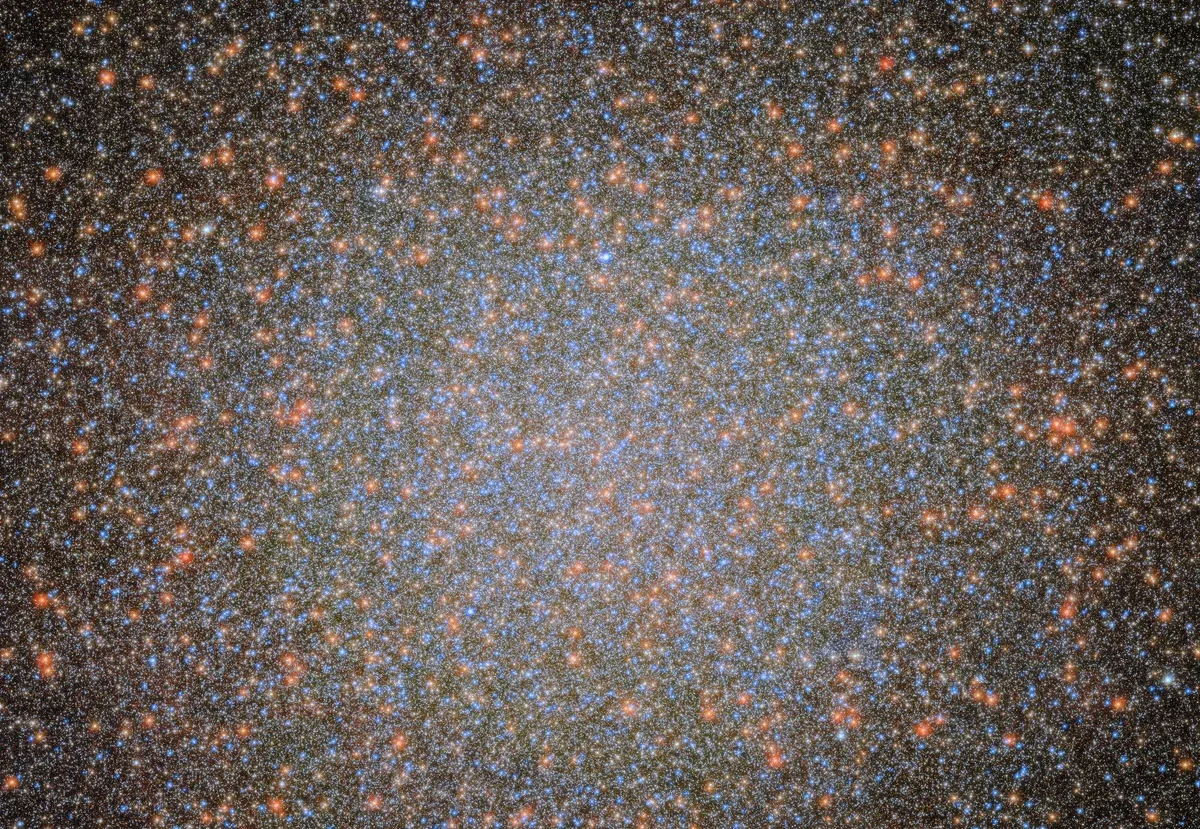
NASA's Hubble Space Telescope revealed a black hole hiding inside a massive star cluster in the Milky Way, ending a long observational gap. The result matters for decision-makers because it validates a previously suspected target and sharpens how future space investment may prioritize similar searches.
NASA's Hubble Space Telescope has revealed a black hole hiding inside a massive star cluster in the Milky Way, finally confirming what scientists had long suspected. For decades, researchers had been unable to spot any direct evidence, leaving the black hole hypothesis stuck in the realm of educated guesses.
That is the real story here: not a routine new image, but a decades-long “we think it’s there, but we can’t see it” problem getting resolved by a single observational breakthrough. Hubble’s view provides the missing detection in the exact kind of environment scientists had identified as a hotspot for a certain kind of black hole. In other words, the cluster did not just look interesting. It was interesting in the way that counts.
If you are used to reading science through the lens of “cool discovery,” it helps to think about it as an evidence pipeline. Researchers identify targets, form a hypothesis, then wait for the instruments to produce the kind of signal that turns suspicion into measurement. Here, the measurement was elusive “for decades,” which matters because it tells you something about the friction in the system. The stars in a massive cluster are dense, and the light signals can be complicated by crowding, background emission, and the fact that black holes themselves do not shine. You are often looking for indirect fingerprints, and those fingerprints can be hard to tease out until the right data quality, observation strategy, or analysis makes them stand out.
For executives and investors who do not live inside observatories, the second-order implication is about capital allocation. When something has been suspected but unproven for decades, it is effectively a stalled bet on future payoff. Hubble delivering the confirmation means the uncertainty drops. That can influence how agencies and partners decide where to focus their next observing campaigns, telescope time, and technology development. It also affects how scientific communities justify budget requests and coordinate mission priorities, because a confirmed detection makes a clearer case for scaling up similar searches.
There is also a governance and regulatory angle, even if the story itself is not about regulators in the usual sense. Space science depends on durable funding models and on compliance frameworks that govern launches, operations, and data usage. When a high-profile instrument like Hubble delivers a breakthrough, the downstream effect can include stronger internal justification for continuing operations and for enabling new missions that extend or replace that capability. In practice, the “regulatory” part shows up as planning discipline. Agencies must show that time on instruments and mission investments will produce defensible scientific outputs. A result that ends decades of non-detection gives leadership something concrete to point to.
Now zoom out to why this matters for the broader Milky Way map. Star clusters are not just backdrops. They are dynamical systems where many stars interact, and those interactions can help shape the formation and evolution of compact objects, including black holes. When scientists identify a cluster as a hotspot and then confirm a black hole hidden inside it, it changes how that cluster gets modeled. Models are not merely academic. They guide what astronomers look for next and how they interpret new signals from other regions of the sky.
For peer decision-makers watching this space, the takeaway is straightforward: when an instrument resolves a long-standing observational gap, it can unlock a chain reaction. The scientific community can move from “suspected” to “measured,” and that shift tends to pull more attention, more proposals, and more follow-up analyses. If you are steering an organization tied to space research, data platforms, or observational technology, this kind of confirmation is the difference between funding something speculative and funding something testable.
Finally, there is a strategic stake you can feel even without being an astrophysicist. Black hole searches are a high-competition arena for both observing time and scientific credibility. A discovery that confirms a previously elusive black hole within a massive star cluster provides a template for how the next generation of detections might be pursued, including which environments look most promising. In a world where budgets are constrained and priorities are constantly contested, turning decades of uncertainty into a clear signal is not just a scientific win. It is an institutional one.
This story's Key Insights and Take-aways are locked.
Create a free account to unlock Executive Actions for one credit.
Register to UnlockAlways free for Executives Club members. Join the Club
More in Science

Alaska's 1,580-foot tsunami had warning signs. Scientists just found them.
Rapid glacier retreat, heavy rainfall, and thousands of tiny tremors preceded Alaska's 1,580-foot tsunami, a warning for every coastal community in a warming world.

The rare mutation that lets high-risk brains dodge Alzheimer's
Scientists found a natural defense against protein buildup, opening a new path to preventive treatments.

3,000 steps a day may halve Alzheimer's decline, study finds
New research links a modest daily walk to less tau buildup and nearly half the cognitive and functional decline, even for those with early signs.