

IMF cuts 2026 growth forecast to 3% again, then sees 2027 rebound
Global demand forecasts are shifting under war-linked uncertainty, with knock-on risks for investors, budgets, and power markets.
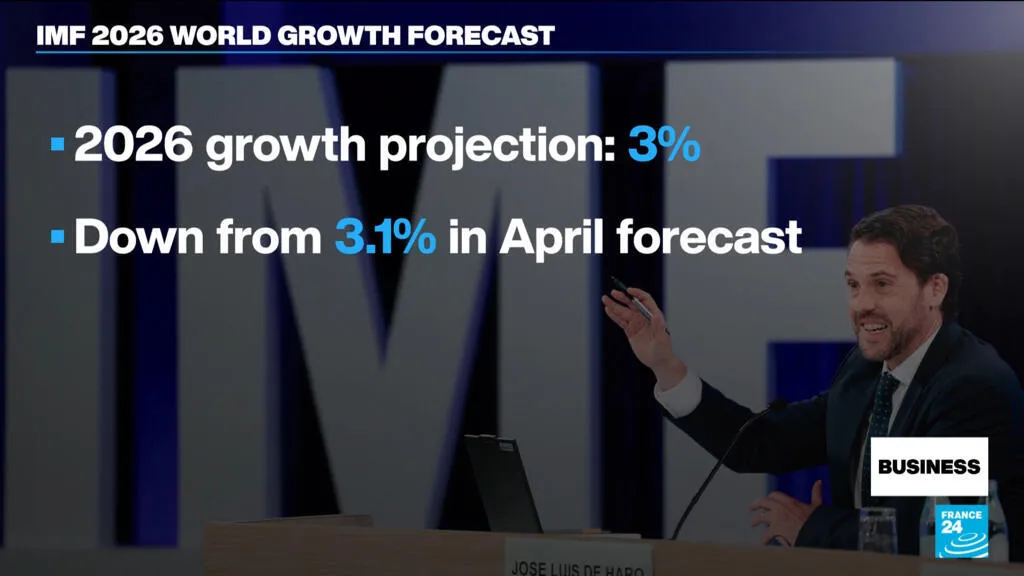
The IMF has lowered its global growth forecast for the second time this year, citing uncertainty and risks tied to the war in Iran. Decision-makers now have to plan around softer 2026 conditions, then a less certain rebound in 2027.
The IMF just did the budgeting equivalent of moving the goalposts: it lowered its global growth forecast for the second time this year to 3% for 2026, while projecting a rebound in 2027. It also pointed to "uncertainty and risks" stemming from the war in Iran. Translation: the world economy is not just slowing, it is doing so in a fog that makes planning harder.
This matters because growth forecasts are not trivia for economists. They quietly drive real decisions: how aggressively companies hire, how governments size tax and spending plans, and how investors price risk across markets. A second cut in the same year is a signal that forecasters think the downside case is becoming more plausible, not less. And when the IMF ties that uncertainty to a specific geopolitical shock, it is basically telling executives that risk management, not just revenue forecasting, should be the center of the boardroom debate.
Now zoom out for a second. The IMF lowering a global growth forecast is usually the product of many moving parts, but the headline driver in this report is uncertainty linked to the war in Iran. In practice, that can show up in how energy markets behave, how supply chains react, and how quickly trade and investment decisions can be made. Even if a business is not directly exposed to Iran, uncertainty can still reduce appetite for long-term commitments. When risk rises and visibility falls, companies tend to delay expansions, renegotiate contracts, and tighten working capital. That is how geopolitical risk turns into economic drag.
The report also ties together two other policy and infrastructure pressure points playing out alongside the IMF update. Spanish Prime Minister Pedro Sanchez is responding to threats from Donald Trump that the US will cut off all trade with his country. For executives, the significance is straightforward: trade threats are not abstract diplomacy. They can change tariff exposure, disrupt sourcing plans, and force companies to re-price margins. When government positions harden, firms that rely on cross-border flows often scramble to understand which routes, products, or parts of their supply chain could get hit.
Then there is the heatwave angle, with France's power system under pressure. That is a reminder that macroeconomic uncertainty and real-world operational strain often travel together. A stressed grid means higher marginal costs for electricity, potential curtailments, and greater volatility for energy-dependent sectors. If growth is forecast to soften while infrastructure stress is rising, CFOs and operations leaders face a double task: protect cash in slower demand conditions and maintain reliability when physical constraints tighten.
Put these threads together and you get a clearer picture of what the IMF update is really doing. It is not just adjusting a number on a spreadsheet. It is flagging a world where risks are concentrated and outcomes are harder to predict, then asking leaders to believe that 2027 will look better. But a projected rebound is not a guarantee. The second forecast cut signals that the path to 2027 depends on conditions improving, and the IMF is explicitly warning that uncertainty is still in the system.
So what should peers do with this, especially boards and senior finance teams? First, treat forecasts as living inputs, not commitments. If the IMF can cut its outlook again within the same year, internal plans that assume steady conditions may need a faster review cycle. Second, connect macro assumptions to operational realities, like energy availability and cost, because heatwave-driven pressure can hit margins quickly even when demand is not collapsing. Third, in countries where trade policy is becoming unstable, stress test supply chains and pricing mechanisms for scenarios where the business environment tightens before it loosens.
The strategic stake is simple: the difference between a manageable slowdown and a painful one is usually preparation for uncertainty. The IMF is warning that risks are real and that the rebound is conditional. In that environment, leadership is less about predicting the future perfectly and more about building a plan that survives bad surprises.
This story's Key Insights and Take-aways are locked.
Create a free account to unlock Executive Actions for one credit.
Register to UnlockAlways free for Executives Club members. Join the Club
More in Politics

Glacial collapse, not rain, killed 180 in Nepal's Himalayan flood
The Himalaya's extreme geography hid the true cause of Nepal's catastrophic flood, a glacial collapse that turned a geological battleground into a mass-casualty zone.

Iran’s Esmail Baghaei says Oman talks start shipping via Hormuz, not US talks yet
Temporary route plans with Oman aim to restart commerce while Tehran says Washington dialogue is not on the table.

Standards watchdog opens probe into Reform UK deputy leader Richard Tice over interests
The parliamentary standards commissioner says it began an investigation on 28 July into a possible undeclared interest.