

InSight spotted a 24 km magma boundary, rewriting how Mars could become habitable
NASA's seismic data suggests Mars once hosted deep magma oceans, hinting at greenhouse-fueled habitability without plate tectonics.
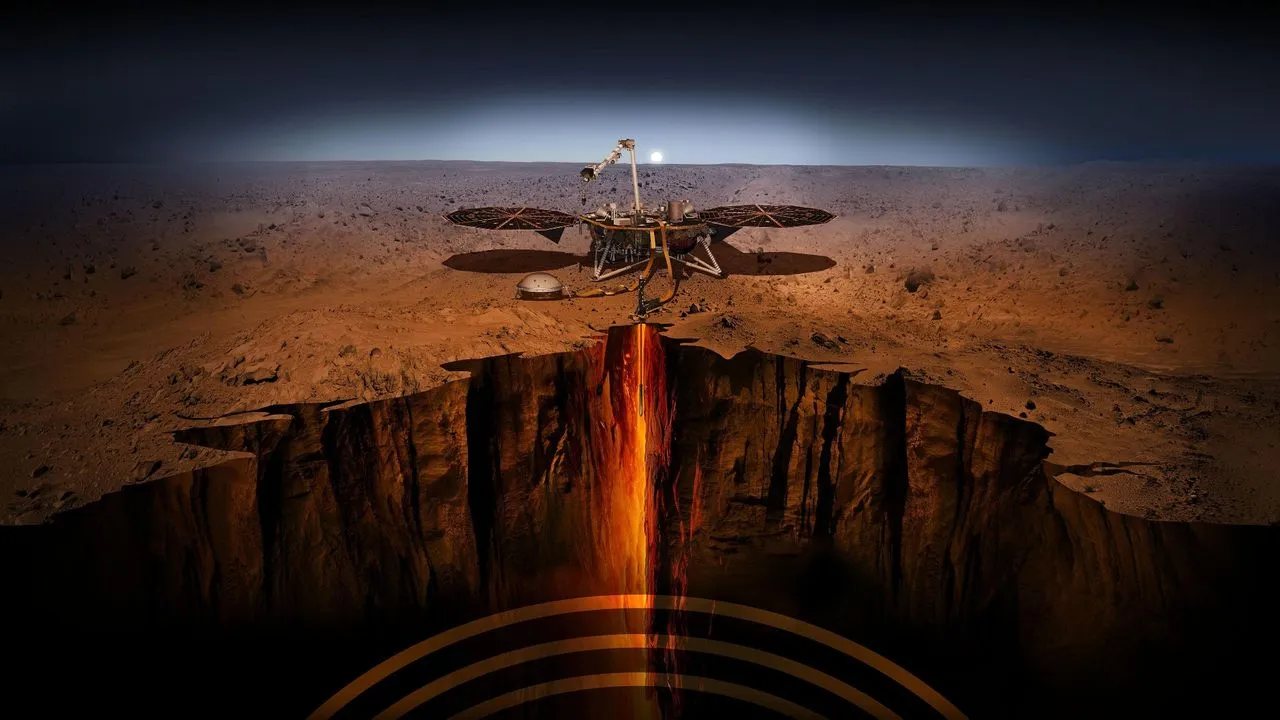
NASA's InSight mission (operating 2018-2022) found a 15 miles (24 kilometers) deep boundary between rock types, interpreted as layers frozen from enormous magma pools. For executives tracking space risk, this reframes Mars' geology, potential resources, and which early-world models might actually cash out.
NASA's InSight mission found a seismic boundary 15 miles (24 kilometers) deep inside Mars, and the explanation is wild: the Red Planet may once have been layered by enormous pools of magma. The marsquakes detected by InSight point to a crust that differentiated around a magma-driven boundary, meaning early Mars might have had a much more complex interior than the standard “stagnant lid” story.
That matters because Mars is not Earth. Earth’s crust is constantly remixed by plate tectonics, with giant slabs shifting above the molten mantle. That tectonic motion helps generate earthquakes and volcanoes, and it also reprocesses the planet’s materials in ways that influence atmosphere and climate. Mars, by contrast, has long been treated as a “stagnant lid” planet, where the crust is one unbroken layer and the mantle beneath is assumed to be fairly homogenous down to at least 23.6 miles (38 km). InSight was designed to test that assumption by listening for marsquakes triggered by meteorite impacts or internal shifts, then inferring Mars’ internal structure from how the seismic waves travel through different rock types.
After years of analysis, researchers at the University of Oxford say the boundary was the missing piece that had not been explained. Using geothermal models and statistics, the Oxford team identified the two rock types that best match the seismic data. Above 15 miles (24 km) deep, they report a thick layer of mafic rock, rich in iron, magnesium, and silica. Below that depth lies denser crystalline ultramafic rock, which still contains iron and magnesium but is depleted in silica, and which descends a further 8.7 miles (14 kilometers) to the crust-mantle boundary.
How do you get that kind of layered differentiation without Earth-style tectonics? The researchers conclude it required huge pools of magma that once resided in giant pockets within Mars’ crust. The idea is that, like oil separating from water, the mafic and ultramafic materials separated over time while the magma was still molten. As the system cooled and froze, the layered rock record remained. The pockets of magma could have extended for hundreds, and possibly even thousands, of kilometers around the planet, with each pool linked to others. That creates a direct line from interior physics to what future missions can measure and where value might sit.
The implications go beyond geology trivia. The Oxford team argues that Mars’ big volcanic systems, including Olympus Mons and the Tharsis volcanoes, would not have been isolated hotspots. Instead, they would have been interconnected beneath the surface through those transcrustal magma systems. This is another surprise: the researchers note that transcrustal magmatism has only ever been found on Earth before. Translation for non-specialists: if Mars could run complex, long-lived magmatic systems without plate tectonics, then other “small, quiet, tectonically unlikely” worlds might also be worth re-examining for complex chemistry and, potentially, habitability.
Habitability is where the business stakes get sharper. The paper’s framing suggests that regurgitating carbon back into the atmosphere via volcanism could have supported a greenhouse effect. Mars’ atmosphere is notoriously leaky because of its small size, low gravity, and lack of a magnetic field, which has contributed to substantial atmospheric loss over time, including large quantities of water escaping into space. If interconnected magma chambers drove large-scale volcanism, they could have belched greenhouse gases back into the atmosphere, thickening it and helping keep temperatures warmer for longer.
Then comes the resource angle that space investors and operators quietly care about: where minerals end up. Lead author Tobermory Mackay-Champion, previously at Oxford during the research and now at the University of Bristol, highlights that the reprocessing of Mars’ crust could have left metal deposits nearer the surface than previously thought. He also points to “significantly more near-surface mineral wealth than previously recognized,” which could boost Mars’ potential for future mining, crewed missions, and, eventually, permanent settlements.
Of course, “more near-surface wealth” is a double-edged sword. It can accelerate mission planning and reduce the amount of drilling needed to reach valuable materials, but it also raises the specter of companies pillaging and exploiting the Red Planet for its resources. That policy tension is starting to matter more as Mars-focused plans move from concept to hardware, because every technical step toward accessibility pressures the question of who gets to extract, how, and under what rules. The findings were published on June 26 in Nature Astronomy, giving the broader Mars science and industry community a new, data-backed starting point: not a simple stagnant lid beneath, but a differentiated interior shaped by massive magmatic systems that could have influenced both climate and composition early on.
This story's Key Insights and Take-aways are locked.
Create a free account to unlock Executive Actions for one credit.
Register to UnlockAlways free for Executives Club members. Join the Club
More in Science

Alaska's 1,580-foot tsunami had warning signs. Scientists just found them.
Rapid glacier retreat, heavy rainfall, and thousands of tiny tremors preceded Alaska's 1,580-foot tsunami, a warning for every coastal community in a warming world.

The rare mutation that lets high-risk brains dodge Alzheimer's
Scientists found a natural defense against protein buildup, opening a new path to preventive treatments.

3,000 steps a day may halve Alzheimer's decline, study finds
New research links a modest daily walk to less tau buildup and nearly half the cognitive and functional decline, even for those with early signs.