

IQM goes public on Nasdaq at about $1.9B, and quantum’s future still feels unsettled
Finland’s IQM just listed, but the market debate is already shifting from hype to survival questions.
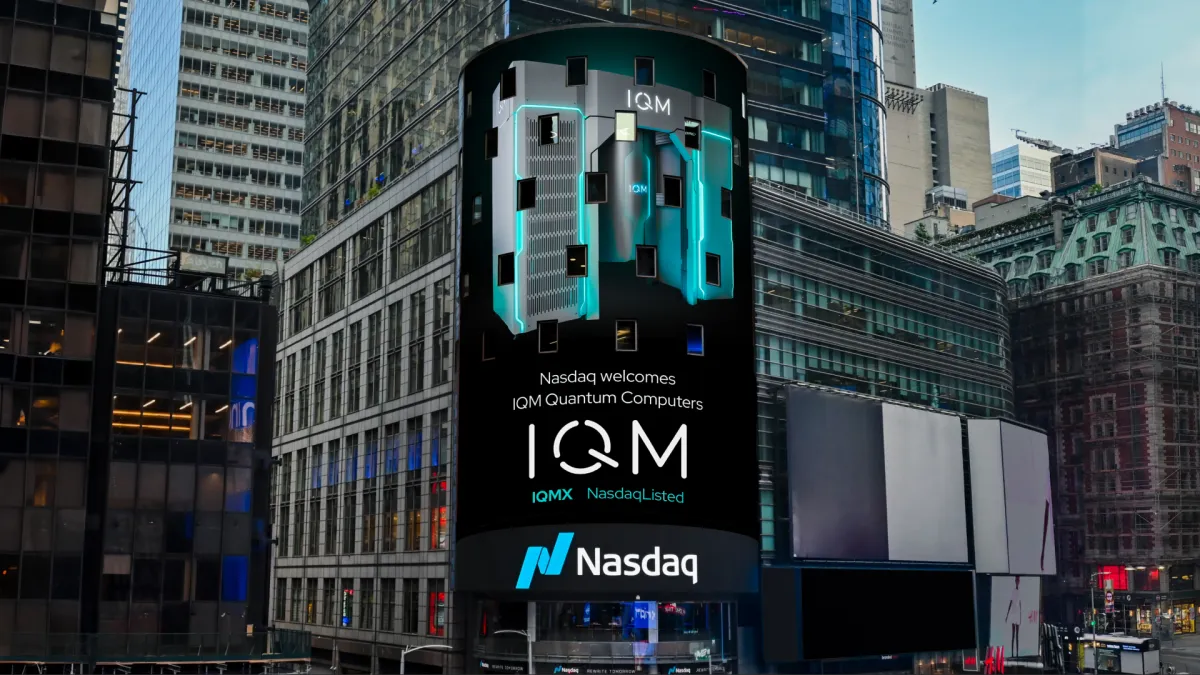
IQM, Europe’s first public quantum company and a full-stack quantum company out of Finland, went public on the Nasdaq today at a valuation of about $1.9 billion. For decision-makers, the consequence is a new benchmark for quantum risk appetite, at a moment when even insiders admit the tech’s future remains uncertain.
IQM, Europe’s first public quantum company, went public on the Nasdaq today at a valuation of about $1.9 billion. That is the headline number decision-makers will anchor on: the market is willing to put real public-company capital behind a technology whose long-term path is still not guaranteed.
The framing matters, because IQM is not pretending quantum is solved. The company admits the future of the tech is uncertain, even as it completes a major corporate milestone. In other words, this is not “quantum is here.” It is “quantum is investable enough to list,” with the uncertainty explicitly acknowledged as part of the deal.
To understand why this is so consequential, zoom out to what going public actually changes. Private quantum companies can float on science progress and grant cycles. A public company has a different rhythm: quarterly expectations, public disclosure, and a continuous need to justify its valuation with milestones that shareholders can understand. When IQM lists at roughly $1.9 billion, it effectively turns technical uncertainty into market scrutiny. Even if the underlying technology moves slowly, the trading floor will still demand updates.
IQM also sits at the center of a second-order tension in deep tech: “full-stack” claims raise the bar. A “full-stack quantum company out of Finland” implies more than one layer of work is being attempted, typically meaning hardware, systems integration, and application readiness all have to advance together. That is not automatically bad, but it raises the risk profile because execution has to be synchronized across components. In private markets, investors can tolerate longer integration cycles if the plan sounds coherent. Public markets usually want proof that execution is moving faster than ambiguity.
There is also a Europe angle. Calling IQM “Europe’s first public quantum company” signals a maturing regional ecosystem, where quantum founders can now pursue Nasdaq liquidity instead of staying locked in venture and strategic rounds. That can pull more capital into the category, but it can also create a harder comparison set. Once one company publishes a valuation and a narrative in the public markets, other quantum startups and funding vehicles will be measured against it, for better or worse. Boards at peer companies will feel this immediately, because it changes how investors talk about timelines and “credible progress.”
Regulatory and market mechanics are a quiet but real factor here. Going public means operating under public-market disclosure expectations and investor protections that do not exist in the same way for private firms. That shifts how uncertainty is communicated. Instead of only telling stories in pitch decks, the company must put facts and risk language in front of the market in a way that can be audited, compared, and challenged. When the company says the future of the tech is uncertain, that admission is now part of the public record, not a soft caveat in a slide.
For decision-makers evaluating quantum exposure, IQM’s listing price does not answer the biggest technical question. It answers a business question: whether capital markets are willing to fund a company tied to a technology whose future is still unclear. That matters even for people outside quantum, because it is a stress test for how public investors are approaching frontier tech categories in general. If IQM can sustain attention and liquidity, it sets a path for other deep tech players to seek public status. If it struggles, it becomes a warning about how quickly “uncertain futures” get repriced when the calendar forces milestones.
So the strategic stake for executives is simple: IQM’s Nasdaq listing at about $1.9 billion puts a visible stake in the ground, and it does so while still calling out uncertainty. The market has to decide whether that uncertainty is a temporary engineering problem or a structural limitation. And for boards and investors watching from adjacent sectors, this is the template they will use: public markets can fund quantum, but only if the company turns uncertainty into trackable progress faster than the market gets bored.
This story's Key Insights and Take-aways are locked.
Create a free account to unlock Executive Actions for one credit.
Register to UnlockAlways free for Executives Club members. Join the Club
More in Business
Comcast shares jump 25% as it plans to split NBCUniversal and Sky
The tax-free spin-off could reshape focus, funding, and competition across media and tech for years.

Bungie cuts most Destiny 2 staff as Sony says Marathon still matters
Herman Hulst confirms layoffs affecting most Destiny and some Marathon teams after Bungie admits Destiny fell short.

SK Hynix jumps 11% after seeking up to $29.4B in Nasdaq listing
The chip giant filed for a Nasdaq listing plan that could raise $29.4 billion, instantly reshaping investor expectations.