

Iran maps strategy against the US as papers ask: power or peace failure?
France 24’s Monday press review connects Iran’s regional posture to US pressure, with two surprising parallel stories.
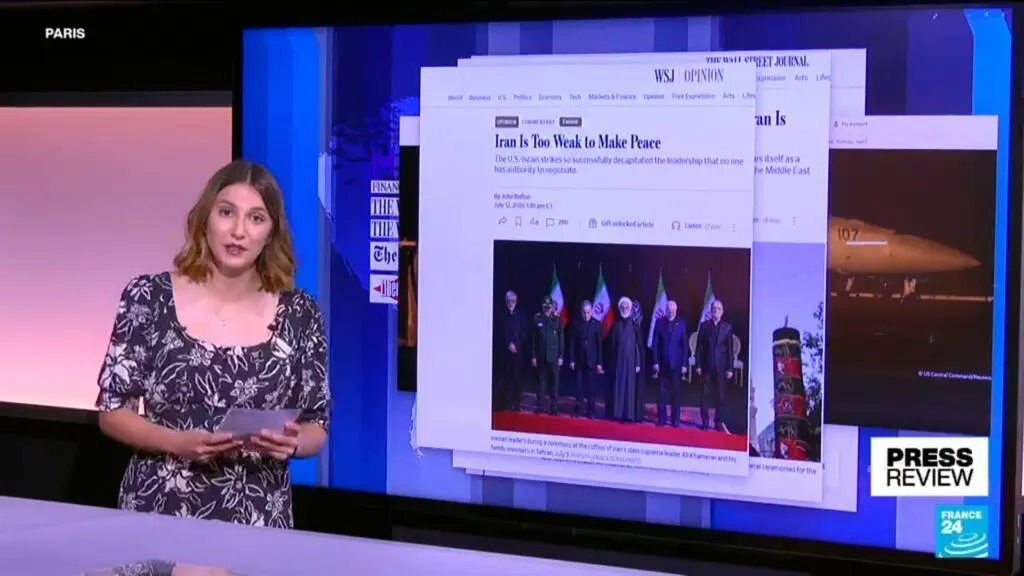
France 24’s Monday July 13 press review says newspapers are analyzing Iran’s strategy against the United States. It also notes a separate report about a quiet refuge in Japan for Russian spies, plus a human interest story about a dog and its “emotional support duck.”
Monday July 13’s press review reads like three different openings to the same headline: one about Iran, one about espionage, and one about a very particular kind of companionship. The through line is leverage. Who has it, who loses it, and how pressure changes behavior across state, security, and even day-to-day life.
On Iran, the papers focus on the country’s strategy against the United States. The question France 24 frames is blunt: is Iran a rising regional power, or too weak to make peace? That debate matters far beyond newspaper talk. In most geopolitical flashpoints, negotiations do not happen in a vacuum. They happen because one side believes it can trade concessions for stability, or because it thinks the alternative is worse. So when analysts parse Iran’s posture toward the US, they are really probing a core decision point for the region: whether Iran is positioning for expansion and deterrence, or searching for a workable off-ramp.
This is also where incentive structures start to matter the way they do in business turnarounds. If Iran is trying to strengthen its hand against the United States, then “peace” becomes less about moral preference and more about whether the counterparty can credibly deliver outcomes that reduce risk. If, instead, the papers treat Iran as too weak to make peace, then the same posture could look like something else entirely, a bid for time or breathing room while internal constraints narrow the room to maneuver. Either way, the US-Iran relationship becomes a live variable that investors, lenders, insurers, and multinational operators watch because it influences sanctions risk, trade flows, and regional security costs. The region’s volatility is not abstract. It shows up in risk premiums and planning assumptions, sometimes quietly, sometimes all at once.
Now zoom out to the second item in the review: in Japan, a quiet refuge has emerged for Russian spies, according to the report. The phrase “quiet refuge” is doing a lot of work. It suggests the kind of operational gap that intelligence professionals and regulators worry about: a jurisdiction that can appear routine on the surface while becoming a safe harbor underneath. For executive decision-makers, the business equivalent is compliance exposure. A location or partner can be “normal” until it is not, and then the reputational and legal costs hit quickly. Even if an executive is not directly involved in intelligence activities, national security events can cascade into tightening oversight, more scrutiny for travel and data handling, and heightened due diligence for cross-border operations.
Tie these two stories together and you get a risk pattern: strategic actors behave as if they have time, unless regulators and counterparties change the rules of the game. When countries strengthen their bargaining posture against a rival power, they also test how much pressure the other side can apply before behavior shifts. When espionage networks find refuge, they test how reliably existing defenses work. The second-order effect for leaders is that “international risk” is rarely a single lever. It is sanctions policy, enforcement intensity, export controls, information governance, and the speed at which governments move from investigation to action.
Finally, the press review adds a deliberately human note. It tells the story of a dog and its “emotional support duck.” That might sound like a palate cleanser, but it still reflects how institutions handle non-standard categories of needs and claims. Emotional support animals and related accommodations sit in a regulatory gray zone that varies by jurisdiction, and even when policies are clear, enforcement can be inconsistent. For boards and executives, the lesson is similar to the geopolitical ones: systems do not just manage assets and weapons, they also manage narratives. People test boundaries, institutions respond, and then compliance becomes both legal and cultural.
So what should decision-makers take from all of this, beyond the odd image of an emotional support duck? Start with the Iran question. If newspapers are asking whether Iran is strong enough to make peace, then the practical implication is that negotiation windows may be narrower or more conditional than anyone wants to assume. If the strategy is aimed at gaining leverage against the United States, expect signaling to be as important as any formal proposal. If the strategy reflects weakness, expect behavior to prioritize survival over compromise. Either scenario can create uncertainty for anyone operating in markets tied to the region.
The executives, investors, and operators who will feel this most are the ones who budget and plan under uncertainty. They need to treat press analysis as more than background noise. It is an early indicator of how narratives are shifting, and narratives often precede policy tightening or easing. Meanwhile, the Japan “quiet refuge” story is a reminder that risk can appear in unexpected places, and the dog-and-duck story is a reminder that regulators handle edge cases with uneven speed. In a world where power is contested and systems are tested, the ability to anticipate second-order effects is not a nice-to-have. It is the job.
This story's Key Insights and Take-aways are locked.
Create a free account to unlock Executive Actions for one credit.
Register to UnlockAlways free for Executives Club members. Join the Club
More in Politics

Glacial collapse, not rain, killed 180 in Nepal's Himalayan flood
The Himalaya's extreme geography hid the true cause of Nepal's catastrophic flood, a glacial collapse that turned a geological battleground into a mass-casualty zone.

Iran’s Esmail Baghaei says Oman talks start shipping via Hormuz, not US talks yet
Temporary route plans with Oman aim to restart commerce while Tehran says Washington dialogue is not on the table.

Standards watchdog opens probe into Reform UK deputy leader Richard Tice over interests
The parliamentary standards commissioner says it began an investigation on 28 July into a possible undeclared interest.