

Jake Tapper calls Trump’s press crackdown “un-American,” warns “we’re watching, so is history”
The CNN anchor points to Air Force One and Pentagon reporter limits, then ties it to DOJ leadership politics.
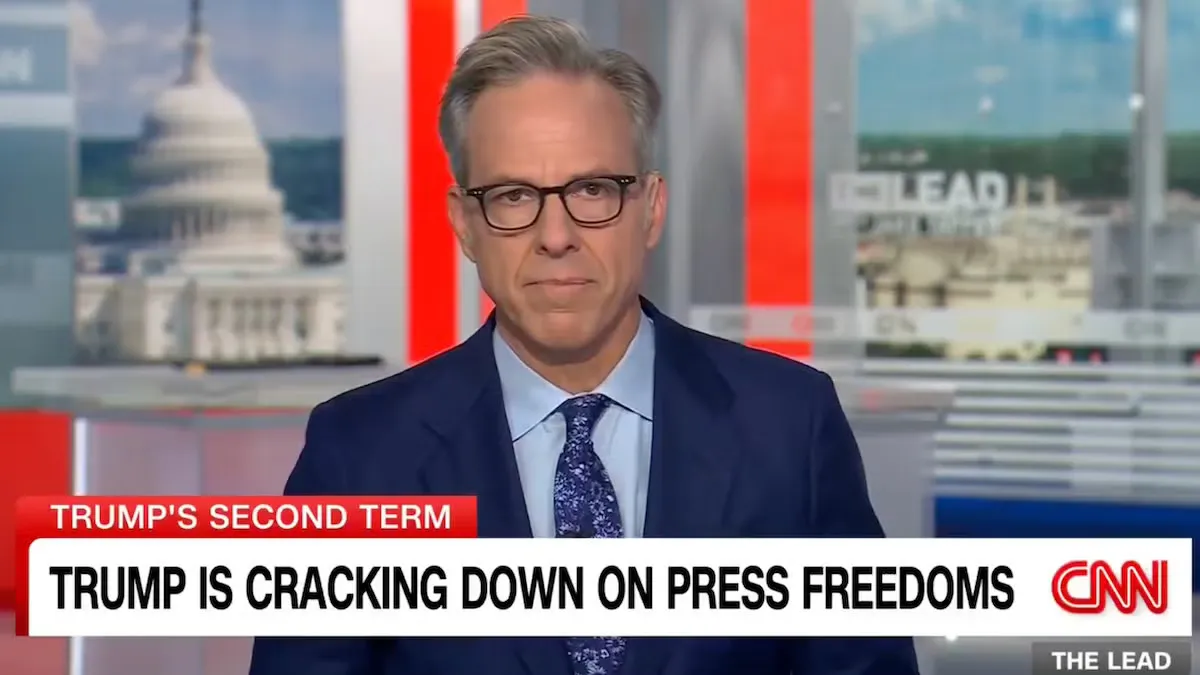
Jake Tapper, CNN’s anchor for “The Lead,” criticized President Donald Trump for repeated attacks on First Amendment protections for the press. The episode highlights White House and Pentagon restrictions on reporters and connects the issue to Secretary of Defense Pete Hegseth’s leak posture and Todd Blanche’s potential Justice Department leadership.
Jake Tapper did not mince words Monday on “The Lead.” The CNN anchor called Trump’s approach to free speech a hypocrisy wrapped in patriotic language, saying, “Mr. First Amendment has turned out to be anything but,” and warning, “We’re watching, so is history.”
His point was not abstract. Tapper laid out a sequence of real-world actions, including restrictions meant to shape how major outlets cover the government. He said the White House barred Associated Press reporters from Air Force One and Oval Office meetings because the AP did not change its style to call the Gulf of Mexico the “Gulf of America,” and he added that the Pentagon tried to impose broad restrictions on reporters, barring them from the building if they did not accept the imposed terms. Both restrictions, Tapper noted, have been challenged in court. For leaders trying to read the room, that is the crux: the conflict is not just rhetoric. It is access, language, and institutional leverage.
Tapper’s framing matters because it connects press freedom to governance incentives. In most modern administrations, the press is not only a storyteller, it is a gatekeeper for public accountability. When the gatekeeper is punished for coverage or for editorial choices, the story shifts from “how does the government communicate?” to “what happens when communication turns conditional?” Tapper described going after reporters as “downright un-American,” calling it part of “a string of deeply concerning escalations.” He also compared the current posture to earlier moments where Trump targeted speech, saying “Jimmy Kimmel and Stephen Colbert come to mind.” The specific detail he returned to is the press-versus-power mechanism: if you refuse the administration’s framing, you risk losing access.
He then widened the lens to what the strategy could be aiming at. Tapper pointed to Secretary of Defense Pete Hegseth and his Signalgate scandal from last year as a place to look for cracking down on leaks. Tapper said both Trump and Hegseth had said such a crackdown would happen. That matters beyond the newsroom, because leak policy sits at the intersection of national security, organizational discipline, and how intelligence and policy insiders manage risk. If the government increases penalties or restrictions around information flow, it can reduce friction in the short run for officials, while increasing the long-run friction for oversight. Executives who rely on government relationships understand the dynamic: when compliance becomes coercive and “what you can say” becomes “what you are allowed to do,” every stakeholder recalibrates.
Tapper also brought in Todd Blanche, Trump’s former personal lawyer, and the upcoming nomination vote to lead the Justice Department. The logic was straightforward in the segment. Tapper said a vote in favor of Blanche would mean “another person pushing Trump’s anti-First Amendment agenda.” Whether someone agrees with that characterization, the operational stake is clear: Justice Department leadership influences enforcement priorities, prosecution posture, and the tone of legal pressure. For corporate and institutional boards, that is not a talking-point issue. DOJ direction affects how subpoena risk is managed, how compliance teams assess exposure, and how outside counsel plans for litigation or motion practice. Tapper specifically linked the press issue to the administration’s view of punishment and pardon, saying it “believes in pardoning January 6 extremists who beat up police officers while they subpoena journalists for doing our jobs.”
And because Tapper mentioned the Senate, the story is also about board-level style politics, translated into institutions. The Senate does not just confirm one person. It signals what kinds of power grabs and legal priorities the rest of the political system will normalize. Tapper asked, “Is the Senate about to sanction this crackdown?” and ended with “We’re watching, so is history.” In Washington, that sentence is not just moral theater. It is a warning about future precedent. If access restrictions and broader reporter limitations are treated as workable tools rather than red flags, other agencies and officials can be emboldened to copy the playbook.
For executives and investors watching from the outside, press freedom is easy to treat like culture. Tapper’s segment argues it is also operational. When media is constrained through access bans, style demands, or building entry restrictions, organizations do not only face fewer headlines. They face different information flow. That can change how quickly risks are understood, how regulators coordinate, how lawmakers respond, and how markets interpret government actions. In other words, press restrictions can become a second-order governance risk: they can slow accountability while speeding up ambiguity. And ambiguity is expensive.
So the strategic stake is bigger than any single segment. Tapper’s checklist includes the White House bar on AP reporters tied to naming conventions for the Gulf of Mexico, the Pentagon’s attempt to impose broad reporter restrictions tied to building access, the court challenges, and the political pathway around Justice Department leadership. If those dynamics continue to harden into policy, the people most affected may not be the anchors. It may be the entire ecosystem of companies, agencies, and institutions that need transparent oversight to function. The Senate vote on Blanche, and the broader posture around leaks and enforcement, is the point where this becomes system-level. That is why Tapper closed with a history lesson. If the pressure campaign sticks, precedent will do the rest.
This story's Key Insights and Take-aways are locked.
Create a free account to unlock Executive Actions for one credit.
Register to UnlockAlways free for Executives Club members. Join the Club
More in Politics

LA County: DOJ's 20,000 'noncitizen' voter list is 'unreliable,' includes U.S.-born
Preliminary review by Los Angeles County election officials finds errors in the federal list, raising the stakes for voter roll integrity ahead of November.

Trump's $1.5B Pentagon chip investment lands in North Carolina
A $1.5 billion defense infusion for North Carolina chipmaking signals a new era of Pentagon-backed reshoring - here's what it means for the industry.

Nigeria confirms first Ebola case in Abuja, a woman just off a Uganda flight
Health Minister Muhammad Ali Pate says the patient flew in from Uganda, putting Africa's latest outbreak on Nigeria's doorstep.