

Jeff Schaffer says they kept filming because Trump headlines kept breaking the sketch
“Life, Larry and the Pursuit of Unhappiness” turns 250 years of history into a weekly, live-updating takedown.
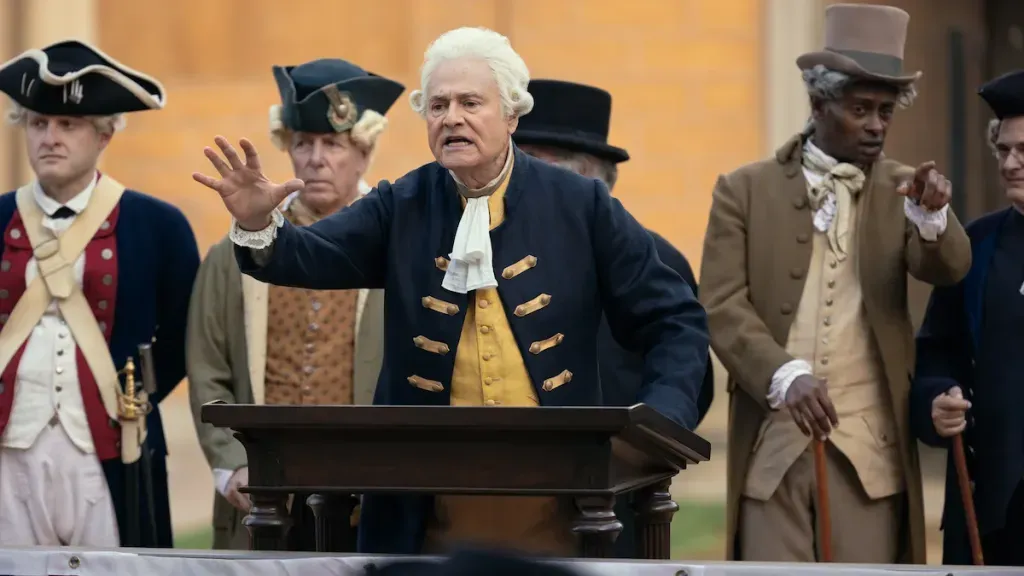
Jeff Schaffer, executive producer of HBO’s “Life, Larry and the Pursuit of Unhappiness,” explains how the George Washington sketch was built to absorb shifting Trump headlines up until air. The result is a time-sensitive satire plus real-world production pressure, heightened by the later death of Rob Reiner.
Jeff Schaffer’s biggest production problem for “Life, Larry and the Pursuit of Unhappiness” was not jokes. It was timing. In an interview with TheWrap, the executive producer said they knew that between the day they shot the George Washington sketch and the day it aired, “20 more terrible things were going to happen between the day we shot it and air.” So they designed the workflow to survive a moving target, shooting plates and coming back for green screens as new developments rolled in.
That “keep-up-or-fail” approach matters because the show is explicitly trying to talk about now through a historical lens. Schaffer described how the Washington segment dodges direct name-dropping of the current commander in chief while still landing pointed political punches. David is dropped into a moment where George Washington “steps aside as president instead of running for a third term,” and then the satire spirals through “hypothetical” questions: what if a future president refuses constitutional limits, dismisses Supreme Court and Congress as “yes men” and “bunch of pussies who care more about party than country,” and, after losing a free and fair election, tries to foment an insurrection instead of conceding. The sketch also imagines using the presidency to enrich himself and his family, sending troops into American cities to terrorize and kill citizens, and even includes a dark line about “distract[ing] from the fact that he's friends with a pedophile.”
In other words, this is not a timeless gag. It is a weekly risk management exercise, performed with comedy. Schaffer explained the production cadence plainly: they shot, then adapted, because “new stuff kept happening.” They “literally just built in time,” with a plan to “come back and hit this” later. And the internal structure of the segment reflects that reality. Schaffer said the sketch was essentially “a list of what if he did this, what if he did that,” and that “it could've been an hour just listing them.” So they tried to turn “greatest hits” into a tight episode, rather than let the news cycle expand the runtime beyond control.
If you zoom out, the operational lesson is familiar to anyone running a company in a fast-moving regulatory or reputational environment. The sketch becomes a model for how to keep a narrative product coherent while the facts on the ground keep shifting. Schaffer even acknowledged the editorial constraint that there was no way to freeze the world during production. That is why the show shoots plates for later compositing. It is basically version control for satire. When the world changes, you patch the footage instead of restarting the whole release.
There is also a strategic communications element in the way they framed “warts and all” history. Schaffer said they did not want to “hit it head on” with direct references, adding that “right now, we have a saggy orange wart that can't go away fast enough.” The approach, as he described it, is to address it through an American history format where the audience can recognize the parallels without the show feeling like a direct news hit. He also said he and David do not factor the political environment into how they approach comedy, pointing to Larry David’s “Seinfeld” rule about timing: if people are watching on Wednesday, don’t watch on Thursday. That means the episode is built to fit the rhythm Larry David wants, even when the content carries a heavier hand than other sketches.
And then production met unpredictability in the human sense too. Schaffer revealed the sketch was shot on Nov. 13, “about a month before the murder of Reiner and his wife Michele.” Rob Reiner appears in the sketch as a “clean-shaven” George Washington, portraying Washington witnessing the public descending into a “full out brawl” by the end after failing to ease concerns about the hypothetical future president. Schaffer said Reiner offered to shave his beard because “George Washington doesn't have a beard,” and called the performance “amazing.” He added that they had “no idea how crazy this sketch would get in December,” noting that they “spent the Friday editing this sketch and it was the last thing we did before the attack.”
That background changes how you read the final editorial decision: whether to lean into the 250th anniversary slot or treat it as too sensitive. Ultimately, Schaffer and David placed the sketch in Friday’s episode timed to the 250th anniversary weekend and added a dedication to Reiner at the end. Schaffer said they wanted to be sensitive “to the content” and “to the star of the piece,” and described July 3 as “the perfect time” to let viewers watch it across the 250th weekend. The strategic bet is that the audience can hold two truths at once: satire aimed at the present, and a tribute that lands after tragedy.
The cameo side plot also reinforces how quickly the show adapts to politics and pop culture. Schaffer pointed to Jimmy Kimmel’s appearance, saying Kimmel came over for “an hour” while they were shooting “parts of two other sketches,” entering and exiting in about “15 minutes.” Kimmel jokes that a hypothetical president would not waste time challenging anyone who makes fun of him, calling it like being a “big baby,” referencing the Trump administration calling for Kimmel to be taken off the air over comments about Charlie Kirk’s killing and Kimmel’s “temporary suspension last year.” The show is threaded through with timing, cross-platform attention, and the reality that public discourse shifts faster than production schedules.
For executives and operators, the second-order takeaway is simple: in any environment where headlines mutate and stakeholder sentiment can harden overnight, you either build a system that tolerates change or you accept that your product ships late to the truth. Schaffer’s “we shot plates and came back and did green screens” approach is not just a creative trick. It is an operating method. And the stakes, even in comedy, are real: the narrative has to remain sharp even as the world keeps moving, and it has to do so while handling real human risk, including editing decisions made days before a tragedy.
“Life, Larry and the Pursuit of Unhappiness” airs Fridays at 9 p.m. ET/PT on HBO and HBO Max, but the bigger point is how the episode was engineered for the only constant in modern media: new developments arriving faster than your first draft.
This story's Key Insights and Take-aways are locked.
Create a free account to unlock Executive Actions for one credit.
Register to UnlockAlways free for Executives Club members. Join the Club
More in Politics

Glacial collapse, not rain, killed 180 in Nepal's Himalayan flood
The Himalaya's extreme geography hid the true cause of Nepal's catastrophic flood, a glacial collapse that turned a geological battleground into a mass-casualty zone.

Iran’s Esmail Baghaei says Oman talks start shipping via Hormuz, not US talks yet
Temporary route plans with Oman aim to restart commerce while Tehran says Washington dialogue is not on the table.

Standards watchdog opens probe into Reform UK deputy leader Richard Tice over interests
The parliamentary standards commissioner says it began an investigation on 28 July into a possible undeclared interest.