

Jodie Foster says “F1” looks AI-made: “Wasn’t it?”
What she noticed in the film and why Hollywood's AI labor fight is now about pricing dignity.
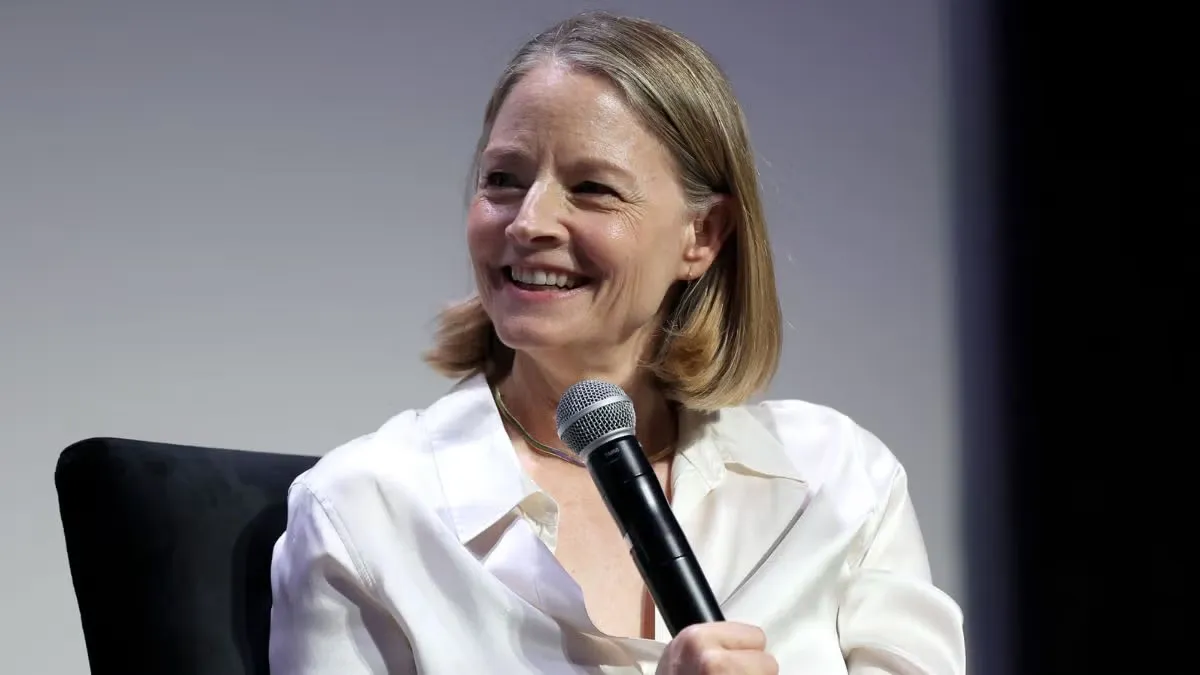
Jodie Foster, speaking at the Aspen Ideas Festival event “Who Owns the Future of Hollywood,” argued that Joseph Kosinski’s “F1” appears to be made with artificial intelligence. Her take ties a top award winning movie’s craft choices to the growing, divisive question of AI’s impact on actor work and labor protections.
Jodie Foster is convinced “F1” was made with AI. Speaking at the Aspen Ideas Festival during a session titled “Who Owns the Future of Hollywood,” the Oscar-winning actress said the film’s structure and the way actors deliver lines look like what you’d get if “a computer was writing exactly what would be the right thing for that time,” adding, “Wasn’t it?”
Foster was careful to frame it as not disparaging AI. She said she knows “F1” went on to make millions of dollars, and then zeroed in on the craft-level signals she believes give her confidence: “the structure was exactly the structure that you would learn in school,” and the performances follow the dialogue in a way that, to her, seems engineered for each moment. She also argued that the production team “was able to dominate the technology” to make something “big and beautiful,” while noting that “a lot of the information” in the movie appears to come from other places.
That is the tension her comments land on, and it is bigger than film trivia. “F1,” directed by Joseph Kosinski and starring Brad Pitt and Damson Idris, was one of last year’s awards leaders. It won the Academy Award for Best Sound and earned nominations for Best Picture, Best Film Editing, and Best Visual Effects. It also made more than $634 million at the global box office. So when a figure like Foster points to “F1” as an AI-like construct, the question for executives is not whether she is right about method. It is what audiences, unions, studios, and platforms now infer about how fast AI is moving from concept to production pipeline.
Foster’s comments also acknowledge the labor question that has become unavoidable across Hollywood and beyond. While she said she was not disparaging AI or its possible use in “F1,” she did not ignore job loss concerns tied to the growth of the technology. Instead, she pivoted to what she sees as the workable bargaining model: “Hopefully, things like unions will be able to come in and say, you can use my actor 20 times, but you’re going to pay him 20 times. And I think that’s fair.” Her idea is basically a pricing rule for repeatable digital labor. If AI can multiply usage, the compensation and protections should scale accordingly, or else the “dignity of the craft” gets treated like an afterthought.
That theme matters for decision-makers because Hollywood is currently split on the AI question, and the split is showing up in public stances. TheWrap notes that AI remains divisive, with A-listers on opposite sides. Weird Al Yankovic recently said he refused to become the “the poster boy” for AI, despite being offered “a nice pile of money.” On the criticism side, actors Scarlett Johansson and Joseph Gordon-Levitt have spoken out against AI, calling for better protections. On the other side of the debate, Reese Witherspoon encouraged women to learn AI tools, and Sandra Bullock said it was time to “lean into” the technology.
For boards and studio leaders, those contrasting public positions are not just culture-war noise. They shape how talent, investors, and regulators interpret risk and reputation. AI governance in the real world tends to arrive through a mix of union bargaining, consumer pressure, and legal standards that tighten over time. When a mainstream star frames AI as something that can be “dominated” by filmmakers while still requiring safeguards, it gives executives a specific path to pursue: adopt capabilities, yes, but build contracting and compensation systems that match usage. Even if Foster’s “F1” theory is personal, her labor prescription is the kind of line executives can translate into negotiations.
Foster also disclosed her own use of AI, which is likely to complicate any attempt to treat her position as purely skeptical. She admitted that her 2025 film “A Private Life,” directed by Rebecca Zlotowski, used AI for a dream sequence. She then made a point that reads like a strategy requirement for creative teams: “What we all would love is that filmmakers would be able to dominate AI, and never lose sight of that.” Her logic is that if creators can steer the tool consistently, they can make work that “reflects us” and “make things better.” That is a fundamentally optimistic stance, but it is paired with a fairness framework for actors.
So what is the practical stake for executives in media, tech-enabled services, and platform ecosystems? It is that production workflows are getting harder to audit, and labor bargaining is getting harder to ignore. If a film can look, sound, and pace like a structure optimized by computation, then talent leverage may depend on proof of usage and how digital re-creations are licensed and paid. Foster’s comments effectively underscore a future where the question is less “is AI used?” and more “who gets paid when AI multiplies creative output,” especially if usage can scale beyond traditional performance contracts. If Hollywood gets the compensation and dignity pieces wrong, the backlash will likely show up first in unions and negotiations, then in regulation and litigation, and only later in box office. The second-order implication for peers is clear: you can’t treat AI adoption as a purely technical rollout. You have to treat it as an economic system with labor, rights, and pricing built in from day one.
This story's Key Insights and Take-aways are locked.
Create a free account to unlock Executive Actions for one credit.
Register to UnlockAlways free for Executives Club members. Join the Club
More in Entertainment

Russell Brand's accuser 'bewildered and confused' as he denies 7 sex charges
The criminal case against the comedian is a live test of how media companies manage talent risk when serious allegations go public.

'It's a Magic Trick': Ballet Experts Say Rosalía's SNL Pose Is Impossible
Three ballet experts tell Rolling Stone Rosalía's gravity-defying SNL stillness shouldn't be possible - and why the debate is now part of the show.

Activision CMO: GTA 6 Will Boost Call of Duty, Not Bury It
Activision's top marketer says Rockstar's blockbuster will drive players back to consoles and into Modern Warfare 4, even as the company admits its recent strategy failed.