

Joe Scarborough tells Republicans to “shut up” after Graham Platner drops out
The “Morning Joe” host calls out GOP attacks on Democrats supporting Platner, citing hypocrisy amid the rape allegations.
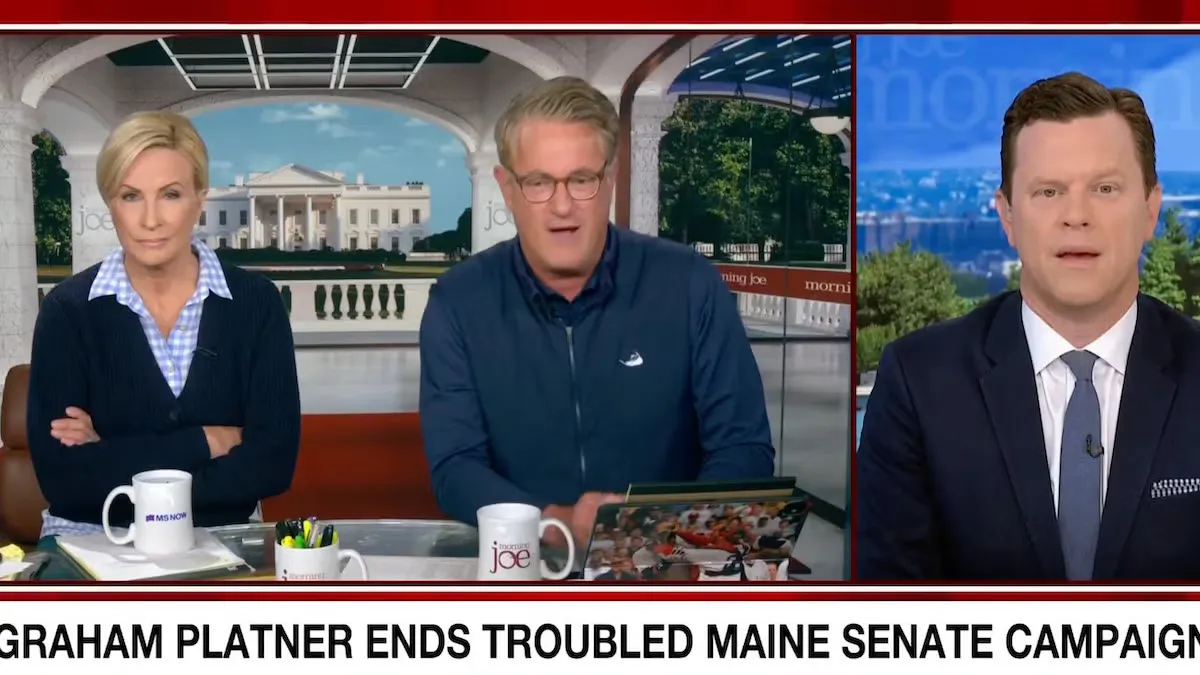
Joe Scarborough used his “Morning Joe” platform to criticize Republicans for targeting Democrats over support for Graham Platner after rape allegations surfaced. The fallout includes Platner’s Wednesday withdrawal and his claim he is not admitting guilt, while his ex Jenny Racicot continues to press her accusations.
Joe Scarborough did not mince words on “Morning Joe” after Graham Platner dropped out of the Senate race, just days after rape allegations became public. The host directly told Republicans they should “really just shut up” if they plan to criticize Democrats for supporting Platner. Scarborough framed it as hypocrisy, particularly because Republicans had been eager to attack Democrats over “morally challenged” candidates, even as critics point to other GOP alignments and political defenses.
In Scarborough’s telling, the GOP problem is not simply that an allegation exists. It is that Republicans are criticizing Democrats for backing Platner while, as Scarborough put it, “you don't have to look at the White House,” or the wider national spotlight. Instead, he pointed to Texas, and specifically to Texas Attorney General Ken Paxton, before adding that Republicans have been “bowing and scraping for the past decade.” The message was clear: if Republicans are going to police morality in Democratic campaigns, they cannot also ignore what Scarborough called their own record. And he pushed the conclusion hard: “It is so hypocritical… Republicans should really just shut up.”
This media moment matters for anyone tracking how allegation-driven politics becomes narrative, coalition behavior, and institutional risk. Platner’s withdrawal came on Wednesday after he posted an 11-minute video announcing he was dropping out of the race “just days after the allegations were made public.” He maintained his innocence while responding to the timing. “I know that some will think this is an admission of guilt, and it most certainly is not,” Platner said. He argued the decision was not because of the allegations, but because of “the structures that are being taken away from us by those in power.” That distinction is not a legal argument, at least not in the way viewers might expect. It is a political one: what happens when campaigns lose institutional backing, fundraising access, and party support.
The allegation timeline is at the center of the story, and it is specific. Platner’s decision follows a Monday report from Politico, where his ex Jenny Racicot accused the rising Democrat of sexual assault. Racicot reiterated her accusations in a sit-down interview with CNN’s Jake Tapper. In that interview, Racicot denied that her allegations were politically motivated, and said her intention was “to let people know who they are voting for.” She also described her personal objective in blunt terms: “I think there are a lot of men in this world relying on the silence of women to be where they are. And I don’t want to contribute to that.” Then she added, “I also want to just get my life back.”
Scarborough’s commentary shows how quickly politics turns into a debate about motives and moral consistency. He did not center the president when he attacked what he called GOP hypocrisy. Instead, he brought Texas Attorney General Ken Paxton into the discussion, and tied it to a broader pattern he described as Republicans “bowing and scraping for the past decade.” For decision-makers watching closely, that is a reminder of how narratives move: when a candidate withdraws, the focus often shifts from allegations themselves to who gets to talk, when they get to talk, and what their prior stance implies.
There is also a structure problem underneath the drama that Platner himself pointed to. In his view, he is not stepping aside because he accepts guilt, but because “the structures” behind him are being removed “by those in power.” That language matters because it hints at the mechanism that produces rapid turnarounds in modern campaigns. Allegations can trigger donor pullbacks, party distancing, and media scrutiny, which can lead to a cascade where remaining support becomes politically expensive or operationally blocked. Even when a candidate insists they did not do what they are accused of, the campaign can still be deprived of the conditions needed to compete.
For Republicans and Democrats alike, the second-order implication is about credibility and coalition discipline. If Scarborough is right that Republicans are selectively applying moral scrutiny, then every new controversy becomes more than a headline. It becomes a test of consistency, and that can shape how swing voters interpret party messaging. Meanwhile, Democrats face a different pressure: distancing can look opportunistic, and defense can look like endorsement. Platner maintained his innocence and still dropped out, which creates a tricky narrative space for everyone around him. Scarborough’s “leave this to the Democrats to clean up their own house” line is essentially a call to reassign moral policing rather than dispute the allegations’ details.
The strategic stakes extend beyond one Senate race. This is what happens when allegation-driven politics meets institutional power: the outcome is not only about who stays on the ballot, but also about who controls the story when support collapses. The Wednesday withdrawal shows how fast campaigns can unravel after allegations, even when candidates claim they are not admitting guilt. And Scarborough’s on-air push tells you how the media will frame the aftermath, including who will be accused of hypocrisy and who will be told to stay in their lane.
This story's Key Insights and Take-aways are locked.
Create a free account to unlock Executive Actions for one credit.
Register to UnlockAlways free for Executives Club members. Join the Club
More in Politics

Glacial collapse, not rain, killed 180 in Nepal's Himalayan flood
The Himalaya's extreme geography hid the true cause of Nepal's catastrophic flood, a glacial collapse that turned a geological battleground into a mass-casualty zone.

Iran’s Esmail Baghaei says Oman talks start shipping via Hormuz, not US talks yet
Temporary route plans with Oman aim to restart commerce while Tehran says Washington dialogue is not on the table.

Standards watchdog opens probe into Reform UK deputy leader Richard Tice over interests
The parliamentary standards commissioner says it began an investigation on 28 July into a possible undeclared interest.