

Johan Sjöström warns Europe’s wildfire “new normal” demands land management, not just weather fixes
The RISE scientist says fires in northern France fit a pattern, forcing regulators and boards to rethink vegetation and preparedness.
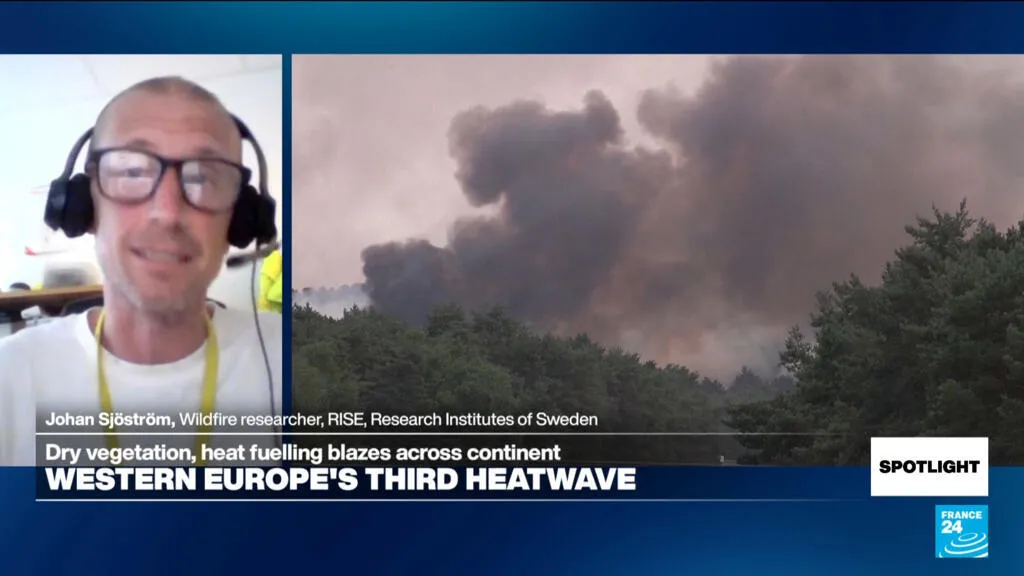
François Picard welcomes Johan Sjöström, Senior Research Scientist at RISE Research Institutes of Sweden. Sjöström argues the devastating wildfires in northern France are part of a European “new normal,” driven by climate, vegetation, land management, and institutional preparedness.
On Spotlight, François Picard hosts Johan Sjöström, Senior Research Scientist at RISE Research Institutes of Sweden. Sjöström’s core claim is blunt: the wildfires devastating northern France are not an isolated anomaly. They are part of a broader “new normal” for Europe.
That framing matters because it shifts the conversation away from treating wildfires like a one-off disaster and toward treating them like a recurring risk system. Sjöström says the analysis must go beyond extreme weather alone, and instead examine how climate, vegetation, land management, and institutional preparedness interact. In other words, fires are not just something that happens to landscapes. They reflect how landscapes are shaped, governed, and responded to.
For decision-makers, this is where the executive briefing turns from “environmental” to operational. Land management is not an abstract policy area. It is a chain of practical choices that affects how quickly vegetation becomes fuel, how fire spreads, and how effectively emergency services can reach impacted areas. When Sjöström focuses on land management strategies, he is implicitly pointing to a lever that can be adjusted before the next season starts, not during the crisis.
Sjöström’s emphasis on institutional preparedness also lands in boardrooms and finance teams, even if the topic sounds like research. Preparedness is where public systems set priorities: how resources are allocated, which agencies coordinate during incidents, what rules exist for prevention and response, and how quickly those rules can be enacted when conditions change. His argument ties preparedness to the same causal system as vegetation and climate, not to a separate “response-only” track.
So what does “diversify landscapes” mean in a governance context? The Spotlight segment’s headline point is that Europe must diversify landscapes and develop land management strategies after years of wildfires. The implication for authorities is that a single, uniform approach to managing land can leave regions more vulnerable to the same fire behaviors, especially when climate conditions intensify. Diversification and land management strategy are essentially risk engineering for the natural world. They aim to reduce the likelihood of catastrophic spread, not merely to improve firefighting after ignition.
There is also a regulatory background embedded in the logic. Wildfire risk touches multiple policy domains at once: land use planning, environmental management, emergency management, and public safety. When a scientist frames wildfires as a “new normal,” regulators face pressure to move from reactive measures to proactive standards. That can mean updating planning frameworks, integrating prevention into budgets, and building stronger cross-institution coordination so that preparedness is not a patchwork of disconnected efforts.
The second-order implication is capital allocation. Even without discussing company balance sheets directly, the risk model Sjöström outlines points to a world where insurers, infrastructure planners, and land-adjacent industries may need to price and manage wildfire exposure differently. If vegetation and institutional preparedness are core drivers of outcomes, then risk does not sit only in the weather forecast. It sits in how land is managed, and in how fast institutions can implement prevention and response. Over time, that can affect planning cycles, procurement decisions, and how organizations structure continuity when climate-driven events become more frequent.
The bigger strategic stakes for peers in similar roles are simple: if Europe treats wildfires as episodic, it will keep paying the cost of late responses. Sjöström argues the opposite, that the pattern is already forming and that the solution is to manage the system that creates vulnerability. Europe, he suggests, has to diversify landscapes and develop land management strategies in tandem with stronger institutional preparedness. The winners in this shift will be the organizations and boards that treat wildfire risk like recurring enterprise risk, not like a headline you read and then forget.
This story's Key Insights and Take-aways are locked.
Create a free account to unlock Executive Actions for one credit.
Register to UnlockAlways free for Executives Club members. Join the Club
More in Science

Alaska's 1,580-foot tsunami had warning signs. Scientists just found them.
Rapid glacier retreat, heavy rainfall, and thousands of tiny tremors preceded Alaska's 1,580-foot tsunami, a warning for every coastal community in a warming world.

The rare mutation that lets high-risk brains dodge Alzheimer's
Scientists found a natural defense against protein buildup, opening a new path to preventive treatments.

3,000 steps a day may halve Alzheimer's decline, study finds
New research links a modest daily walk to less tau buildup and nearly half the cognitive and functional decline, even for those with early signs.