
Juliette Binoche tells Karlovy Vary why artists must act “unafraid” to be universal
Her career-spanning conversation, then two premieres show the festival betting on intimacy, not formula.
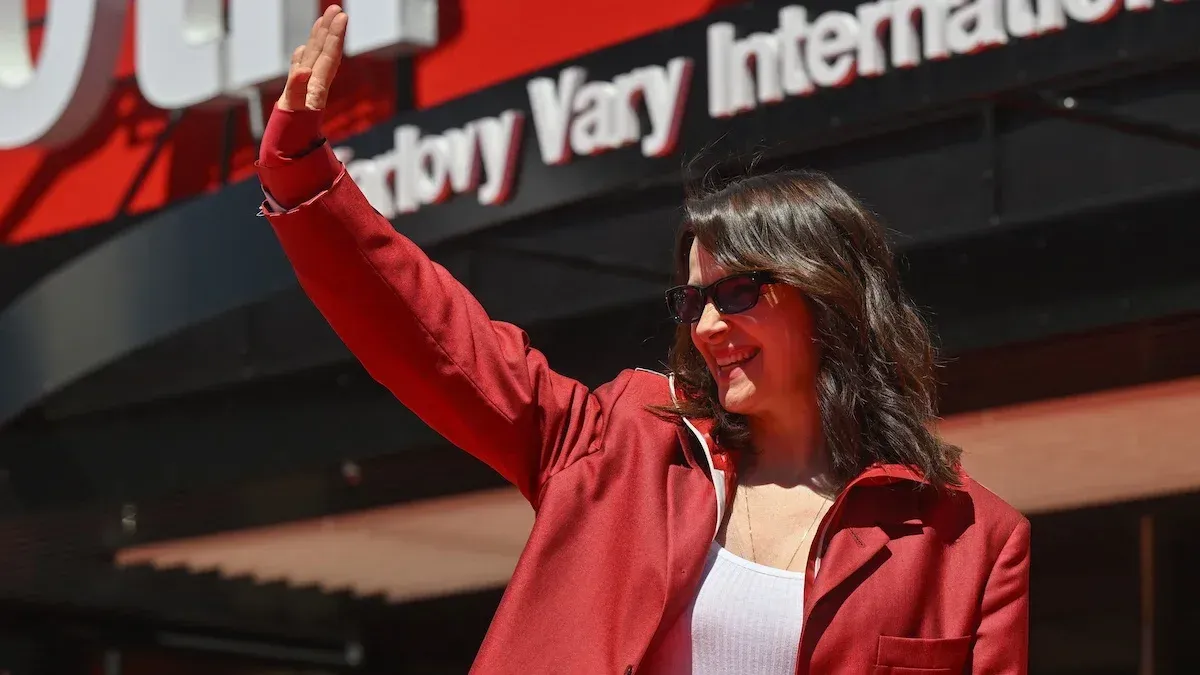
Juliette Binoche received the Karlovy Vary International Film Festival Crystal Globe and discussed her directorial debut “In-I in Motion.” The day’s lineup, including “Fruit Gathering” and “Teenage Sex and Death at Camp Miasma,” highlights a market-facing strategy: audience-first programming and risk-taking narratives.
The Karlovy Vary International Film Festival already feels like one of the world’s most compact movie worlds, but Thursday made the case in high definition: Juliette Binoche took the stage at 4:30 p.m. for a standing-room-only conversation, after being handed the festival’s Crystal Globe for Outstanding Artistic Contribution to World Cinema and tasked with introducing her directorial debut, “In-I in Motion.” Her message cut right through the industry noise. “When you're choosing an artistic path, you cannot be frightened,” Binoche told a room packed with industry insiders. “You have to show something intimate as an actor, as an artist in general, because why else do it? You have to show something you've never shown before. Then the audience can relate to it and feel their own intimacy -something that belongs to them in a way. That's when it becomes universal.”
If you’re a decision-maker trying to understand why events like KVIFF matter, that quote is the playbook in plain English: take credible creative risk, then make sure the audience can still see themselves in it. Binoche reinforced that acting, at its core, is exposing parts of yourself you usually do not share. Even her recollection of winning the Oscar for “The English Patient” landed less like a fairy tale and more like a survival story. “You're just trying to survive,” she said of Oscar night, describing the moment you walk on stage, “you've left the light and suddenly it's all black,” then the flashes, the cameras, and the feeling that “you're not quite a human being anymore.” Her practical conclusion was clear: acting comes down to “giving yourself, sharing what we go through as human beings.” For an executive audience, that translates to an operational question. What happens when you design a slate or a release strategy around authenticity and audience relatability, instead of manufacturing safe reactions?
That theme of intimacy showed up again, immediately, in the festival’s next move. After Binoche’s conversation, the Hotel Thermal, the Soviet brutalism monument that effectively is the festival’s beating heart, kept buzzing. Live music and DJ sets drifted in from the outdoor stages, carrying attendees across the red carpet toward the 7:30 p.m. world premiere of “Fruit Gathering” in the Thermal’s main hall. The film, set in contemporary Myanmar and unfolding across several seasons, follows a slow-burning queer longing between two young women who leave their rural homes to become family breadwinners in the city’s garment factories. The naïve San Kyi (Nandar Myat Aung) makes little effort to hide her feelings, while Theint (Nandar Myint Lwin), perpetually cash-strapped, stays resolutely coy, recognizing that being desired might be advantageous “at least in the short term.”
On paper, this is just a story. In market terms, it is a bet. KVIFF positioned the premiere as a confident feature debut for director Aung Phyoe, emphasizing its emotional restraint immersed in lush excess. The description even flags the creative tension: Aung “occasionally struggles to contain the film's competing impulses,” especially as it shifts away from social realism toward a more impressionistic mode. The increasingly elusive final act cycles through possible conclusions, which “muddy” the film’s thematic architecture and makes the 97 minutes feel longer. Yet the key is how the festival frames that risk: these “excesses” are treated less like shortcomings and more like evidence of a filmmaker reaching beyond conventional boundaries. The world premiere audience cheered, and the KVIFF jury later loved it enough to award “Fruit Gathering” the festival’s top prize two days later. For executives and board members, that’s the second-order point: festivals do not just “show culture.” They create outcome data for creative risk, audience tolerance, and what kinds of narratives can win legitimacy.
Then KVIFF doubled down on choice architecture and access, which matters more than most strategy decks admit. Outside the Thermal after Thursday’s premiere, ushers were already resetting the grand hall for the 10:30 p.m. screening of “Teenage Sex and Death at Camp Miasma.” In keeping with KVIFF’s non-hierarchical spirit, screenings run on a first-come, first-served basis. That meant some Thursday-night attendees camping outside the main hall had no accreditations at all, and some did not even know what they were waiting to see. One viewer, 35-year-old Anton, said he read the description, decided it could be “good,” and chose it because it was later in the evening. He also described his festival routine as alternating spa treatments with auteur cinema. He is not just a visitor. He is an example of the festival’s broader thesis in action: high-level cinema can be low-friction to access.
The description of Anton’s friends adds more than local color, it hints at what platforms and mainstream studios often miss. Anton encouraged Prague friends Libor and Radek to join, and Libor let them pick based on time slots and descriptions, calling it “kind of a freestyle.” He framed it as “a film festival,” where you go for it and “hope for the best.” By Thursday night, Anton had seen nearly 20 films, with Marie Kreutzer’s “Gentle Monster” standing out. He said he does not like when directors or writers try to shape his opinion. He prefers films that are “a bit disturbing,” present a perspective, then let the audience draw its own conclusions. Libor agreed, arguing the mainstream market is “saturated” and that movie scene needs “a fresh start,” which is why they prefer alternative films that allow creators more freedom.
Now, a regulatory note, because creative risk does not happen in a vacuum. While the source does not discuss film censorship rules or formal compliance processes at KVIFF, it does describe an egalitarian screening model where access is first-come, first-served, and some attendees come without accreditations. That kind of public-facing accessibility can complicate how any festival manages audience experience, messaging, and content expectations, especially when films include provocative subjects like “teenage sex” in the title. Even without naming a specific regulator or policy in the article, the second-order implication is real: when you run open-entry screenings, you are implicitly relying on audience self-selection and cultural context to keep programming effective. And when it works, it can generate trust and community. When it fails, it can force organizers into heavier gatekeeping.
The strategic stakes for peers in similar roles are straightforward. KVIFF’s Thursday shows a two-part engine: a programming identity that prizes intimate, artist-driven risk, paired with access mechanics that invite audiences in rather than demanding gatekept credentials. Binoche’s directorial debut and her comments about choosing an artistic path “without” fear are the philosophical headline. The premieres of “Fruit Gathering,” which won the festival’s top award after a world premiere, and the 10:30 p.m. screening of “Teenage Sex and Death at Camp Miasma,” which drew laughs and applause, are the proof. In an era where many content strategies optimize for predictability, this is a reminder that bold creative choices can still scale, as long as the audience feels ownership of the emotional journey.
This story's Key Insights and Take-aways are locked.
Create a free account to unlock Executive Actions for one credit.
Register to UnlockAlways free for Executives Club members. Join the Club
More in Entertainment

12TB Steam 'teraleak' goes beyond Valve: GTA 3, Mafia 2 prototypes exposed
A 12-terabyte dump of Steam data reveals prototypes and builds of third-party classics like GTA 3 and Mafia 2, plus unreleased Valve content, rewriting game history.

LinkedIn's romance problem: 1 in 4 workers say dating on it is fair game
A new survey shows a quarter of U.S. employees treat the professional network as fair game for romance, even as LinkedIn bans it and removes hundreds of thousands of offending posts.

Enhypen's first No. 1 album breaks K-pop's Billboard 200 streak
The K-pop group's 98,000-unit debut tops the chart while Dolly Parton's catalog reentry shows how death reshapes streaming.