
July 2 Atlas V blasts 29 Amazon Leo satellites, equaling Atlas’s heaviest load record
A 12:24 a.m. EDT window kicks off Amazon’s low Earth orbit push, tying an Atlas V weight record.
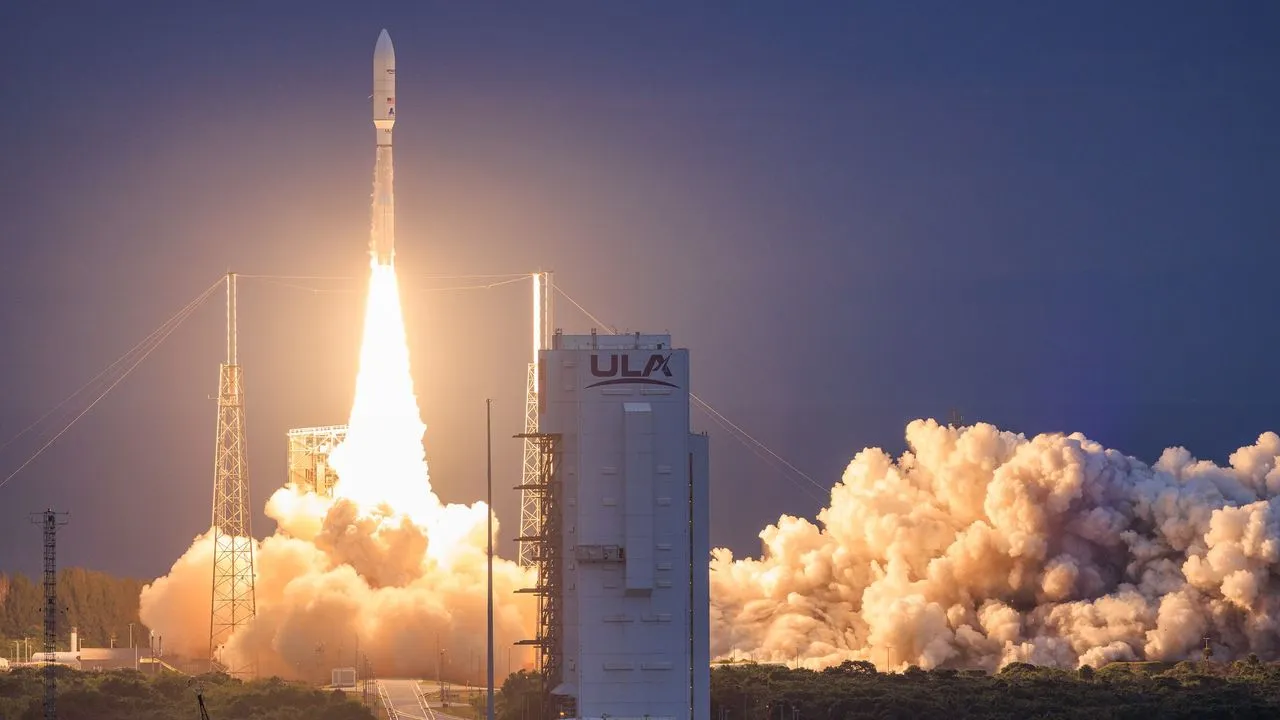
United Launch Alliance will launch an Atlas V rocket from Cape Canaveral Space Force Station on July 2 carrying 29 Amazon Leo internet satellites. For decision-makers, the mission is another measurable step in Amazon Leo’s competition with Starlink and an execution test for the launch cadence behind it.
United Launch Alliance (ULA) is scheduled to launch an Atlas V rocket carrying 29 Amazon Leo spacecraft on Thursday, July 2, during a 29-minute window that opens at 12:24 a.m. EDT (0424 GMT). Coverage begins around midnight EDT (0400 GMT). If you are tracking the race to build low Earth orbit internet capacity, this is not a “someday” story. It is another concrete launch moment, with 29 spacecraft going up at once, and it lands in a specific, high-stakes pattern: scaling a megaconstellation fast enough to matter.
The numbers are punchy for a reason. The 29 satellites going up total about 18 tons, tying the record for the heaviest load ever launched by an Atlas V. That record was set on the Amazon Leo 5 mission in early April and has been equaled multiple times since. In other words: this is not the rocket learning how to carry big payloads. This is the rocket proving that it can keep doing it, which matters when an operator like Amazon Leo is aiming for sustained deployment rather than one-off wins.
Amazon Leo is Amazon’s broadband megaconstellation in low Earth orbit, and it is eventually planned to consist of about 3,200 satellites. That scale is the whole game. The mission on Thursday is one step in a buildout that has to balance cost, launch availability, orbital capacity, and the engineering reality that every payload needs to reach orbit cleanly to be useful. Execution is the edge in constellation competition because the network value compounds with deployed satellites.
For context, Amazon Leo is competing with SpaceX’s Starlink, which currently has nearly 11,000 satellites and is still growing. That gap is not just a scoreboard detail. It affects how quickly each network can populate coverage, how quickly throughput can be increased, and how resilient the network is to failures or service changes. Amazon Leo has been active already, with about 370 craft reaching orbit on a total of 14 missions to date, using three different rockets: the Atlas V, SpaceX’s Falcon 9, and Arianespace’s Ariane 6.
Within that mix, Atlas V has been the most active workhorse for Amazon Leo. It has conducted 8 of the Atlas V liftoffs for the megaconstellation, which was originally known as Project Kuiper. The mission timing and sequencing also show how “flight numbers” can diverge from “mission numbers” because not every launch carries operational satellites. The first of those Atlas V launches lofted two prototype satellites, not operational craft, which is why Thursday’s mission is called Amazon Leo 8 rather than Amazon Leo 9. That distinction may sound like bureaucratic labeling, but it is the kind of detail operators and investors watch because it tells you what portion of the deployment effort is mature hardware versus earlier-stage systems.
The Atlas V variant on Thursday is particularly specific: the rocket is the 551, described as the most powerful variant. The configuration matters because it explains why the mission can hit that heavy-load threshold. The numbers mean the rocket sports five solid rocket boosters, a 5-meter-wide (16.5 feet) payload fairing, and a Centaur upper stage with a single engine. In plain terms, it is a stack designed to lift big payloads to space with the upper stage then handling the final steps toward orbit. For a deployment program, reliability at this configuration is as important as headline payload weight.
Then there is the “second-order” fact that often gets missed in launch hype: tying a historical weight record is a signal about repeatability. The Atlas V record was set on Amazon Leo 5 in early April and has been equaled multiple times since, and now this mission ties it again with Amazon Leo 8. For boards and CFOs, that kind of repeatable capability feeds into forecasting. If launch vehicles can consistently move payloads at the planned masses, the operator can plan procurement, schedule ground infrastructure scaling, and keep the overall deployment cadence on track.
Strategically, this is what peers should take from the July 2 launch: the constellation market is built on rhythm. It is not enough to win one launch or one contract. Operators need a pipeline of successful deployments that steadily increases the satellite fleet, and the launch system has to keep up. With Amazon Leo pushing toward about 3,200 satellites and Starlink already at nearly 11,000, every mission that reaches orbit with a heavy, meaningful payload reinforces the execution credibility that regulators, partners, and capital markets all care about.
This story's Key Insights and Take-aways are locked.
Create a free account to unlock Executive Actions for one credit.
Register to UnlockAlways free for Executives Club members. Join the Club
More in Technology

Nvidia's $89B data center quarter: the 9 companies cashing in
The AI buildout is minting fortunes beyond GPUs, and memory, cloud, and cooling suppliers are riding the same wave.

Google quietly links your phone number to every Android account on your SIM
Adding a SIM now ties your phone number to all Google accounts - and future accounts inherit it. Here's the security and privacy stakes.

Hijacker AI 'Skynet mode' runs 100,000 attack steps against exposed models
Symantec caught a criminal AI agent that borrows other models, steals data, and mines crypto; the only relief is no confirmed victims yet.