

Juno found Io’s subsurface heats up 40F below the surface, upending volcano monitoring
NASA’s Juno Microwave Radiometer peered 2-6 meters down, revealing heat gradients and likely porous resurfacing that could rewrite how we study volcanic worlds.
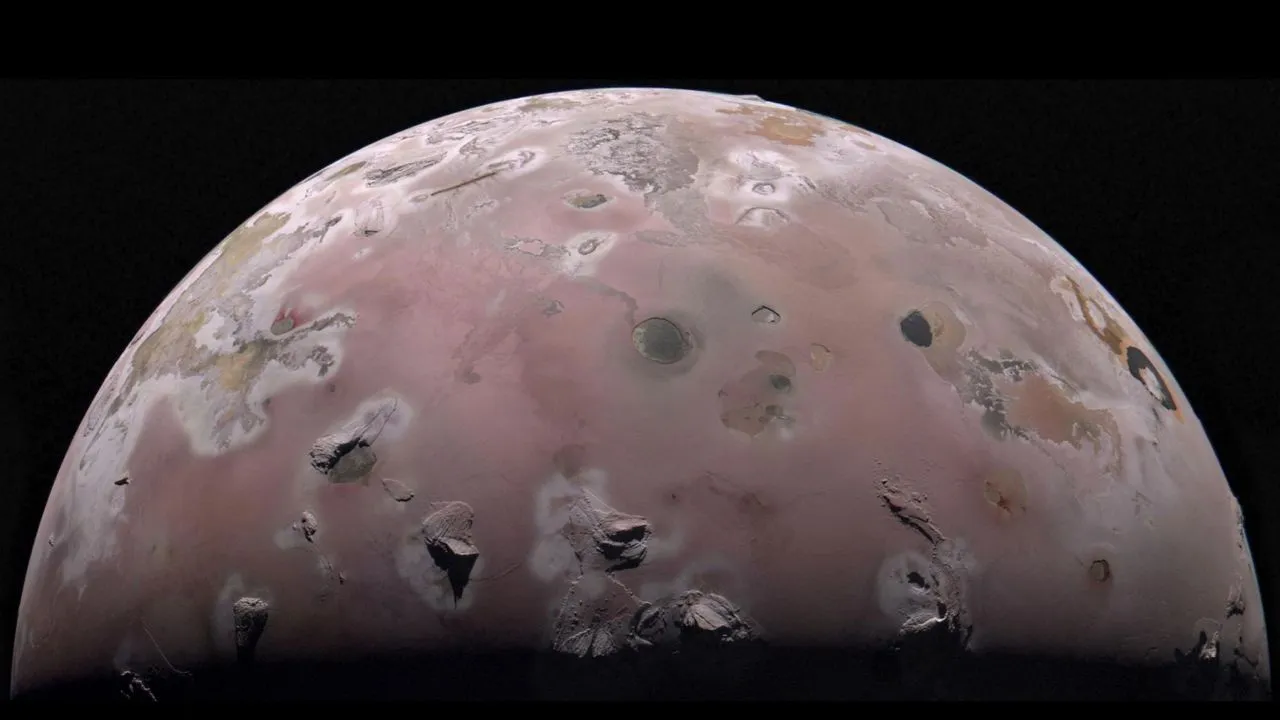
NASA’s Juno spacecraft, using its Microwave Radiometer (MWR) during late-2023 and early-2024 flybys of Jupiter’s moon Io, measured temperatures 2-6 meters beneath the surface for the first time. The findings (published July 22 in the Journal of Geophysical Research: Planets) could reshape volcanic science from other worlds to Earth by enabling subsurface heat tracking instead of surface-only infrared snapshots.
NASA’s Juno probe turned a microwave instrument toward Jupiter’s volcanic moon Io and, for the first time, measured what lies beneath the surface. During close flybys of Io in late 2023 and early 2024, Juno’s Microwave Radiometer (MWR) probed roughly six to 20 feet (two to six meters) underground. What it found is the headline in physical form: temperatures rising by more than 40 degrees Fahrenheit (22 degrees Celsius) just a few feet below the surface.
That is not a minor tweak to how scientists measure volcanoes. Until now, researchers had relied almost entirely on infrared observations, which can only detect Io’s surface temperature. Juno’s subsurface “heat map” adds an entirely new dimension: it shows how heat moves through a planetary crust, not just how hot the top layer happens to be at the moment.
The practical implication is simple, and it matters in the way only real-world measurement matters: if you can observe the gradient under a rocky surface, you can potentially infer what is happening inside before eruptions fully announce themselves at the top. In a statement, Scott Bolton, coauthor of the study and Juno’s principal investigator, highlighted exactly that. He said the surprise that MWR-like instruments can see below a rocky moon’s surface has “important implications for studying Earth's volcanoes,” adding that if scientists look with an MWR-type instrument near an Earth volcano, they might see a similar signature in the subsurface temperature gradient. In other words, Juno did not just look at Io. It demonstrated a method with transfer value.
Juno’s measurements also revealed localized hot regions: temperatures measuring between 18 and 36 degrees F (10 and 20 degrees C) warmer than the surrounding terrain. These warm pockets hint that the internal heat is not just diffusing uniformly upward. They also connect to another twist in the data. Io is famous for towering mountains and active volcanoes, yet much of its surface appears remarkably smooth and made of unusually low-density material, according to the statement.
Researchers think that apparent contradiction comes from what Io is doing all the time. They believe the moon is blanketed by porous layers of volcanic ash, sulfur frost, and other eruptive debris that continually resurface the moon. That continual resurfacing would bury older terrain beneath fresh deposits, making the surface look smoother than you might expect from a world with hundreds of active volcanoes. The hot subsurface regions could therefore reflect how heat propagates through these porous layers and through the conductive crust beneath.
So where is the heat coming from? The study lays out two leading possibilities consistent with the observations. One is that heat is rising steadily from Io’s molten interior through a conductive crust. The other is that it comes from pockets of cooling lava flows trapped just below the surface. Either way, the data provide the clearest picture yet of how Io transports heat from its interior, and crucially, how that transport shows up in microwave signatures a few meters down.
What makes Io an especially valuable “test case” is that its volcanism is extreme for a reason that is fundamentally different from Earth. Unlike Earth, where volcanism is driven largely by heat from radioactive decay, Io is continuously stretched and squeezed by Jupiter’s immense gravity as it orbits the giant planet. That constant tidal flexing generates enormous internal heat, fueling hundreds of active volcanoes and making Io the most volcanically active object in the solar system. For executives watching how science and engineering tools evolve, this matters because extreme environments can make signals clearer, like a stress test for instruments and models.
The transfer story does not end at Earth, either. Bolton also framed Io as a “window” into tidal heating throughout the cosmos, a fundamental process that supplies energy and heat to worlds far from their parent star. He noted that tidal heating can create the most volcanic body in the solar system in Io’s case, and also fuels subsurface oceans on moons of giant planets such as Europa and Ganymede. Until now, scientists could observe heat escaping at the surface or through eruptions. With Juno’s approach, they can now characterize how the heat is moving from the interior toward the surface.
That has second-order relevance for planetary science and astrobiology. If microwave instruments can probe beneath icy surfaces, they could help evaluate whether moons like Europa and Ganymede have environments suitable for life as we know it by improving understanding of how heat moves through their crusts. And the study’s broader background point is that because Io is an extreme example, it serves as a natural laboratory for studying how heat moves through planetary crusts, which could help scientists better understand ancient volcanism on Mars, Venus, and Earth’s moon.
One more detail closes the loop for decision-makers in the broader research ecosystem: these findings were published July 22 in the Journal of Geophysical Research: Planets. In the next cycle of instrument planning and mission designs, that publication date is not just a formality. It is a checkpoint for credibility, a reference point for models, and a new evidence base for teams trying to move from “surface observations” toward “subsurface thermals.” If Juno’s technique can reliably extract subsurface temperature gradients, it changes what scientists can measure, and that changes what scientists can forecast. Heat transport is not glamorous. But in volcanology, it is often the difference between guessing and understanding.
This story's Key Insights and Take-aways are locked.
Create a free account to unlock Executive Actions for one credit.
Register to UnlockAlways free for Executives Club members. Join the Club
More in Science

Alaska's 1,580-foot tsunami had warning signs. Scientists just found them.
Rapid glacier retreat, heavy rainfall, and thousands of tiny tremors preceded Alaska's 1,580-foot tsunami, a warning for every coastal community in a warming world.

The rare mutation that lets high-risk brains dodge Alzheimer's
Scientists found a natural defense against protein buildup, opening a new path to preventive treatments.

3,000 steps a day may halve Alzheimer's decline, study finds
New research links a modest daily walk to less tau buildup and nearly half the cognitive and functional decline, even for those with early signs.