
JWST finds ‘dust factories’ formed 2 to 3 billion years ago in metal-poor Sextans A
The James Webb Space Telescope peels back how early galaxies seeded stars with metals, using a nearby dwarf as a stand-in.
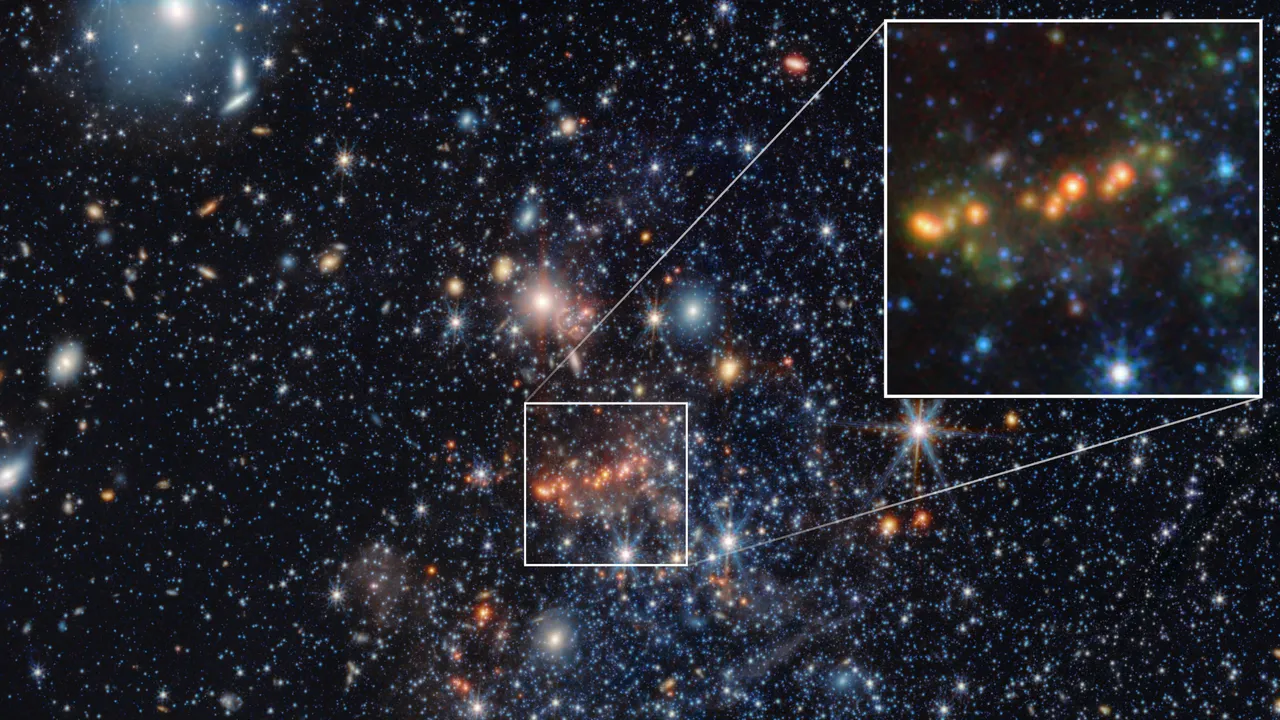
Astronomers using the James Webb Space Telescope studied Sextans A, a metal-poor dwarf galaxy 4.6 million light-years away, to infer how early “dust factories” enriched the young universe. The results, published Monday (July 20) in The Astrophysical Journal, point to dust-forming stars that emerged 2 to 3 billion years ago, giving decision-makers a concrete example of how next-gen instruments can compress discovery timelines.
James Webb Space Telescope observations of Sextans A have delivered a rare, high-resolution look at cosmic “dust factories” that helped seed future star birth. The study indicates these thick, dust-enshrouded factories formed between 2 billion and 3 billion years ago, pointing to stars with initial masses about 1.5 times the mass of the sun. For anyone trying to understand how the early universe went from mostly hydrogen and helium to the richer chemical mix that makes planets and chemistry possible, that is the headline you want.
The strategy matters, too: instead of trying to directly dissect the very first galaxies, the research team used a nearby stand-in. Team leader Claudio Gavetti of the National Institute for Astrophysics (INAF) explained that directly studying the galaxies that populated the early universe is still very difficult, so observing a closer galaxy like Sextans A, which presents similar chemical conditions, offers “a precious opportunity” to understand how the first generations of stars evolved and what role they played in transforming the interstellar medium. In plain terms, Webb is doing something practical: using a modern laboratory to reconstruct ancient processes.
Here is the cosmic setup. In the early universe, chemistry was “dull,” dominated by hydrogen with helium and only a tiny fraction of heavier elements astronomers call “metals,” meaning elements heavier than hydrogen and helium. The first stars, often referred to as POP III stars, were therefore metal-poor. Over their lifetimes, POP III stars fused hydrogen and helium in their cores to forge heavier elements. When they ended their lives in supernova explosions, they dispersed those metals into the interstellar medium, the gas and dust between stars. Over time, cooler, denser regions of these clouds collapsed under gravity, birthing the next generation, POP II stars, which were richer in metals because of the supernova legacy.
Our Sun is classed as a POP I star, meaning it is even richer in metals than those second-generation stars. But not all modern galaxies are so enriched. Dwarf galaxies, including Sextans A at the outer edge of the Local Group, can be extremely metal-poor. The study estimates Sextans A contains only between 1% and 7% of the heavy elements found in the Sun, which makes it a compelling proxy for metal-poor early galaxies. That is the intellectual pivot: rather than treating early-universe conditions as unreachable, the team finds a local environment that matches key chemical assumptions.
Then comes the instrumentation and the “where to look” problem. Using JWST’s NIRCam (Near-InfraRed Camera) and MIRI (Mid-Infrared Instrument), Gavetti and colleagues obtained high-resolution observations that mapped the dwarf galaxy’s entire population of stars during an evolutionary phase called the asymptotic red giant branch. This phase is associated with stars larger than the sun exhausting helium in their cores, creating an inert carbon core while fusion continues in outer layers that alternate between helium and hydrogen burning. The stars “puff out” as a result, and can undergo thousandfold increases in brightness. That combination of brightness and evolutionary physics is why it is a useful moment to hunt for whether dust is forming.
The findings revealed that about 90% of the asymptotic red giant branch stars studied were not surrounded by envelopes of dust. In contrast, around 20 or so stars were embedded in thick dust shells. Those fewer, dust-enveloped stars are the likely “dust factories” the paper is focusing on, because dust is what can absorb, reprocess, and redistribute the metals coming out of dying stars, ultimately shaping the composition of future star-forming gas. The team then links their properties to timing and origin: these dust factories formed between 2 billion and 3 billion years ago, from stars with initial masses about 1.5 times the mass of the sun.
There is a second layer here that matters beyond astronomy. The scientists behind this study say this type of research would have been impossible before Webb. Team member Flavia Dell’Agli of INAF put it in terms of capability, saying JWST allows scientists to observe “in unprecedented detail environments that until a few years ago were beyond our reach,” and that the value of the data lies not only in images, but in the ability to compare observations with theoretical models and verify how correctly they describe stellar evolution. For decision-makers in any technical field, that is the pattern: better instruments reduce ambiguity, shorten feedback loops with models, and make previously theoretical timelines testable.
Published Monday (July 20) in The Astrophysical Journal, this work helps complete the picture of how the universe as we see it today took shape by clarifying which stars were most likely to create the metal dust that enriched later generations. And while this is a deep-space story, it has a very terrestrial implication for operators and investors watching frontier tech: the “new telescope” moment is not just about taking prettier pictures. It is about turning indirect questions into directly testable measurements, one proxy galaxy at a time.
This story's Key Insights and Take-aways are locked.
Create a free account to unlock Executive Actions for one credit.
Register to UnlockAlways free for Executives Club members. Join the Club
More in Science

Alaska's 1,580-foot tsunami had warning signs. Scientists just found them.
Rapid glacier retreat, heavy rainfall, and thousands of tiny tremors preceded Alaska's 1,580-foot tsunami, a warning for every coastal community in a warming world.

The rare mutation that lets high-risk brains dodge Alzheimer's
Scientists found a natural defense against protein buildup, opening a new path to preventive treatments.

3,000 steps a day may halve Alzheimer's decline, study finds
New research links a modest daily walk to less tau buildup and nearly half the cognitive and functional decline, even for those with early signs.