
JWST reveals Centaurus A's black-hole battle scars, ending decades of dusty guesswork
A July 6, 2026 image shows collision wounds, warm dust filaments, and jets shaping star birth.
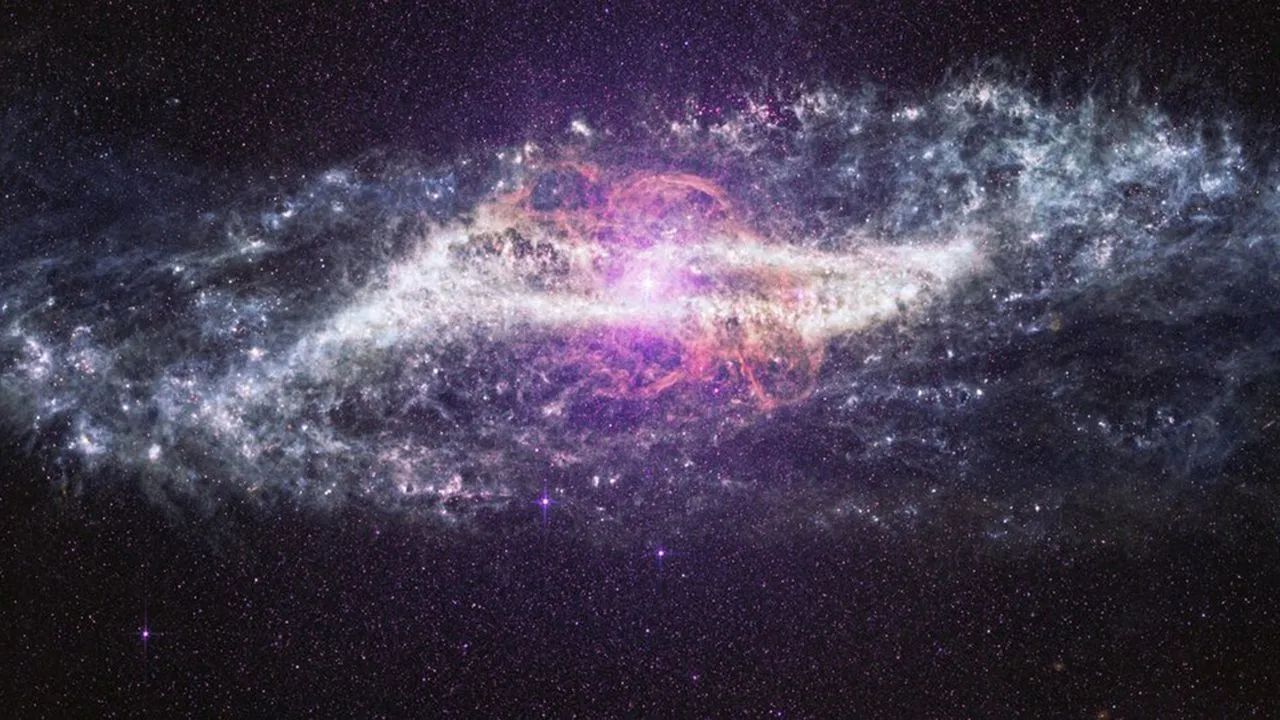
The James Webb Space Telescope (JWST) shared a never-before-seen view of the Centaurus A galaxy (NGC 5128) on July 6, 2026. The image uses JWST mid-infrared vision to pierce dust that blocked earlier views and to spotlight a black hole actively feeding, collision aftermath, and gas reshaped over billions of years.
On July 6, 2026, the James Webb Space Telescope (JWST) shared an image of the Centaurus A galaxy (NGC 5128) that functions like a diagnostic scan of a violent cosmic incident. JWST does not just show “pretty space.” It reveals star dust, collision scars, filaments, loops, and clouds of warm dust, plus the fingerprint of a black hole that is actively feeding. The big unlock: JWST detected wavelengths humans cannot see, and those mid-infrared wavelengths can pass through dust that previously hid the galaxy’s core.
Why this matters for decision-makers, even if you are not buying telescope time: Centaurus A is relatively near the Milky Way at about 11 million light-years away. That proximity is exactly what makes the new image useful, because it lets astronomers study an unusual and active galaxy in remarkable detail. In visible light, dust lanes obscure the center, leaving earlier telescopes to see mostly obscuration. JWST’s Mid-Infrared Instrument shifts that story from “we cannot tell what is happening” to “here is what is happening,” with the black hole region glowing in white and pale pink and structures stretched across the scene.
Centaurus A is shaped by violence and chaos, and the JWST view makes that much harder to dismiss as coincidence. The image captures the aftermath of a major cosmic collision, with scientists believing Centaurus A collided with another galaxy roughly 2 billion years ago. That ancient merger did not just leave a faint memory. It rearranged dust and gas, warped large-scale structure, and likely influenced star formation over immense timescales. In the JWST image, the evidence shows up as a warped gray-and-white parallelogram-shaped structure cutting across the galaxy, and as pink and lavender ribbons curving above and below it in an S shape. These are the galaxy’s “battle wounds,” but they are also a record of physics playing out across eons.
Earlier telescopes were limited by what they could see through. In visible light, thick dust lanes obscure the center of Centaurus A and block part of the story. Hubble and Spitzer previously imaged Centaurus A, including in near-infrared wavelengths, but they also saw mainly dust. Near-infrared light can help compared with visible, yet it still struggles with heavy obscuration when the question is “what is the core doing right now?” JWST’s mid-infrared approach is the difference between imaging a crime scene through smoke versus imaging it through a different part of the spectrum where the smoke becomes translucent. Put plainly: infrared light can pass through that dust, enabling JWST to see the galaxy’s center glowing, rather than only the dust curtain.
At the heart of Centaurus A is an actively feeding supermassive black hole, surrounded by vast clouds of dust that trace the galaxy’s turbulent history. Material falling toward the black hole releases enormous energy and launches powerful jets. Those jets do not just decorate the galaxy. They shape the surrounding gas and dust, which means the same system that can fuel the growth of the black hole also limits the birth of stars by changing the environment where stars would form. The image therefore connects two processes that are often discussed separately in astronomy, black hole feeding and star formation, and it shows them operating in the same turbulent ecosystem.
This comes near the end of JWST's fourth year of science operations. The telescope’s science operations began in July 2022 with the release of spectacular images. JWST launched on Dec. 25, 2021, and is predicted to operate for about 20 years. For executives, investors, and operators watching high-precision research ecosystems, it is a useful reminder of how capability expansions actually work: it is not just “more data,” it is new instrumentation and wavelength coverage that removes bottlenecks. When you remove a bottleneck, you do not only refine existing answers. You change what questions become answerable.
There is also a cultural and strategic subtext here: astronomy is a long game, but the payoff is increasingly tied to systems that can observe through constraints. Dust blocking the core is a practical limitation, not a philosophical one, and JWST’s design makes that limitation less fatal. The image credit list underscores the collaboration behind the work, with NASA, ESA, and the Hubble Heritage (STScI/AURA)-ESA/Hubble Collaboration acknowledged, including R. O’Connell (University of Virginia) and the WFC3 Scientific Oversight Committee. Even if your day job is not in space science, the organizational lesson applies across research and deep-tech: complex problems require multi-institution tooling, and new views often arrive when teams match the right instrument to the right obstruction.
For peers in any role that depends on interpreting incomplete signals, the strategic stakes are simple. Centaurus A is not an “ordinary” galaxy. It is a nearby laboratory for understanding how galaxy mergers rearrange dust and gas, trigger star formation, and influence galaxy growth. JWST’s image shows how quickly the story changes when you can see past the dust, and it makes clear that the black hole is both fuel and limiter in that story. The clearer the view of the core, the clearer the downstream model of how galactic systems evolve, and the clearer the model is, the better everyone can allocate attention to what matters next.
This story's Key Insights and Take-aways are locked.
Create a free account to unlock Executive Actions for one credit.
Register to UnlockAlways free for Executives Club members. Join the Club
More in Science

Alaska's 1,580-foot tsunami had warning signs. Scientists just found them.
Rapid glacier retreat, heavy rainfall, and thousands of tiny tremors preceded Alaska's 1,580-foot tsunami, a warning for every coastal community in a warming world.

The rare mutation that lets high-risk brains dodge Alzheimer's
Scientists found a natural defense against protein buildup, opening a new path to preventive treatments.

3,000 steps a day may halve Alzheimer's decline, study finds
New research links a modest daily walk to less tau buildup and nearly half the cognitive and functional decline, even for those with early signs.