

JWST turns Einstein lensing into orange arcs, revealing galaxies under 1 billion years old
The new MACS J0553.4-3342 image shows how gravity magnifies the earliest faint galaxies, extending JWST’s reach.
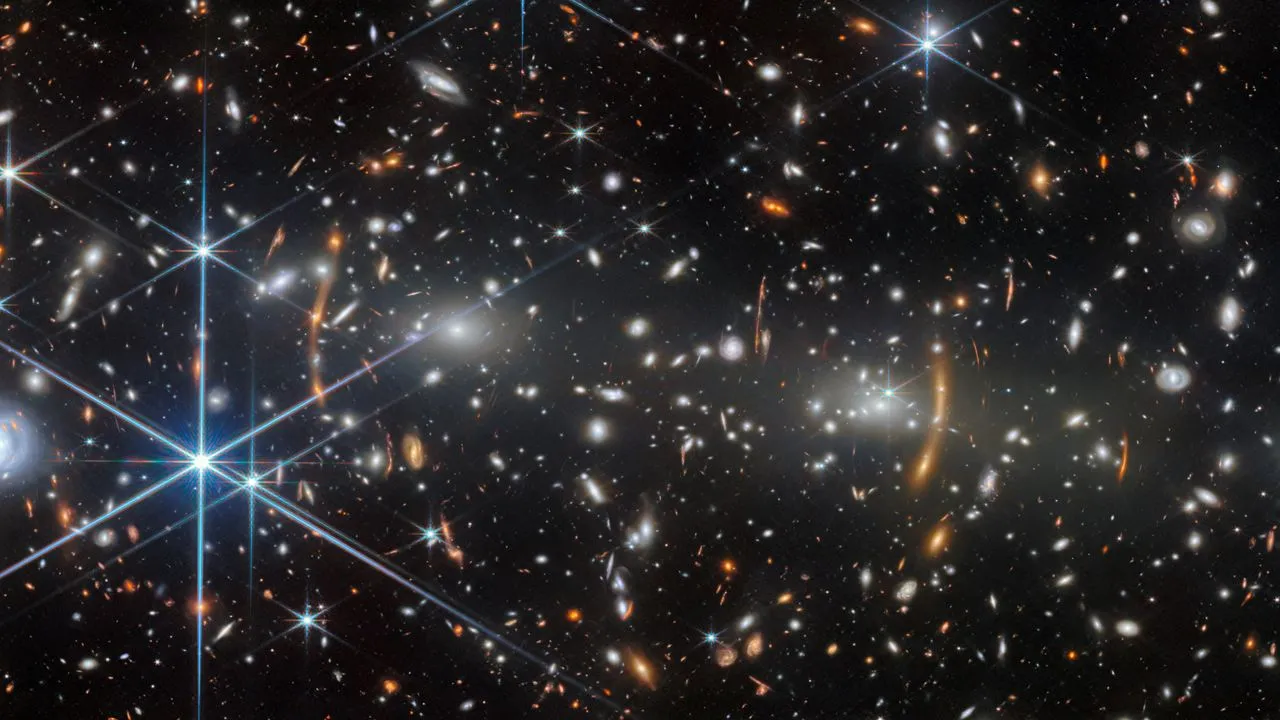
NASA’s James Webb Space Telescope captured a new view of galaxy cluster MACS J0553.4-3342, in which gravitational lensing warps and magnifies distant galaxies from under the first billion years after the Big Bang. For decision-makers funding or prioritizing space science and adjacent tech, the image is a practical proof point that nature’s “lens” can expand observational capability.
Around 100 years ago, Albert Einstein made an audacious prediction about space. Today, the James Webb Space Telescope (JWST) is using that prediction to do something very close to a cosmic magic trick: turn gravity into a magnifying glass.
In a newly released JWST image shared in July 2026, Einstein’s gravitational lensing appears as a set of bright points, ringed halos, and contorted orange arcs in the galaxy cluster MACS J0553.4-3342. The cluster sits in the constellation Columba, and ESA says the two bright white beacons at the gravitational center are massive elliptical galaxies, each wreathed in its own sub-cluster of smaller galaxies. Those two elliptical galaxies are also in a real fight. Astronomers studying light that appeared roughly 4.4 billion years ago say the cluster is in the messy process of merging, with the two principal ellipticals already having slammed through each other once. They now sit about 1 million light-years apart, and eventually that gap will close as the galaxies swoop back together and combine into one.
So what does this have to do with decision-makers, not just astronomers? Because gravitational lensing is not just pretty. It is a capability multiplier. The source explains that Einstein theorized gravity could curve the fabric of space-time, bending the paths of light the way a curved glass lens bends light to make an object look larger. Gravitational lensing has been confirmed through dozens of telescope observations, and it is a crucial tool for observatories like JWST when scientists want to probe the light of the oldest and faintest galaxies.
That matters because JWST’s core mission is effectively bottlenecked by how dim early galaxies are. Early in the universe, there is less accumulated starlight and, for many targets, less signal to separate from the background. Lensing helps change that math. In this image, the “jewels” are not the two bright central galaxies. They are the orange arcs bookending the cluster. The lensing magnification acting along the light’s route to Earth allows JWST to detect light from several faint galaxies that formed less than a billion years after the Big Bang.
The image also demonstrates another lensing quirk that can be easy to miss if you only look at the aesthetic. ESA notes that three bright dots in the left-hand arc are actually three repeated images of a single galaxy. In other words, the universe is not merely enlarging a scene. It is warping the geometry enough to create multiple views of the same distant object, stretched into elongated streaks and arcs. The trippy effect appears several times throughout the image, with each elongated orange streak functioning like a warped window into an ancient corner of the cosmos that would otherwise be impossible to see.
There is also a bigger scientific payoff baked into the same mechanism. The source says that through observations like these, scientists using JWST have discovered that the oldest stars and galaxies have grown larger and faster than leading theories of cosmology predict should be possible. That is the kind of result that forces a board-level conversation in any science program, even if you are not writing astrophysics proposals for a living. When observations repeatedly find discrepancies with “what we expected,” the spend is no longer just about collecting data. It becomes about updating models, revising priorities, and deciding which new instruments or survey strategies will resolve the tension.
For peers who manage portfolios across space science, instrumentation, research partnerships, or even data infrastructure that supports astronomy, this is a strong reminder of how second-order capability works. The lens is not manufactured. It is supplied by massive structures in the universe, like MACS J0553.4-3342. That means the observational opportunity is distributed: some targets are naturally better “screens” for early-universe light. If you are planning instruments or selecting observing programs, you are effectively optimizing access to the rare cases where nature provides a higher signal-to-noise boost.
And for anyone tracking what might come next, the source makes a clear point: “Using one cosmic oddity to uncover another,” gravitational lensing could keep astronomers busy for decades to come. The merger dynamics, the repeated images, and the ability to reach galaxies from under a billion years after the Big Bang all suggest that the deepest questions in cosmology may increasingly be answered through a mix of new telescopes and clever exploitation of cosmic geometry. In that world, who moves fastest is usually the team that can translate new images into improved observing strategies, faster model iteration, and smarter coordination across agencies and instruments.
This story's Key Insights and Take-aways are locked.
Create a free account to unlock Executive Actions for one credit.
Register to UnlockAlways free for Executives Club members. Join the Club
More in Science

Alaska's 1,580-foot tsunami had warning signs. Scientists just found them.
Rapid glacier retreat, heavy rainfall, and thousands of tiny tremors preceded Alaska's 1,580-foot tsunami, a warning for every coastal community in a warming world.

The rare mutation that lets high-risk brains dodge Alzheimer's
Scientists found a natural defense against protein buildup, opening a new path to preventive treatments.

3,000 steps a day may halve Alzheimer's decline, study finds
New research links a modest daily walk to less tau buildup and nearly half the cognitive and functional decline, even for those with early signs.