
JWST unveils FS Tau protostars: “independence fireworks” show accretion happens in bursts
A new James Webb image of FS Tau reveals outflow gaps and blue gas ridges that support episodic accretion.
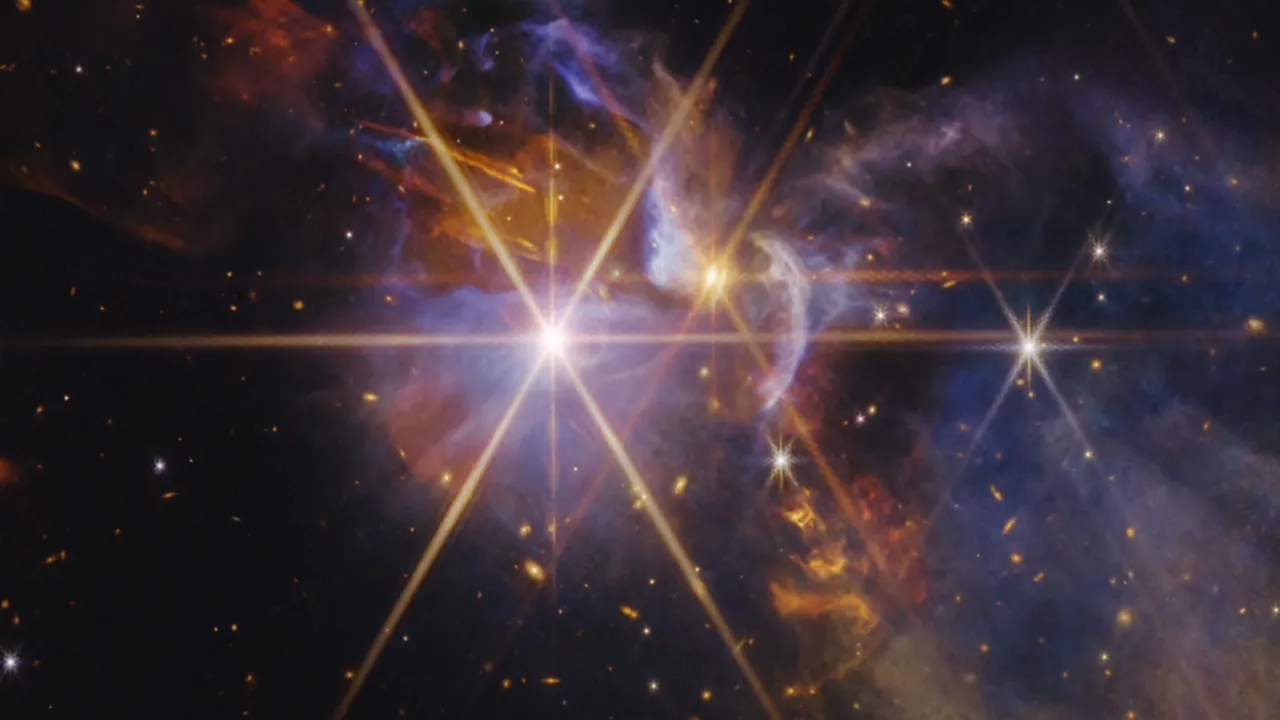
NASA released a James Webb Space Telescope image of the protostars in the FS Tau region, celebrating the 250th anniversary of the birth of the U.S. The image shows how infant stars break away from their natal molecular cloud, with evidence that they accrete material in discrete episodes.
NASA has released a new James Webb Space Telescope image of FS Tau, a star-forming region about 450 light-years away, to celebrate the 250th anniversary of the birth of the U.S. The scene looks like cosmic fireworks, but the real story is more consequential: these “protostars” are in the final stretch of becoming fully fledged stars, breaking away from the molecular cloud that formed them.
In the image, the protostars in FS Tau sit embedded in thick clouds of gas and dust that are hard to see with traditional telescopes. The reason JWST is such a big deal here is simple and practical: it can peer through that obscuring material with infrared observing power, making it possible to visualize the protostars in “great detail.” In other words, the fireworks are a visible outcome of a physical process that previously was harder to test directly.
So what are we actually looking at? Protostars begin when patches in vast molecular clouds cool and form clumps. Those clumps collapse under their own gravity. From there, protostars keep gathering material from their prenatal clouds until their cores reach enough mass to ignite nuclear fusion, converting hydrogen into helium. Once fusion turns on, the object becomes a main-sequence star. FS Tau has been a “popular target for astronomers aiming to study the evolution of low-mass stars,” and while the region was previously well studied, JWST’s sharper infrared view adds new evidence about how those stars grow.
One of the aims of the research tied to this kind of observation is to investigate how radiation and outflows from low-mass stars affect their surrounding environment. Protostellar outflows are not just scenery. They happen because as protostars gather matter from their surroundings, they sometimes blast out some of it. In the JWST image of FS Tau, that activity shows up as prominent blue ridges. The source describes these blue structures as gas that has been shunted by outflows, creating dense regions of matter that reflect light from nearby protostars. If you are thinking “space is chaotic,” that’s accurate, but the key executive-level insight is that the chaos can still carry a pattern.
That pattern is where the interpretation gets interesting. The JWST image reveals gaps between the outflows. Those gaps support a theory that protostars accrete matter in discrete episodes, separated by periods when accretion lies dormant. In plain English: rather than a smooth, continuous feeding schedule, the protostars appear to go through bursty phases of growth. For decision-makers watching how evidence accumulates, this is a reminder that better instrumentation does not just increase resolution, it can change the shape of the underlying story. “Accretion in episodes” is not a vibe. It is an inference supported by observable structure, specifically the gap-and-ridge signatures that JWST can capture through the dust.
There is also a second-order point worth flagging for leaders who live in the world of systems and incentives: outflows can regulate the very growth they originate from. If protostars feed intermittently and their outflows sculpt the surrounding gas, then the environment is not merely passive background. It is part of the control loop. The blue ridges marking dense, reflected-light regions tell you the outflows are doing work on the medium. The gaps between outflow features hint that the underlying feeding process is not uniform. Put those together and you get a more dynamic model of early stellar development, where feedback between growth and environment matters.
And yes, there is a human reason NASA chose this moment: the release is meant to celebrate the 250th anniversary of the birth of the U.S. But beneath the patriotic framing, the substance is scientific and method-driven. JWST’s ability to observe in the infrared is what makes the thick clouds of star-forming gas and dust transparent enough to inspect how low-mass stars evolve. The same capability that produces “cosmic fireworks” also makes FS Tau an unusually readable laboratory for tracking how infant stars push outward while they grow inward.
For executives and board members, the strategic takeaway is not about astronomy trivia. It is about what happens when a new sensing capability turns a previously “well studied” target into a sharper test of competing theories. Today’s upgraded view of FS Tau, with Hubble comparisons referenced in the source, shows how instruments can shift from general understanding to specific mechanisms like episodic accretion. That is the kind of progress that compounds, because better evidence can redirect research agendas, collaborations, and funding priorities across years. In space science, and really anywhere knowledge is capital, the best moments are often when the fireworks are not just pretty, they are diagnostic.
This story's Key Insights and Take-aways are locked.
Create a free account to unlock Executive Actions for one credit.
Register to UnlockAlways free for Executives Club members. Join the Club
More in Science

Alaska's 1,580-foot tsunami had warning signs. Scientists just found them.
Rapid glacier retreat, heavy rainfall, and thousands of tiny tremors preceded Alaska's 1,580-foot tsunami, a warning for every coastal community in a warming world.

The rare mutation that lets high-risk brains dodge Alzheimer's
Scientists found a natural defense against protein buildup, opening a new path to preventive treatments.

3,000 steps a day may halve Alzheimer's decline, study finds
New research links a modest daily walk to less tau buildup and nearly half the cognitive and functional decline, even for those with early signs.